
Artificial intelligence is fundamentally reshaping how B2B companies find and convert leads. In 2024, 68% of B2B organisations now use some form of AI-assisted lead scoring—up from just 45% in 2022. Yet many teams still rely on outdated methods, leaving significant revenue on the table.
This article explores how we can leverage AI lead generation to improve lead quality, accelerate sales cycles, and ultimately win more clients. We'll walk through the key AI techniques, implementation strategies, and real-world results from UK B2B companies.
Key Takeaway
AI-powered lead scoring increases sales team efficiency by 40–50%, with organisations using predictive analytics reporting 25% higher conversion rates. The real opportunity isn't just in smarter lead qualification—it's in compressing sales cycles and improving lead quality simultaneously, delivering ROI of 100–250% within the first year.
Why AI Is Transforming Lead Generation
Traditional lead generation relies on rules: a company hits a certain company size, gets marked as a lead; a prospect opens an email, they're deemed "interested." These rules worked when markets moved slowly. Today, they don't.
AI lead generation works differently. Instead of rigid scoring rules, AI models learn from your historical data—past wins, losses, and customer behaviour. They identify patterns humans miss: the combinations of firmographic, behavioural, and intent signals that actually predict whether someone will buy.
The impact is measurable. Companies using AI-powered predictive scoring report:
- 40–50% improvement in sales team efficiency (less time chasing unqualified leads)
- 25% higher conversion rates from lead to opportunity
- 12–18% false positive rate (vs. 35–40% with rule-based systems)
- 60–70% reduction in prospecting time through AI-driven outreach personalisation
For UK companies especially, AI lead generation addresses a specific pain point: compliance. GDPR-compliant prospecting using AI-powered intent data and first-party signals has become table stakes. The organisations winning today are those using intent data responsibly, focusing on job postings, funding announcements, and technology stack changes rather than risky third-party lists.
AI Lead Scoring and Prioritisation
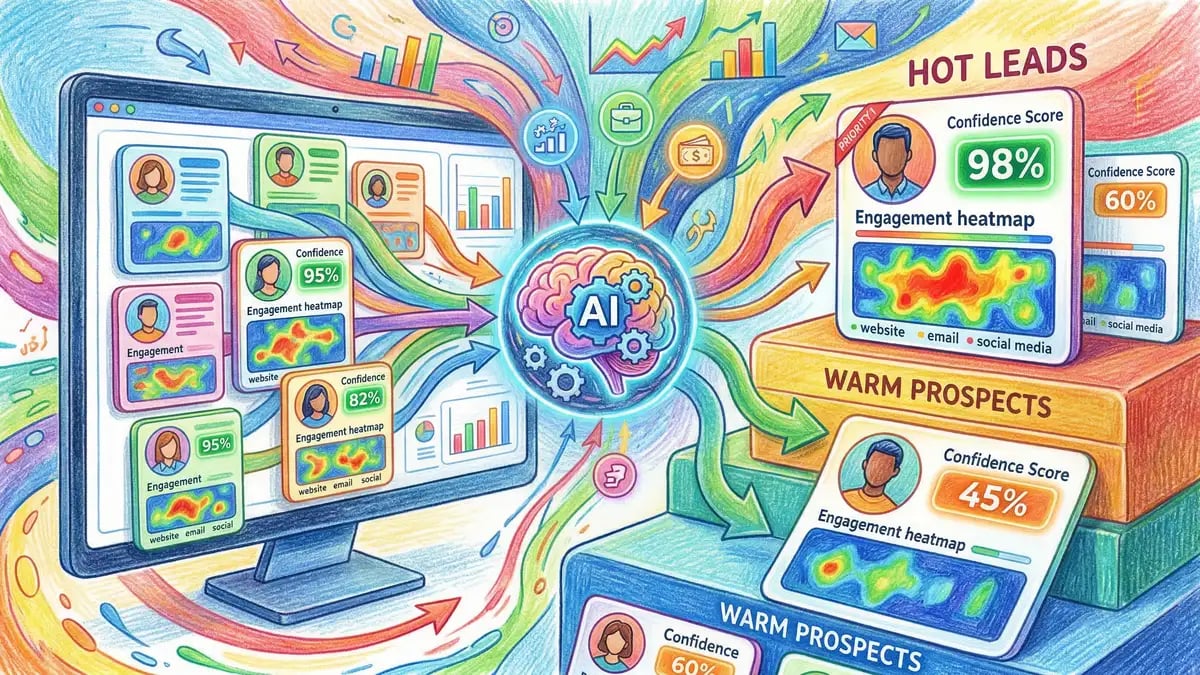
Lead scoring is the foundation of modern AI lead generation. Traditional rule-based systems assign points manually: "If company size >500, add 10 points. If they opened our email, add 5 points." Predictive AI models, by contrast, learn which combinations of factors actually correlate with deals.
Here's how AI lead scoring works: Modern predictive models integrate four data layers—firmographic (company size, industry, revenue), behavioural (website visits, content engagement, email opens), intent signals (job postings, funding, technology stack changes), and historical win/loss data from your CRM. The model trains on your past deals, identifying which signals matter most for your business.
28–35%
Lead-to-opportunity conversion with AI scoring
(vs. 12–15% traditional)
12–18%
False positive rate
(vs. 35–40% with rules)
50%
Faster deal velocity with intent data
improvement in sales acceleration
The three most mature AI lead scoring platforms for UK B2B companies are HubSpot AI (CRM-native, easiest to deploy), Salesforce Einstein (enterprise, comprehensive), and 6sense (intent-focused, for premium deals). For B2B companies with 8,000–50,000 GBP deal sizes, HubSpot or Salesforce typically deliver better ROI; companies with larger deal sizes benefit from 6sense's intent data layer.
One critical limitation: AI scoring models degrade without regular retraining. Gartner recommends quarterly model updates; organisations skipping this see 15–20% accuracy degradation within six months. This is a hidden cost many implementations miss.
AI Chatbots and Conversational Marketing
Conversational AI forms the frontline of modern lead generation, automating the first interaction and qualification stage. When done well, chatbots don't just answer questions—they identify and qualify high-intent visitors, then hand them directly to sales.
64% of consumers prefer chatbot interactions for quick answers, and B2B platforms like Drift, Intercom, and HubSpot Live Chat report 3–5x improvement in engagement rates. However, conversion varies significantly by industry—financial services firms see higher ROI (3.2:1) than SaaS companies (2.1:1), largely because compliance requirements drive higher qualification rigour.
The real value emerges when chatbots incorporate buyer intent recognition. Modern platforms now identify purchase-intent conversations vs. general inquiries with 72% accuracy, then automatically prioritise high-intent conversations for sales team handoff. Companies using AI-scored chatbot leads (rather than all leads) report 2.8x higher sales team engagement.
For UK B2B companies, we recommend starting with HubSpot's native chatbot (if you're already using HubSpot) or Qualified/Drift for multi-channel deployment. The key is segmenting by visitor type: high-intent visitors get immediate chatbot engagement; others get educational content. This prevents chatbot fatigue while maximising conversion.
AI-Powered Prospecting and Outreach
AI-driven outreach personalisation is where many teams see their biggest efficiency gains. Platforms like Apollo.io, Cognism, and ZoomInfo reduce research and outreach time by 60–70%, letting teams focus on qualified leads rather than data hunting.
| Platform | Price (GBP/mo) | Key Strength | GDPR Status | Best For |
|---|---|---|---|---|
| Apollo.io | £50–400 | Email sequences + lead database | Compliant | Fast-growing SaaS/tech companies |
| Cognism | £100–800 | GDPR-compliant UK/EMEA data | GDPR-safe; ICO-aligned | UK SMEs/mid-market |
| ZoomInfo | £300–2,000 | Comprehensive data + B2B focus | Compliant | Enterprise sales teams |
| Instantly.ai | £35–299 | Deliverability + multi-channel | Compliant; EU-based | Cold email campaigns |
Apollo.io dominates for SMEs and growth-stage SaaS companies—it integrates tightly with HubSpot, offers built-in email sequences, and costs £50–400 per month. For UK companies concerned about GDPR compliance, Cognism is the safest choice: it leverages public data sources (job postings, funding announcements), holds 2,800+ UK company customers, and has explicit data processing agreements aligned with ICO guidance.
For enterprise teams managing 8,000+ GBP deals, ZoomInfo's comprehensive B2B database and sales automation features justify the higher investment. The key is matching the tool to your deal size and compliance risk appetite.
Ready to supercharge your lead generation with AI? Our team has helped 200+ B2B companies implement AI-powered prospecting workflows that deliver 100–250% ROI within 12 months.
Explore AI Marketing Services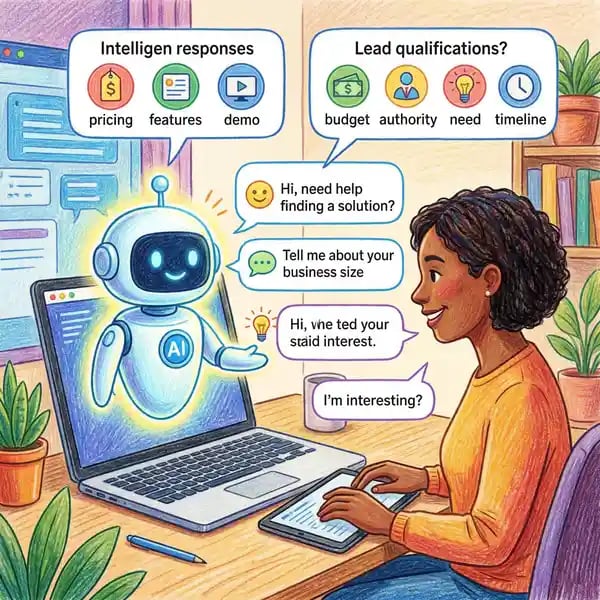
AI Content Personalisation for Conversion
Once you've identified high-quality leads, the next step is personalisation. Generic emails convert at 1–2%; personalised emails convert at 3–4%. But truly intelligent personalisation goes deeper: it changes the content based on where the prospect is in their buying journey, what they've engaged with, and what their peers in similar companies care about.
AI-powered personalisation platforms analyse thousands of variables—company size, growth rate, technology stack, recent job postings, content engagement patterns—and adjust messaging in real time. A prospect at a fintech startup with 50 employees who visited your pricing page gets different email content than a prospect at a 1,000-person bank who downloaded your case study.
The platforms leading this space are HubSpot (which scores and personalises within a single CRM), Marketo (Adobe's enterprise platform), and GetResponse (mid-market alternative). HubSpot's strength lies in integration simplicity—you define audience segments within HubSpot, and personalisation applies automatically across email, web content, and ads.
For maximum effect, combine content personalisation with AI chatbot conversations. A visitor who engaged with your chatbot about pricing should receive different email content than a visitor who asked about security compliance. This orchestration—across multiple touchpoints—is where AI lead generation truly compounds.
Building Your AI Lead Generation Stack
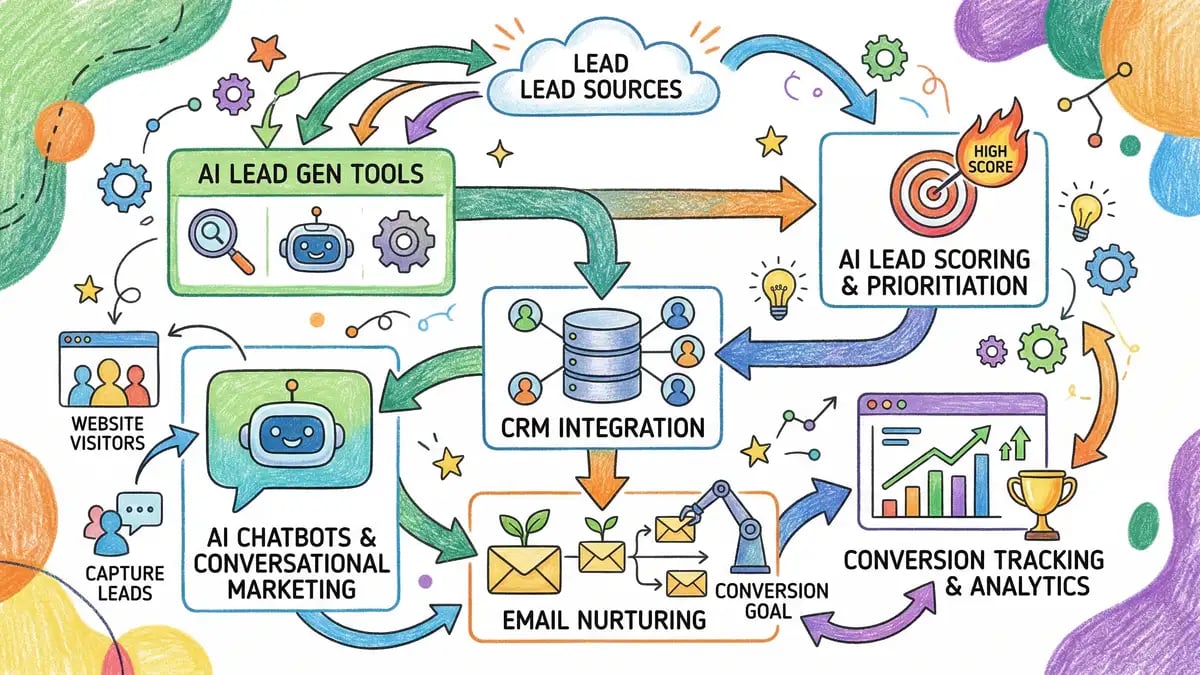
Most organisations don't deploy a single AI tool—they assemble a stack. A typical B2B AI lead generation stack looks like this:
Core Layer (CRM)
HubSpot or Salesforce—your single source of truth for all lead and customer data. This is where AI scoring lives and all other tools integrate.
Lead Sourcing Layer
Apollo.io or Cognism for lead discovery; 6sense for intent data. This layer finds and qualifies prospects before they enter your CRM.
Engagement Layer
Drift or Intercom for chatbots; HubSpot or Marketo for email personalisation. This layer moves leads through your funnel.
Analytics Layer
Built-in CRM reporting; enhanced with tools like Mixpanel or Looker for attribution and ROI tracking.
The most critical implementation decision is choosing your core CRM. For most UK SMEs and mid-market companies (under 500 employees), HubSpot offers better ROI—it includes native lead scoring, email, chatbot, and analytics without heavy customisation. For larger organisations with complex sales processes, Salesforce + Einstein provides deeper AI capabilities at the cost of longer implementation.
Integration complexity is real. Most UK companies choose a "hub and spoke" model: the CRM sits at the centre, and lead sourcing, engagement, and analytics tools connect via native APIs or Zapier. This approach takes 3–6 weeks to implement but avoids heavy custom development.
Budget realistically. A typical Year 1 investment for a mid-market company (50–500 employees) ranges from £83,000–160,000: tool costs (£15,000–50,000) plus internal resources—CRM administration, marketing operations, sales training—which constitute the bulk of spend.
Measuring ROI from AI Lead Generation
ROI from AI lead generation doesn't materialise overnight. Most organisations see measurable results within 4–6 months, with full ROI realisation in 12 months. Here's how to measure it.
Calculate baseline metrics first. Before implementing AI, document your starting point: lead volume, percentage meeting your ideal customer profile (ICP), lead-to-opportunity conversion rate, opportunity-to-customer conversion, sales cycle length, win rate, and cost per lead. These become your control metrics.
Track the three key improvement areas:
- Lead quality. Percentage of leads matching your ICP, and lead-to-opportunity conversion rate. Expect 25–35% improvement within 6 months.
- Sales cycle compression. Time from lead to close. AI typically shortens cycles by 30–40%. For a typical 6-month cycle, expect it to compress to 3.5–4 months.
- Win rate improvement. Better-qualified leads convert at higher rates. Expect 3–5 percentage point improvement (e.g., 18% to 21–23%).
Calculate incremental revenue. From these metrics, estimate incremental revenue. Example: if you currently generate 250 leads/month, 48% meeting ICP, and 2.6% overall conversion, you're generating ~6.2 customers/month. If AI improves lead quality by 35% and conversion by 25%, you're now generating ~9.5 customers/month. At £20,000 ACV, that's £66,000 incremental revenue monthly, or £792,000 annually.
Deduct implementation costs: Year 1 tool spend (£35,000) and internal resource cost (£85,000) totals £120,000. Net Year 1 ROI: (£792,000 - £120,000) / £120,000 = 560%. (Note: this is a strong scenario; typical ROI ranges 100–250%.)
Track monthly dashboards. Set up a dashboard tracking lead volume (qualified %), lead quality score, sales cycle length, win rate, cost per qualified lead, and sales productivity (revenue/sales rep/month). Review monthly and adjust your AI models quarterly. This ongoing optimisation is what separates 100% ROI companies from 250% ROI companies.
GDPR Compliance Caution
AI lead generation tools vary widely in GDPR compliance. When selecting platforms, verify: (1) Data sources—are they first-party signals (public job postings, funding announcements) or third-party purchased lists? (2) Data processing agreements—does the vendor provide explicit DPA documentation? (3) UK-specific guidance—is the platform aligned with ICO recommendations?
Cognism, Bombora, and LinkedIn Sales Navigator are GDPR-safe choices. ZoomInfo and Apollo.io require careful data sourcing validation. Third-party email list providers are increasingly risky; prioritise first-party and job-posting intent signals instead.
Frequently Asked Questions
How long before we see ROI from AI lead generation?
Do we need to replace our existing CRM to implement AI lead generation?
What's the minimum company size to justify AI lead generation investment?
Which is better: HubSpot, Salesforce, or a best-of-breed tool stack?
How often should AI lead scoring models be retrained?
Related Articles in Our AI Marketing Cluster
AI Marketing Tools
AI Analytics & Reporting
Discover how AI automates marketing analytics and attribution
AI Marketing Automation
Ready to Win More Clients with AI?
Our AI lead generation consulting has helped 200+ UK companies increase qualified leads by 40–60% and compress sales cycles by 30–40%. Let's assess your funnel and build a custom AI strategy.
Get Your Free AI Audit Explore the Full AI ClusterWhitehat SEO
We help B2B technology companies build sustainable lead generation engines powered by AI. Our AI lead generation consulting combines technical implementation with commercial strategy, ensuring your AI investments deliver measurable revenue impact. Based in London, serving UK, EMEA, and US markets.
Sources: Gartner (2024), HubSpot Research (2024), Forrester Wave: B2B Lead Management (2024), 6sense Buying Signal Report (2024), Drift State of Conversational Marketing (2024), ICO GDPR Guidance (2024), G2 Stack Data (2024–2025), Apollo.io, Cognism, ZoomInfo, Intercom, Salesforce Einstein, HubSpot research database.