
B2B marketing teams should use AI as a production accelerator while keeping human expertise at the centre of every piece of content. The most effective approach in 2026 combines AI drafting tools with expert editorial oversight, brand voice governance, and structured answer engine optimisation. According to the Content Marketing Institute, 95% of B2B marketers now use AI-powered tools, yet Google's December 2025 core update confirmed that content without genuine human expertise faces significant ranking penalties.
This guide from Whitehat SEO, a London-based HubSpot Diamond Solutions Partner, provides a practical framework specifically for UK B2B teams navigating the shift from experimental AI use to systematic, compliant, results-driven content production. Whether your team is just starting with AI tools or looking to refine an existing workflow, you will find the evidence, the processes, and the regulatory context to build a content engine that performs across both traditional search and AI-powered discovery platforms.
What Is the UK AI Adoption Gap and Why Does It Matter?
The UK marketing sector sits at a striking inflection point. Government research published in January 2026 by the Department for Science, Innovation and Technology (DSIT) found that only 16% of UK businesses currently use at least one AI technology, while 80% are neither using nor planning to adopt AI. Yet among the businesses that have adopted AI, marketing and administration are the most common applications, each at 72% (DSIT AI Adoption Research, 2026).
This gap between early adopters and the majority creates a window of competitive advantage for B2B teams that move now. Globally, 66% of marketing professionals use AI tools in some capacity, with text-based content creation leading at 55% (HubSpot AI Trends Report, 2025). The Content Marketing Institute's 2026 research is even more decisive: 45% of B2B marketers are prioritising AI tool investment for 2026, placing it 12 points ahead of the next closest priority (CMI B2B Trends, 2026).
The skills challenge is equally significant. Marketing Week's Career and Salary Survey of 3,500+ respondents found 75.8% of UK marketers identify AI expertise as a major skills gap (Marketing Week, 2025), while only 23% have received on-the-job AI training despite employer expectations (Adobe for Business, 2025). Whitehat SEO's AI consultancy and implementation services exist specifically to bridge this gap for UK B2B companies, helping teams build practical AI workflows rather than experimenting without direction.
The Bottom Line
UK businesses face a genuine competitive opportunity: 80% of companies haven't adopted AI, and those who do now will build skills and content infrastructure that competitors will struggle to replicate. For B2B teams, the next 12–18 months are critical for establishing a sustainable human+AI content engine.
What Does Google's 2025 Enforcement Mean for AI Content?
Google's official position remains consistent: quality matters more than creation method. As Google's John Mueller stated in November 2025, the search engine's systems evaluate whether content is helpful, accurate, and created to serve users rather than manipulate rankings. Google's own documentation on using generative AI content confirms this approach. However, three significant enforcement escalations through 2025 made the practical implications much clearer.
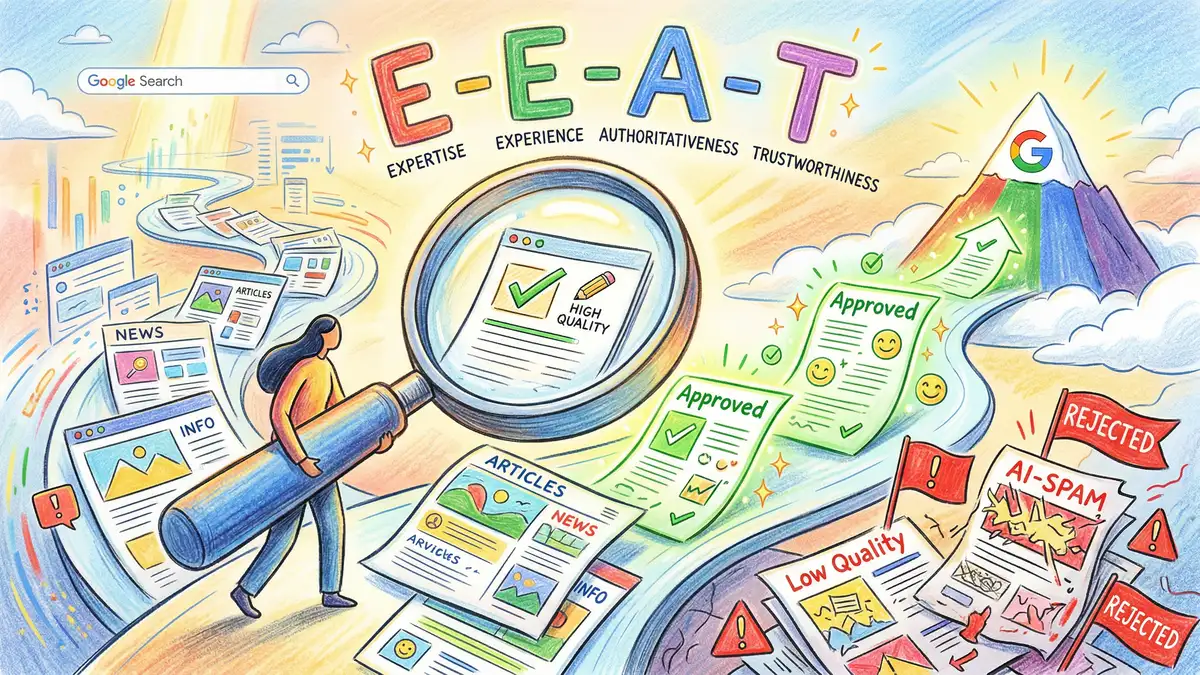
January 2025 brought updated Quality Rater Guidelines that explicitly direct human raters to assess whether content is AI-generated. Content where all or nearly all of it is produced by AI with little effort or originality can now receive the lowest quality rating (Search Engine Land, 2025). June 2025 saw Google issuing manual actions specifically targeting sites publishing large volumes of AI content at scale. Then the December 2025 core update, widely described as the most significant of the year, broadened E-E-A-T requirements beyond health and finance topics to virtually all competitive queries (Search Engine Journal, 2025).
The data supports a nuanced picture. As of September 2025, roughly 17% of the top 20 Google results contain AI-generated content (Originality.ai, 2025), up from approximately 2% before 2019. Yet human-generated content still dominates 83% of top rankings for competitive keywords (Rankability, 2025). AI content can rank, but it overwhelmingly underperforms expert-enhanced content where it matters most.
For UK B2B teams, the takeaway is straightforward. AI is a production tool, not a publishing tool. Every piece of AI-assisted content needs genuine human expertise layered in: original insights, author perspective, current examples, and rigorous fact-checking. Whitehat SEO's approach to SEO services has always centred on E-E-A-T principles, and the December 2025 update only reinforced why that matters.
83%
Top Rankings
Human-written content dominates
17%
AI-Generated Top Results
Up from 2% before 2019
95%
B2B Marketers Using AI
Yet lacking proper frameworks
Sources: Originality.ai 2025, Rankability 2025, Content Marketing Institute 2026
What Is the Human+AI Content Workflow That Delivers Results?
The highest-performing B2B content teams in 2026 are not choosing between human and AI creation. They are building structured workflows where AI handles the tasks it excels at (research synthesis, first-draft generation, repurposing) while humans contribute what AI cannot (original experience, strategic thinking, brand voice, subject matter expertise). McKinsey estimates generative AI could boost marketing productivity by 5% to 15% of total marketing spending (McKinsey, 2023), and CoSchedule reports 83% of marketers using AI experience increased productivity, saving an average of five or more hours per week (CoSchedule, 2025).
As Ann Handley, Chief Content Officer at MarketingProfs, has observed: "GenAI invites us to ask important questions that can help marketers create content more efficiently. But is speed always the goal? In the creative process, fast does not always equal good." Andy Crestodina, co-founder of Orbit Media Studios, reinforces this point: "Tell a story, and you're automatically different from AI because AI has no world experience. Express an opinion, and you're automatically different from AI because AI has no point of view."
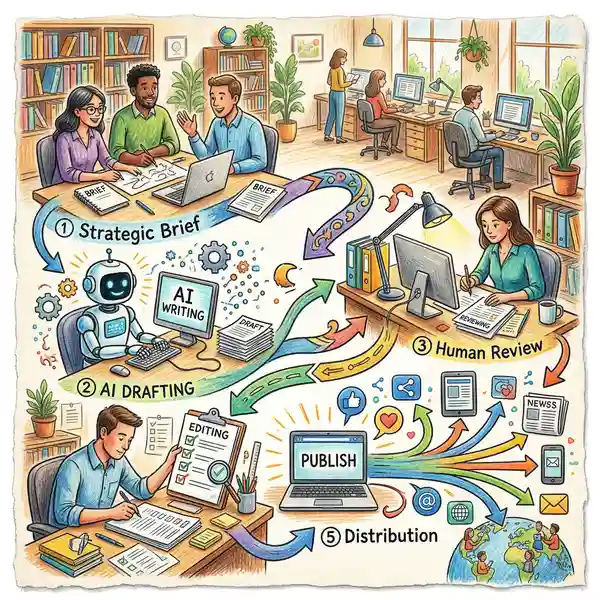
A practical five-stage workflow for B2B content teams looks like this:
Strategic Brief (Human-Led)
Define the target persona, search intent, keyword targets, internal linking requirements, and the unique perspective or data your organisation brings. This stage cannot be delegated to AI.
Research and First Draft (AI-Assisted)
Use AI tools to synthesise industry data, generate structural outlines, and produce initial draft content. Feed in your brief, brand voice guidelines, and any proprietary data.
Expert Enhancement (Human-Led)
A subject matter expert reviews the draft, adds original insights, replaces generic statements with specific experience, inserts real case studies, and ensures technical accuracy.
Editorial and Compliance Review (Human-Led)
Check brand voice consistency, verify all statistics and sources, confirm regulatory compliance, and apply SEO and AEO optimisation best practices.
Distribution and Repurposing (AI-Assisted)
Use tools like HubSpot's Content Remix to atomise the approved piece into social posts, email summaries, and presentation slides, with human approval before publishing.
Robert Rose, Chief Strategy Advisor at the Content Marketing Institute, has cautioned against eliminating what he calls "valuable friction" from the creative process. The struggle of shaping ideas, testing arguments, and refining language is what builds marketing expertise. Companies that lean into technology-supported human creativity will become the content authorities in the age of AI.
How Should You Build Your AI Content Tech Stack?
Choosing the right tools depends on your team's size, existing technology investments, and the types of content you produce. The global generative AI content creation market was valued at $14.8 billion in 2024 and is projected to reach $80.12 billion by 2030, growing at 32.5% annually (Grand View Research, 2024). That growth has created a crowded marketplace. Here is how the leading options compare for a typical UK B2B team of around 10 people:
| Tool | Best For | Monthly Cost | Key Strength |
|---|---|---|---|
| HubSpot Breeze AI | HubSpot users | Included in Hub | Native CRM context |
| ChatGPT Business | General purpose | ~£200 | Widest capability |
| Claude Team | Thought leadership | ~£200 | Writing quality |
| Jasper AI | Marketing content | ~£475 | Brand voice tools |
| Writer.com | Enterprise governance | Custom pricing | Compliance controls |
Source: Grand View Research 2024, vendor pricing 2026
Whitehat SEO recommends a three-tier approach for most UK B2B teams. Tier one is your core platform, ideally HubSpot Content Hub Professional or Enterprise with Breeze AI for workflow-integrated content, CRM-driven personalisation, and content repurposing. Tier two adds a quality layer with Claude Pro or ChatGPT Plus for thought leadership drafting, complex whitepapers, and strategy documents where nuanced writing matters. Tier three is optional and covers specialist tools like Jasper for teams needing brand voice at scale, or Writer.com for organisations with strict governance and compliance requirements.
All major tools now offer GDPR-compliant data handling with Data Processing Agreements available. However, UK teams should conduct a Data Protection Impact Assessment before routing any CRM or personal data through third-party AI tools, as the ICO states the vast majority of AI use will trigger this requirement.
What Does HubSpot Breeze AI Offer as a CRM-Connected Advantage?
HubSpot's AI suite is not a standalone writing tool. It is an integrated AI layer that runs across the entire platform, making it fundamentally different from general-purpose AI tools. For B2B teams already invested in HubSpot, Breeze AI offers a unique advantage: context. It knows your contacts, deals, company data, and customer history, which means it can generate content that is more targeted than anything a disconnected tool can produce.
The key components include Breeze Assistant, a conversational AI available across all Hubs for summarising records, drafting content, and creating workflows. Content Agent generates blog posts, landing pages, and case studies from prompts that incorporate CRM context, with integrated SEO via Semrush keyword data. Content Remix repurposes a single approved asset into emails, social posts, ads, and landing pages. And Brand Voice learns your organisation's tone from existing content and applies it consistently across all AI output.
HubSpot's new AI Engine Optimisation feature, introduced in 2025, helps optimise brand presence in responses from large language models. This directly addresses the growing importance of visibility in AI-powered search. As HubSpot CMO Kipp Bodnar noted at INBOUND 2025, B2B buyers arriving via LLM-based search convert at 12 times the rate of traditional Google search traffic (The Angle, 2025). The volume is smaller, but the value per visit is significantly higher.
Real-world results support the investment. HubSpot customer Agicap reported saving 750 hours per week and increasing deal velocity by 20% with Breeze. Sandler achieved 25% more engagement and four times more sales leads. Aerotech saves 18 hours weekly and closes deals 50% faster. As a HubSpot Diamond Solutions Partner, Whitehat SEO helps UK businesses configure Breeze AI to match their specific content workflows, buyer personas, and compliance requirements.
How Should You Maintain Brand Voice Across AI Content?
Brand voice inconsistency is one of the fastest ways to undermine trust in B2B marketing. Research from Lucidpress found that 77% of organisations report producing content that does not reflect their brand voice, and the Content Marketing Institute reports only 23% of successful content marketers actively use documented brand voice guidelines when training their AI tools (Envive AI, 2024).
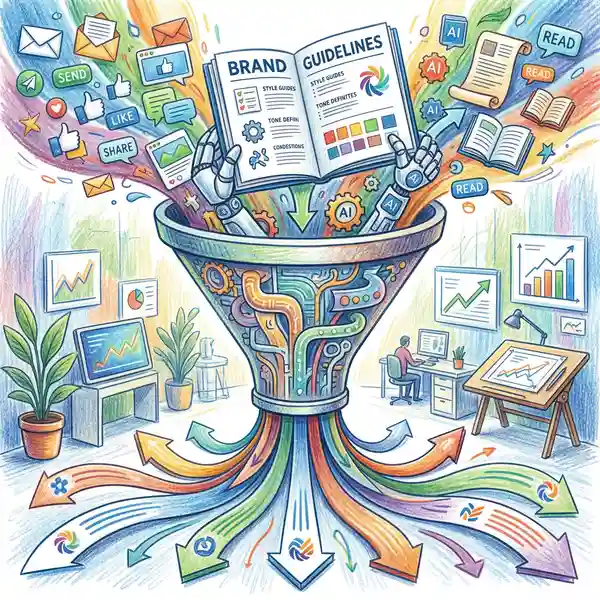
For B2B teams using AI, a documented brand voice guide is no longer optional. It is the control mechanism that prevents AI from flattening your organisation's distinctive communication style into generic marketing language. Your brand voice document should specify tone attributes (such as authoritative but approachable), vocabulary preferences (including UK English spelling conventions), structural patterns, and specific words or phrases to avoid.
HubSpot's Brand Voice feature allows teams to feed existing approved content into the system so AI-generated output matches established patterns. For teams using standalone tools like ChatGPT or Claude, creating a detailed system prompt that incorporates brand voice guidelines achieves a similar effect. Whitehat SEO's marketing services include brand voice development as a foundational step before any AI content programme begins, because getting this right at the start prevents costly inconsistency later.
A practical quality assurance process for AI-assisted content includes three checkpoints: a subject matter expert reviews technical accuracy and adds original insight, an editor checks brand voice compliance and readability, and a final reviewer confirms SEO and AEO requirements including proper internal linking, schema markup, and standalone section structure.
What Are the UK Regulatory Compliance Requirements for AI Content?
UK B2B teams must navigate three overlapping regulatory frameworks when using AI for content creation. Getting compliance right is not just about avoiding penalties. VML research found that companies disclosing AI use saw a 47% lift in ad appeal, 73% lift in trustworthiness, and 96% lift in overall trust compared to companies that did not disclose (VML, 2025). Transparency is a competitive advantage.
Critical Compliance Deadline
The EU AI Act Article 50 transparency obligations take effect on 2 August 2026. AI-generated text published for public interest must be labelled. However, a critical editorial exemption exists: content reviewed by humans where humans hold editorial responsibility does not require disclosure. This exemption directly rewards the human+AI workflow.
Action now: UK agencies serving EU clients should begin implementing human-reviewed AI workflows and documentation systems to prepare for compliance by August 2026.
UK advertising standards (ASA/CAP): There is no blanket legal requirement in the UK to disclose the use of AI in advertising, as confirmed by the ASA's May 2025 guidance (ASA, 2025). AI-generated content is held to exactly the same standards as human-created content under existing CAP and BCAP Codes. However, the ASA is actively using AI-based monitoring, scanning approximately 28 million ads in 2024 and targeting 50 million in 2025.
EU AI Act (critical for UK agencies serving EU clients): Article 50 transparency obligations take effect on 2 August 2026. AI-generated text published for public interest must be labelled, and penalties reach up to €35 million or 7% of global annual turnover. However, a critical editorial exemption exists: content reviewed by humans where humans hold editorial responsibility does not require disclosure under Article 50. This exemption directly rewards the human+AI workflow described earlier. The first draft Code of Practice on Transparency was published in December 2025, with the final version expected by June 2026 (Cooley, 2025).
UK GDPR: When AI tools process personal data from your CRM, you need a lawful basis under Article 6. The ICO's guidance confirms that Data Protection Impact Assessments are required for most AI use cases (ICO, 2025). Privacy notices should disclose AI use in content processes, and international data transfers through third-party AI providers require UK GDPR-compliant safeguards.
The UK currently has no standalone AI legislation. The government's "pro-innovation" sector-specific approach means a comprehensive bill is not expected before the second half of 2026, and will likely be narrower than the EU AI Act. Whitehat SEO's recommendation: build your processes to the higher EU AI Act standard now. This future-proofs against both UK and EU requirements and positions your organisation as compliance-ready ahead of regulation. Our AI consultancy services include regulatory compliance frameworks tailored to UK B2B marketing operations.
How Should You Prepare for AI-Powered Search Discovery?
The way B2B buyers find and evaluate suppliers is changing rapidly. Forrester reported in July 2025 that AI-generated traffic represents 2% to 6% of B2B organic traffic, growing over 40% monthly, with B2B buyers adopting AI-powered search at three times the rate of consumers (Digital Commerce 360, 2025). As Kipp Bodnar observed, "Visits and revenue are going to get decoupled for the first time."
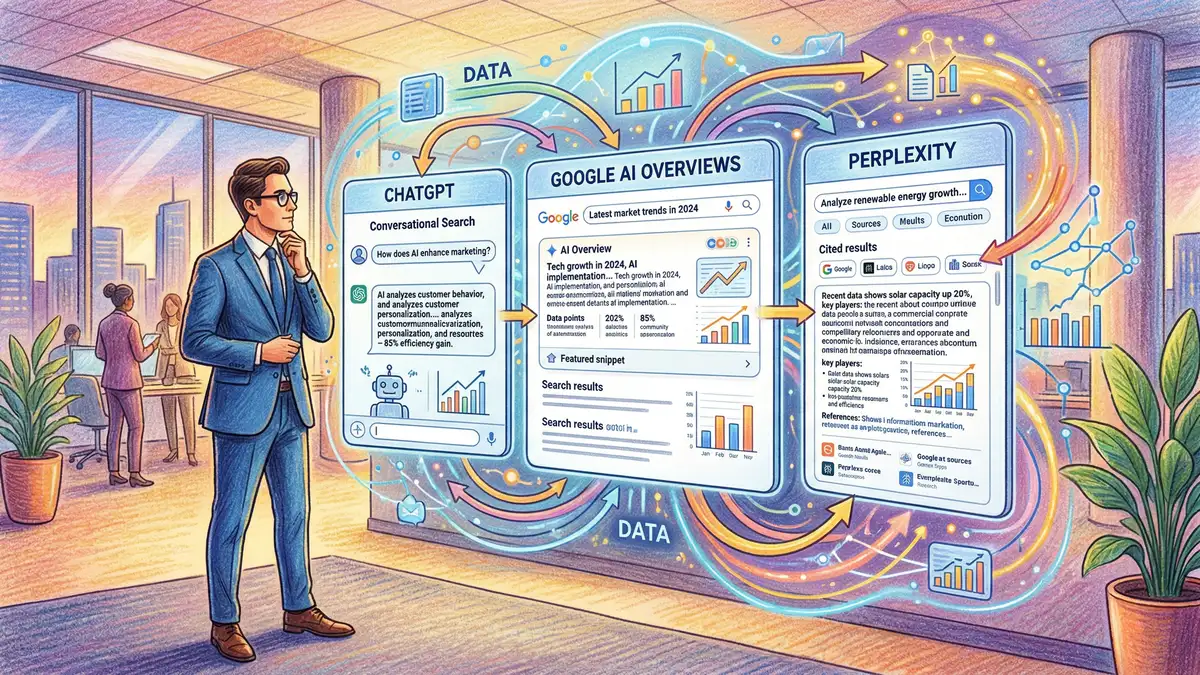
This shift demands content structured not just for Google rankings but for citation by ChatGPT, Perplexity, Google AI Overviews, and Claude. The principles of answer engine optimisation include writing direct answers in opening paragraphs, making each section comprehensible as a standalone extract, embedding brand names in quotable statistics and findings, and including comprehensive FAQ sections that match natural language query patterns.
Content Marketing Institute research shows that B2B marketers' top achieved goals include creating brand awareness (87%), generating demand and leads (74%), and nurturing leads (62%), with 46% planning to increase content budgets in the coming year (CMI, 2025). AI tools accelerate content production across all of these goals, but the strategic direction must remain human-led. Whitehat SEO's answer engine optimisation services help B2B businesses structure their content for visibility across every platform where buyers now search.
What Is the Business Case for Measuring AI Content ROI?
Building the business case for AI-assisted content requires concrete data. The Wharton School's 2025 AI Adoption Report found companies integrating generative AI see an average of $3.70 in value for every $1 invested, with top performers achieving $10.30 per dollar. Three out of four leaders report positive returns (Wharton, 2025).
In the UK specifically, 56% of firms using AI reported productivity gains, with most estimating improvements of up to 20% (DSIT, 2025). The DMA's analysis of 153 award-winning campaigns using automation showed a 50% effectiveness boost for performance marketing and a 32% increase in marketing ROI (DMA, 2025). McKinsey's research on AI-driven personalisation indicates it can reduce customer acquisition costs by up to 50%, lift revenues by up to 15%, and increase marketing ROI by up to 30%.
$3.70
Average ROI Per Dollar
Integrated generative AI
50%
Effectiveness Boost
Performance marketing campaigns
11.4
Hours Saved Weekly
Per employee via generative AI
Sources: Wharton School 2025, DSIT 2025, DMA 2025
For budget planning, content marketing teams save approximately 11.4 hours per week per employee through generative AI adoption, and AI-generated content can reduce production costs by up to 65% compared to traditional creation methods. However, these savings should be reinvested in quality, not used to simply produce more. The IPA Bellwether Q4 2025 report shows UK marketing budgets remained flat, with respondents emphasising "AI readiness" as a priority. The smartest B2B teams are using AI efficiency gains to produce fewer, better pieces rather than flooding channels with volume.
Whitehat SEO helps clients build AI-integrated content strategies with clear attribution and measurement frameworks, so the ROI case strengthens over time rather than remaining theoretical.
Ready to build a sustainable AI content strategy? Speak with our AI implementation experts to discuss how structured workflows can transform your content productivity.
Book a Discovery CallFrequently Asked Questions
Does Google penalise AI-generated content?
Google does not penalise content simply because AI created it. However, the December 2025 core update significantly increased enforcement against AI content that lacks genuine expertise, originality, or editorial oversight. Content must demonstrate E-E-A-T signals regardless of how it was produced. Human enhancement of AI drafts is essential for competitive rankings.
Do UK businesses need to disclose AI use in marketing content?
There is currently no blanket legal requirement in the UK to disclose AI use in advertising or marketing content (ASA/CAP, May 2025). However, UK agencies serving EU clients must prepare for the EU AI Act's Article 50 transparency obligations by August 2026. The editorial exemption means human-reviewed AI content may not require disclosure.
What is the best AI writing tool for B2B marketing teams?
For teams already using HubSpot, Breeze AI offers the strongest advantage because it integrates CRM data directly into content creation. For standalone writing quality, Claude and ChatGPT lead. The most effective approach combines HubSpot Breeze for CRM-integrated tasks with a general-purpose tool for thought leadership content.
How much time does AI save B2B content teams?
Research shows content marketing teams save approximately 11.4 hours per week per employee through generative AI. CoSchedule reports 83% of marketers using AI experience increased productivity, with average time savings exceeding five hours weekly. The key is reinvesting saved time into quality enhancement rather than simply increasing volume.
How should UK marketers handle GDPR when using AI tools?
UK teams should conduct a Data Protection Impact Assessment before routing CRM or personal data through AI tools. Identify a lawful basis under Article 6 of UK GDPR, ensure international data transfer safeguards are in place, and update privacy notices to disclose AI use in content processes. Most major AI platforms now offer compliant Data Processing Agreements.
What is answer engine optimisation and why does it matter for B2B?
Answer engine optimisation (AEO) structures content to be cited by AI platforms like ChatGPT, Perplexity, and Google AI Overviews. B2B buyers are adopting AI-powered search at three times the consumer rate (Forrester, 2025), and visitors from AI search convert at 12 times the rate of traditional search. AEO ensures your brand appears in these high-value AI responses.
Can AI maintain a consistent brand voice across content?
AI can maintain brand voice when properly configured with documented guidelines. HubSpot's Brand Voice feature learns from existing content, while standalone tools require detailed system prompts. However, 77% of organisations report inconsistent content, which means governance processes and human editorial review remain essential quality controls.
Ready to transform your content production with AI?
Whitehat SEO's AI consultancy framework helps UK B2B teams build sustainable, compliant, results-driven content programmes that outpace competitors. From workflow design to regulatory compliance to proof of ROI, we guide you through every stage.
Clwyd Probert
CEO & Founder, Whitehat SEO
Founded Whitehat SEO in 2011 and became a HubSpot Diamond Partner. Runs the world's largest HubSpot User Group in London, guest lectures at UCL on AI implementation for marketing, and advises enterprise clients on AI transformation and content strategy. Focuses on practical frameworks that bridge technology and human creativity. ChatGPT for marketing
References
- Department for Science, Innovation and Technology — AI Adoption Research (January 2026)
- Content Marketing Institute — B2B Content and Marketing Trends: Insights for 2026
- HubSpot — 2025 AI Trends for Marketers Report
- Marketing Week — 2025 Career & Salary Survey
- Google Search Central — Using Generative AI Content
- Originality.ai — AI Content in Google Search Results (September 2025)
- Rankability — Does Google Penalize AI Content?
- McKinsey — The Economic Potential of Generative AI
- CoSchedule — AI Marketing Statistics
- Grand View Research — Generative AI in Content Creation Market Report (2024)
- The Angle — HubSpot CMO on AI-Powered Search (2025)
- Envive AI — Brand Voice Consistency Statistics (2024)
- VML — Do Brands Need to Disclose When They Use AI? (2025)
- ASA — Disclosure of AI in Advertising Guidance (May 2025)
- Cooley LLP — EU AI Act: First Draft Code of Practice (December 2025)
- ICO — Guidance on AI and Data Protection
- Digital Commerce 360 — Forrester: AI Search Reshaping B2B Marketing (July 2025)
- Wharton School — 2025 AI Adoption Report
- DMA — The Value of Automation Report 2025
- Search Engine Land — Google Quality Raters Assessment of AI-Generated Content (January 2025)