
Data overwhelms most marketing teams. We collect it constantly—campaign performance, customer journeys, website behaviour, email engagement—yet struggle to extract actionable insights. Report creation consumes hours. Dashboards go unread. Decisions rely on gut feeling rather than evidence.
AI analytics and reporting tools change this equation. Rather than drowning in raw data, we now have intelligent systems that automatically identify patterns, predict outcomes, and recommend actions. Natural language interfaces replace complex query builders. Real-time anomaly detection prevents budget waste. Predictive models forecast campaign performance before launch.
We'll explore how AI transforms marketing analytics from a compliance exercise into a strategic advantage. From platform selection to implementation roadmaps, you'll learn how to harness these tools—and avoid the pitfalls that derail many organisations.
Key Takeaway
AI-powered analytics reduce report creation time by 60–90%, reclaiming over 500 hours annually per team member. By automating routine analysis and attribution modelling, we shift from reactive reporting to predictive strategy—where insights drive decisions before problems emerge, not after data reveals them.
Why AI Is Revolutionising Marketing Analytics
Marketing analytics has long operated in a fixed pattern: collect data, compile reports, distribute spreadsheets, then wait for questions to emerge. This reactive cycle leaves decision-makers perpetually one step behind market changes. AI inverts this model.
Generative AI now powers analytics interfaces. Rather than constructing queries or navigating menu hierarchies, we ask questions in natural language: "Which campaigns drove conversions last week?" or "When did audience engagement drop and why?" AI systems parse these queries, navigate complex data models, and surface relevant insights within seconds—no SQL expertise required.
This democratisation matters. Analysts no longer become reporting bottlenecks. Campaign managers access self-service insights. Executives ask exploratory questions without IT intervention. Speed compounds value: faster insights mean faster optimisation cycles, tighter campaign feedback loops, and more nimble competitive responses.
Real-time anomaly detection adds another dimension. Traditional dashboards show historical performance; they flag what happened yesterday. AI-powered systems identify deviations as they occur—a sudden traffic spike, unexpected CTR collapse, audience quality degradation. We respond within minutes rather than waiting for weekly review meetings.
Pattern recognition capabilities reveal hidden relationships. Machine learning models uncover correlations humans miss: which audience segments convert despite low engagement metrics, how external events affect campaign performance, which messaging variations drive repeat purchases. These insights compound competitive advantages over time.
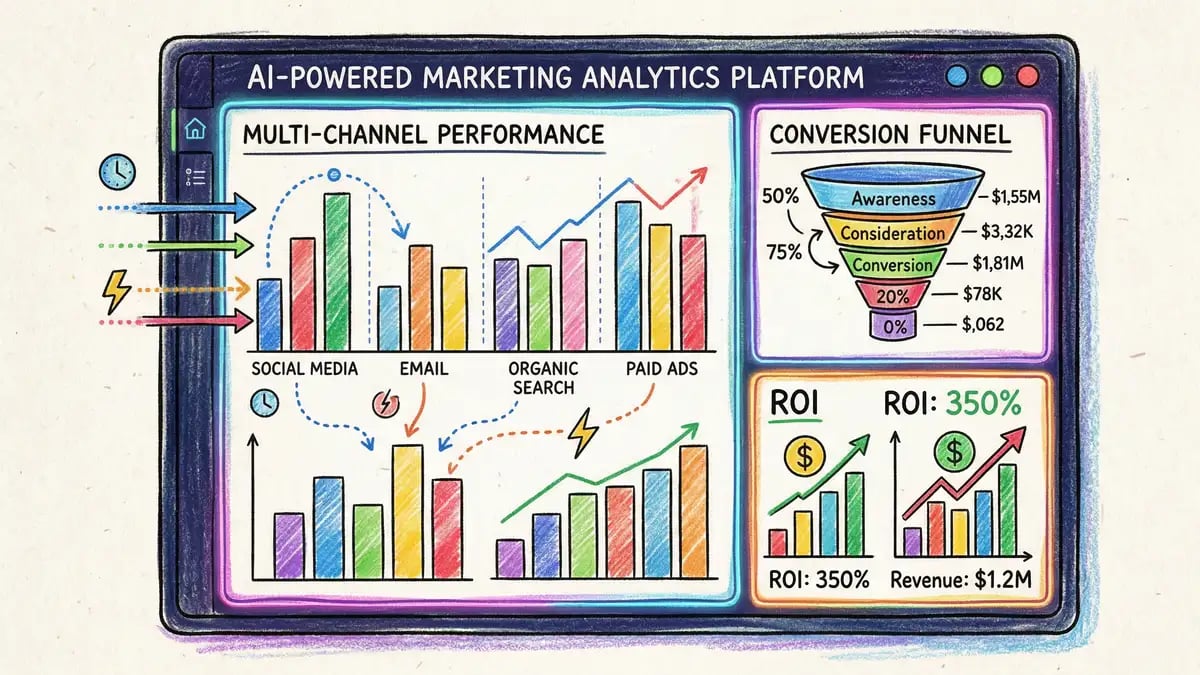
AI-Powered Analytics Platforms: Platform Landscape 2026
Five platforms dominate the AI analytics space. Each addresses different team sizes, budgets, and technical sophistication. Understanding their strengths prevents costly platform mismatches.
Google Analytics 4 (GA4) remains the entry point for most teams. Its free tier delivers robust event tracking and basic AI insights. The new Gemini insights feature generates natural language summaries of performance trends. For small-to-mid teams operating on tight budgets, GA4's cost-to-capability ratio remains unbeaten. Limitations emerge at scale: attribution modelling remains basic, and custom analysis requires BigQuery expertise.
Adobe Analytics targets enterprise marketers managing omnichannel customer journeys. Its AI capabilities integrate across Experience Cloud—connecting analytics with ad buying, content personalisation, and customer data platforms. Multi-touch attribution and predictive audiences differentiate this platform. Trade-off: cost scales sharply, requiring six-figure annual commitments. Best suited for organisations already invested in Adobe's ecosystem.
Tableau excels at data visualisation and exploration. Its AI-powered natural language querying (Ask Data) lets non-technical users ask questions of structured datasets. Integration with Salesforce and cloud data warehouses enables enterprise-scale analysis. Ideal for organisations with complex data governance needs or existing Salesforce relationships. Steeper learning curve for basic users.
Power BI Copilot leverages Microsoft's generative AI to automate report generation and insight discovery. Tight integration with Excel and Azure data ecosystems appeals to organisations already committed to Microsoft platforms. Cost efficiency and ease of adoption make it compelling for mid-market teams. Limitations: less mature attribution modelling compared to Adobe or Tableau.
Looker (Google Cloud) provides enterprise-grade data governance with semantic layer architecture. Organisations needing strict access controls, complex permission hierarchies, and extensive audit logging favour Looker. Its strength lies in preventing bad analysis: the semantic layer enforces consistent metric definitions across teams. Setup complexity and implementation timelines exceed other platforms.
| Platform | Best For | AI Capabilities | Starting Cost | Implementation |
|---|---|---|---|---|
| GA4 | Small-mid teams | Gemini summaries, basic anomaly detection | Free (360 tier £40k+/year) | 1–2 weeks |
| Adobe Analytics | Enterprise omnichannel | Multi-touch attribution, predictive audiences, journey AI | £100k+/year | 3–6 months |
| Tableau | Advanced visualisation, self-service analytics | Ask Data, natural language querying, pattern detection | £50k+/year | 2–3 months |
| Power BI Copilot | Microsoft ecosystem teams | Automated report generation, quick insights, Q&A | £10–20/user/month | 2–4 weeks |
| Looker | Enterprise governance, data stewardship | LLM-based exploration, semantic consistency, anomaly alerts | £75k+/year | 4–6 months |
AI Attribution Modelling: Beyond Last-Click
Last-click attribution persists despite its fundamental flaws. A customer discovers us via LinkedIn, considers the offer for a week, clicks an email, and converts. Attribution assigns 100% credit to that email click. It ignores LinkedIn's discovery role entirely. Budget allocation based on this false credit inevitably shifts spend toward lower-funnel channels whilst underinvesting in awareness.
Data-driven attribution (DDA) using machine learning corrects this distortion. Rather than arbitrary rules, DDA analyses millions of customer journeys and models actual conversion probability contributed by each touchpoint. The model learns: LinkedIn generates awareness (low direct conversion impact but essential for downstream journeys), email drives consideration, and retargeting ads seal conversions. True credit distribution emerges.
This reallocation often surprises organisations. Channels assumed high-performing show inflated credit from last-click bias. Underinvested channels reveal disproportionate impact when attribution improves. We've observed clients reallocate 20–30% of budgets after implementing DDA, resulting in 15–25% revenue increases within six months through improved channel mix.
Multi-touch attribution platforms like GA4's data-driven attribution, Adobe's Journey Analytics, and specialised tools like mParticle model customer journeys across devices and channels. AI continuously refines models as new conversion data arrives. Temporal patterns matter: touchpoints closer to conversion receive higher weight, whilst earlier awareness efforts receive appropriate recognition.
Limitations deserve acknowledgement. Attribution models require substantial first-party data; privacy regulations constraining data collection worsen attribution accuracy. iOS privacy changes, third-party cookie deprecation, and GDPR compliance restrictions all complicate the data foundation underpinning attribution models. Organisations must combine deterministic data (CRM records, email engagement) with probabilistic modelling (statistical inference from patterns) to maintain attribution accuracy despite privacy constraints.
Predictive Analytics for Marketing: Forecasting & Anomaly Detection
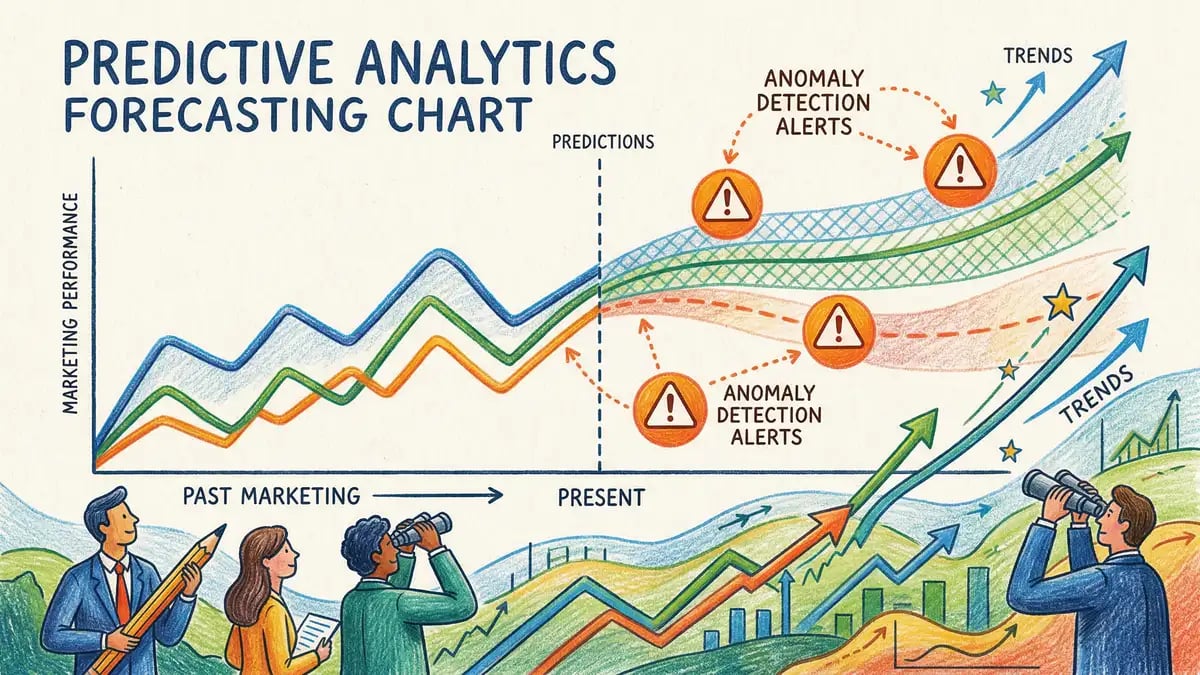
Predictive analytics shift marketing from reactive to proactive. Rather than observing performance retrospectively, AI models forecast outcomes before campaign launch and flag risks in real-time.
Campaign performance forecasting leverages historical data plus external factors. A model trained on two years of campaign data learns patterns: this audience segment converts at 3.2%, cost-per-acquisition trends upward 5% monthly, seasonal effects spike May through July. When launching a similar campaign, the model predicts likely performance within a confidence interval. Budget recommendations follow: "This audience mix should yield 500 conversions at £28 per conversion, with a 15% probability of exceeding £35 CPA if market conditions deteriorate."
Real-time anomaly detection prevents waste. A campaign launches with expected daily spend of £500 and target CPA of £25. By hour six, spend runs 40% above forecast with CPA deteriorating to £42. Most teams discover this in daily reports—after 18 hours of budget bleed. AI-powered anomaly systems alert within minutes, enabling immediate pause or bidding adjustment. Early intervention prevents £5,000–£10,000 unnecessary spend across a single misfiring campaign.
Predictive audience modelling identifies high-value prospects before engagement. Machine learning profiles existing customers, identifying shared characteristics correlated with lifetime value. "This 50,000-person lookalike audience likely contains 18% repeat purchasers vs. 6% baseline; acquire this segment at premium bid prices." Targeting shifts from volume-based (reach maximum people) to value-based (reach maximum value per pound spent).
Churn prediction protects revenue. Models identify customers at risk of churning by analysing engagement decay, support tickets, and usage patterns. Rather than waiting for cancellations, proactive outreach intervenes: personalised retention offers, product education, executive check-ins. Recovery rates from at-risk segments reach 30–40% with timely intervention versus 5–10% through reactive responses to confirmed churn signals.
Ready to implement AI-powered marketing analytics?
Explore Our AI Marketing Services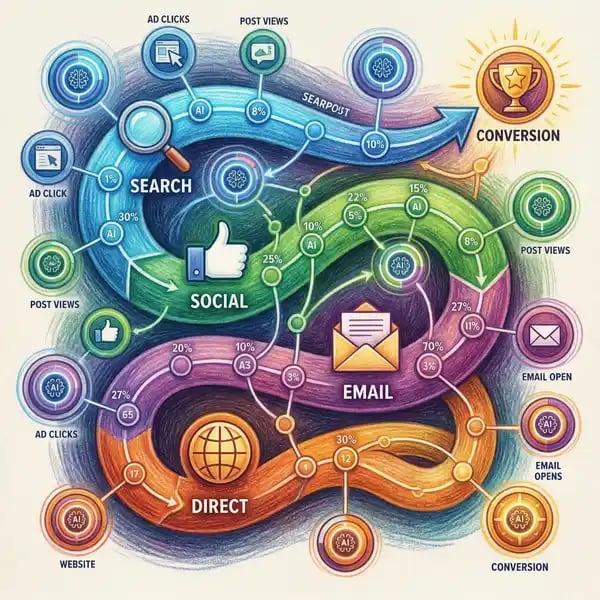
Automated Reporting and Dashboard Tools
Report generation consumes disproportionate analyst time. Query data, format tables, write commentary, distribute PDFs, respond to follow-up questions—a Tuesday report can occupy 6–8 hours. Multiplied across monthly, quarterly, and ad-hoc requests, this overhead paralyses analytics teams.
AI-powered reporting automation eliminates this drudgery. Platforms like Microsoft Copilot for Microsoft 365, Tableau Pulse, and Adobe Analytics Intelligent Alerts generate narratives automatically. Query data sources, extract key metrics, compose summaries, identify anomalies, surface recommendations—all without human intervention.
Distribution shifts from push (analysts send reports hoping executives read them) to pull (stakeholders access interactive dashboards answering their specific questions). Self-service analytics reduces analyst dependency. Campaign managers explore performance without ticket requests. Executives drill into segments without waiting for custom analysis.
Natural language interfaces democratise access further. Rather than navigating complex dashboards, users ask questions: "Show me social media performance for Q1 segments by region." The system returns relevant visualisations and summaries. Non-technical stakeholders access insights previously requiring analyst translation.
Scheduled automated reports maintain stakeholder engagement without analyst overhead. Marketing director receives a Monday morning summary: "Week 36 summary: overall conversions up 8%, CPA decreased 5% vs. forecast, two campaigns flagged for underperformance. Click to investigate." These summaries drive action without consuming internal reporting resources.
Implementing AI Analytics: A Practical Roadmap
Successful AI analytics implementation requires sequenced phases, not big-bang platform migrations. Rushing to deploy sophisticated attribution models before establishing foundational data quality wastes investment.
Phase 1: Foundation (Months 1–2)
Audit existing data infrastructure. Map all marketing touchpoints (paid ads, email, website, CRM, offline channels). Identify integration gaps. Many organisations operate fragmented systems where email performance sits in one platform, paid ads in another, CRM in a third—no unified view. Fix connectivity before building advanced features.
Establish data governance. Define metric ownership (who defines conversion rate?), implement consistent naming conventions (campaign_id vs. campaign ID vs. campaignId), and document calculations. AI models trained on inconsistent data produce unreliable outputs.
Assess compliance requirements. Conduct GDPR audit, understand consent management implications, review PECR obligations for marketing communications. Plan data retention policies that balance analytics requirements with regulatory minimisation principles. Document consent mechanisms supporting AI processing.
Phase 2: Platform Selection & Implementation (Months 2–4)
Evaluate platforms against your specific maturity stage. Early-stage teams implement GA4 (cost-effective, well-documented). Established teams managing multiple channels evaluate Tableau, Adobe, or Looker. Technical capacity influences choices: teams comfortable with Python and SQL tolerate Looker complexity; non-technical teams need Power BI simplicity.
Pilot before committing. Run six-week proofs of concept with two platform finalists. Build comparative dashboards, calculate costs at scale, assess user adoption. Real-world testing surfaces integration complexities that vendor demos obscure.
Implement core reporting infrastructure. Connect data sources, establish baseline dashboards tracking standard metrics (traffic, conversions, revenue, CPA), and train teams on basic navigation. Resist overcomplication: five excellent dashboards beat twenty confusing ones.
Phase 3: AI Capabilities (Months 4–6)
Enable natural language querying. Most platforms offer this as toggle switch; activation requires minimal effort. Run workshops teaching teams to ask questions naturally rather than constructing queries. Monitor query patterns; frequently asked questions suggest dashboard gaps worth addressing.
Implement automated anomaly detection. Start conservative (alert only on >20% deviations from baseline, not minor fluctuations). Tune thresholds based on alert noise—frequent false positives breed dismissal; too-high thresholds miss real issues.
Launch automated reporting. Select three high-value reports representing volume, complexity, and strategic importance. Automate these initially; success builds confidence for broader rollout. Measure time savings; quantified value justifies platform investment to finance leadership.
Phase 4: Advanced Modelling (Months 6+)
Implement attribution modelling. Ensure sufficient transaction volume (typically 500+ monthly conversions) for DDA to stabilise. Start with last-click baseline, then gradually shift credit allocation as model confidence increases. Document changes to stakeholders; attribution shifts can surprise teams accustomed to last-click metrics.
Build predictive models. Forecast campaign performance for upcoming launches, predict churn for customer retention programmes, identify high-value lookalike audiences. Allocate dedicated analyst time; these models require maintenance as business conditions evolve.
Establish governance around AI recommendations. Not all algorithmic suggestions merit action. Create decision frameworks: which recommendations can automated systems execute (bid adjustments, budget reallocations) versus require human approval (audience targeting changes, offer strategy shifts). Balance efficiency against risk.
Compliance Warning: Data, Consent & Transparency
AI analytics introduce compliance risks. GDPR requires documented consent for analytics processing and explicit justification for automated decisions affecting marketing. PECR reforms mean maximum fines reaching £17.5 million or 4% of global turnover for email targeting violations. When using AI to predict churn, identify high-value audiences, or personalise messaging, ensure transparent AI usage policies, regular bias audits, and human oversight of recommendations. Maintain detailed audit trails demonstrating fairness. UK regulators increasingly scrutinise automated decision-making; organisations treating AI analytics as "black box" tools face enforcement action.
Frequently Asked Questions
What is the difference between traditional analytics and AI-powered analytics?
Traditional analytics requires manual query construction, analysis, and interpretation. An analyst might spend two hours answering "Which campaigns performed best last month?" AI-powered systems answer this instantly through natural language interfaces. More importantly, AI identifies patterns humans miss: unusual audience segments driving disproportionate conversions, external events explaining performance shifts, early warning signals of declining trends. Traditional analytics answer questions posed; AI analytics surface unexpected insights proactively.
How does AI attribution modelling improve marketing ROI?
Last-click attribution distorts channel performance assessment. Awareness channels generating initial discovery receive zero credit; lower-funnel channels claiming 100% credit despite limited impact. AI attribution models journey paths, revealing true channel contributions across awareness, consideration, and conversion stages. This accurate credit distribution enables proper budget allocation: increasing spend toward high-impact awareness channels and reducing waste on falsely-credited conversion channels. ROI improves 15–25% on average through improved channel mix within six months of attribution correction.
What are the main compliance risks when using AI analytics?
Three regulatory pressures converge. First, GDPR (and Data (Use and Access) Act 2025 amendments) require documented legal basis for analytics processing; using AI to process personal data requires explicit consent or demonstrated necessity. Second, PECR reform imposes maximum fines of £17.5 million or 4% of global turnover for targeted marketing violations; AI-driven segmentation and personalisation intensify PECR risk. Third, EU AI Act provisions (increasingly referenced by UK regulators) require transparency, bias auditing, and human oversight for high-risk automated decisions. Mitigation: document all AI usage, maintain consent records, conduct bias audits quarterly, establish human review processes for sensitive recommendations.
Which AI analytics platforms are best for mid-market marketing teams?
Mid-market teams operate in the £10k–£50k annual budget range. GA4 (free to £40k) covers fundamental analytics; Gemini insights provide AI capabilities at minimal additional cost. For visual analysis and self-service dashboarding, Power BI Copilot (£10–20 per user monthly) offers excellent value within Microsoft ecosystems. Teams requiring advanced attribution or complex data governance lean toward Tableau (£50k+). Avoid Adobe Analytics unless already invested in Experience Cloud; its £100k+ price point targets enterprise spenders.
How can I prevent AI analytics from making biased decisions?
Bias emerges from training data reflecting historical prejudices. If your company historically acquired more affluent customers, models trained on this data will recommend targeting similarly affluent audiences—missing profitable segments. Mitigation requires intentional design: audit training data for bias sources (overrepresented segments, underrepresented demographics), use diverse data sources, establish governance frameworks requiring human review of sensitive recommendations, validate algorithmic recommendations against business logic before automation, monitor model performance across demographic segments for drift, and maintain transparent documentation of AI usage. Quarterly bias audits become standard practice, particularly for churn prediction, audience targeting, and offer personalisation models.
Explore Related Topics
Ready to Transform Your Marketing Analytics?
AI analytics shift marketing from historical reporting to predictive strategy. We help organisations implement platforms, model customer journeys, and build autonomous reporting systems that reclaim analyst time and improve ROI.
Research Sources: This article synthesises insights from Google Analytics 4 documentation, Adobe Analytics white papers, Tableau Pulse research, Microsoft Power BI case studies, Looker platform resources, and UK regulatory guidance from the Information Commissioner's Office on GDPR, PECR, and AI governance frameworks.
Clwyd Probert
Managing Director, Whitehat SEO
Clwyd leads Whitehat's AI consulting practice, specialising in analytics infrastructure, attribution modelling, and predictive marketing systems. He has implemented AI analytics platforms for 50+ clients ranging from mid-market SaaS to enterprise retailers, recovering over 10,000 annual analyst hours through automation. Clwyd advises on compliance frameworks balancing GDPR, PECR, and emerging AI regulations.