
B2B Networking for Introverts
Whitehat SEO Ltd • B2B Marketing • HubSpot
How Can Introverts Network in B2B Without Burning Out in 2026?
A practical, UK-English playbook for marketing leaders who want relationships and pipeline, not awkward small-talk marathons.
Direct answer (AEO): Introverted B2B leaders can network effectively in 2026 by focusing on a few high-fit conversations, using AI to prepare smarter questions, and running follow-up as a system inside your CRM. The goal is not “work the room”; it’s to create repeatable relationship momentum that turns into meetings, opportunities, and measurable pipeline.
If that sounds suspiciously “process-y”… good. In 2026, buyers increasingly self-serve and shortlists form early, so the advantage goes to teams that create consistent touchpoints before, during, and after events. Gartner found 61% of B2B buyers prefer a rep-free buying experience (25 June 2025), which means relationships are often built through content, community, and timely follow-up—not cold pitches. Source (Gartner, 2025)
This guide is built for marketing leaders who want low-drain networking that still shows up in the numbers. Where it makes sense, we’ll show how to capture conversations, automate follow-up, and track impact with HubSpot onboarding that turns networking into pipeline.
Quick definition: In this article, “networking” means building mutually useful relationships that shorten buying cycles—not collecting business cards like Pokémon.
Networking in 2026 rewards systems, not charisma
B2B networking used to be about visibility: be the loudest person near the buffet and hope your badge was readable. In 2026, buyers research in private, shortlists form earlier, and being “memorable” matters less than being relevant. The 6sense B2B Buyer Experience Report says buyers choose a Day-One shortlist vendor 95% of the time (2025), so the people you meet are often validating a decision that’s already forming. Source (6sense, 2025)
This makes “random mingling” a weak strategy. What works is a repeatable system: target the right people, start conversations with context, then follow up quickly and consistently. The good news for introverts: systems are quieter than charisma. They’re also measurable—and that’s what marketing leaders are judged on.
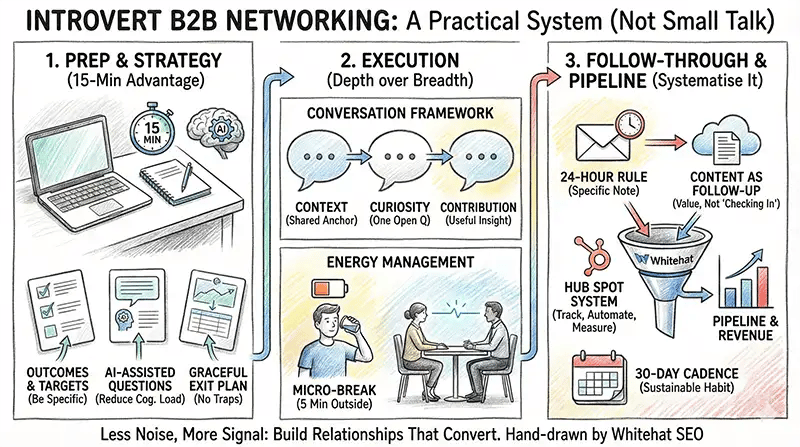
Introverts win by trading breadth for depth
Introvert-friendly networking is not “doing extroversion, but with gritted teeth”. It’s a different game: fewer conversations, more relevance, and better follow-through. If you can get from “nice to meet you” to “we should explore this” in one meaningful exchange, you’ve done more than someone who spoke to twenty people and followed up with none.
Susan Cain’s networking advice lands on a useful truth: most people don’t hate meeting people; they hate superficial small talk. Her practical tips focus on choosing your people, preparing talking points, and pacing your energy so you can show up consistently. Source (Susan Cain, accessed 2026)
For B2B marketing leaders, depth looks like this: a clear reason to connect, a thoughtful question that uncovers a problem, and a next step that respects time (a short call, a useful resource, or a warm intro). That combination is rare—and rarity gets remembered.
A 15-minute pre-event routine that reduces anxiety
Preparation is the introvert’s advantage because it removes uncertainty. Set a timer for 15 minutes and do four things: (1) pick one outcome (for example, two relevant conversations and one follow-up call booked); (2) identify five people or companies you want to meet; (3) write three questions you can ask anyone; and (4) plan a graceful exit line so you never get trapped.
Hybrid work makes this easier because you can warm up relationships online before you meet in person. The Office for National Statistics reported 28% of workers in Great Britain were hybrid workers in Jan–Mar 2025. Source (ONS, 11 June 2025)
If you want a low-pressure place to practise this approach, the London HubSpot User Group is designed for conversation and learning, not forced selling.
AI preparation that makes you sound more human
The best use of AI for networking is not writing robotic messages. It’s reducing cognitive load: summarising a company’s positioning, mapping likely priorities, and generating sharper questions. Microsoft’s Work Trend Index reports 75% of global knowledge workers use AI at work (2024), so a little machine-assisted homework is normal now. Source (Microsoft, 2024)
Keep it practical. Use prompts like: “What are three plausible priorities for a UK SaaS marketing director in 2026?” or “What questions reveal whether a team has an attribution gap?” Then rewrite the output in your voice and sanity-check it against what you actually know. Gartner reports 27% of CMOs say their marketing organisation has limited or no GenAI adoption in campaigns (18 Feb 2025), while 47% of adopters report a large benefit from using GenAI for evaluating and reporting on marketing performance. Source (Gartner, 2025)
If you want help doing this without creating a compliance headache, here’s our approach to AI-assisted workflows with governance.
A conversation framework that avoids small-talk purgatory
When you dislike small talk, you need a framework that gets to substance quickly. Use a simple three-step flow: context → curiosity → contribution. Context is a shared anchor (“I noticed you’re presenting on revenue attribution”). Curiosity is one open question (“What’s the hardest part of making that stick internally?”). Contribution is one useful insight or resource (“We’ve seen teams fix that by aligning lifecycle stages and reporting first”).
You don’t need an elevator pitch; you need a reason to keep talking. TED Ideas author Karen Wickre recommends “keeping in loose touch” and nurturing connections before you need them (27 Nov 2018). Source (TED Ideas, 2018)
If the conversation is going nowhere, end kindly: “I’m going to grab a quick drink, but I’d love to follow up—what’s the best email?” Polite, clear, no awkward fade-out.
Energy management that prevents the “networking hangover”
The fastest way to hate networking is to treat every event like a social endurance race. Instead, plan your energy like you plan your diary. Pick the two moments that matter (a specific talk, a dinner, a targeted breakout) and give yourself permission to skip the rest. Arrive early (quieter), take micro-breaks (five minutes outside), and leave before your social battery hits zero.
Events are still very in-person, but you get choice. Bizzabo reports an event format mix of 60% in-person, 35% virtual, and 5% hybrid (2024 data, published on a 2025 page). The same page cites that 81% of attendees are most interested in networking with experts at events (Freeman, 2024)—so your best move is to build energy around one or two expert conversations rather than endless mingling. Source (Bizzabo, 2025; cites 2024)
Think “high-quality contacts per hour”, not “hours survived”. Introvert networking works when you stop treating depletion as a moral failing and start treating it as a design constraint.
Choosing the right rooms matters more than attending more events
Introvert networking gets easier when the “room” matches your values and your market. Conferences are good for density (many people in one place), but communities are good for depth (repeated exposure over time). For B2B, communities often win because they create trust through familiarity: you become “that person who always brings useful answers” rather than “that stranger who popped up once”.
If you’re choosing between three random conferences and one high-relevance community, pick the community. You’ll get more follow-up opportunities, and you’ll have more natural reasons to reconnect. That’s why we run the London HubSpot User Group—a predictable place for marketers to learn, share, and build relationships without the “hard sell” vibe.
Rule of thumb: one flagship community + 2–4 targeted events per year beats “event spam” every month.
LinkedIn networking for introverts works best asynchronously
LinkedIn is the introvert’s networking home turf because it rewards thoughtfulness over volume. The goal is not to send fifty connection requests; it’s to build recognition with the people who matter. Start with a weekly rhythm: comment on five posts from your target niche, share one practical insight, and send one message that has a clear reason for existing.
A non-cringey message looks like: “Hi [Name]—I saw your note about [specific thing]. We’ve been working with similar teams on [relevant outcome]. Curious: what’s been the biggest blocker for you so far?” That’s contextual, respectful, and it invites a real answer.
If you’re promoting a community or event, this guide on how HubSpot uses HubSpot for promoting HUGs shows how to turn attention into attendance without turning into a spam cannon.
Follow-up is where networking becomes pipeline, not a memory
Most networking “fails” after the event because follow-up is vague. Fix that with a 24-hour rule: every worthwhile conversation gets a short message within a day, while context is fresh. Keep it simple: remind them who you are, reference the specific moment, share one useful thing, and suggest one small next step.
Example: “Great chatting after the attribution panel. You mentioned lifecycle stages are inconsistent—here’s a quick checklist we use to align them. If you’d like, I’m happy to compare notes for 15 minutes next week.” That’s helpful, not needy.
This is where a CRM matters. If follow-up lives in your head, it dies there. A clean setup—properties, tasks, sequences, and reporting—makes consistency easy. That’s the point of HubSpot onboarding that turns networking into pipeline.
Content as follow-up keeps you remembered without constant meetings
Introverts often dislike the “just checking in” message because it feels empty. Content fixes that. If you publish a useful article, template, or short insight, you have a natural reason to reconnect: “Thought this might help with what you mentioned.” Over time, this turns follow-up into value delivery, not social maintenance.
The 2026 twist is that content now fuels answer engines as well as humans. If your content is structured clearly, AI platforms can cite you when buyers ask questions. That’s why we prioritise Answer Engine Optimisation (AEO): you can become “the source” before a buyer ever books a call.
If you want a practical example of turning expertise into a system, this HubSpot onboarding guide (2026 edition) is a good model for “useful, citeable, and actionable”.
Measuring networking ROI in HubSpot protects your budget and your sanity
If you can’t measure networking, you’ll eventually stop doing it—or your finance team will stop funding it. The fix is to track networking like any other channel: define success, capture it consistently, and report it in a way leadership understands. In HubSpot, that usually means: an “Event/Community Source” property, consistent lifecycle stages, meeting outcomes, and deal association hygiene.
Use three tiers: activity (meaningful conversations, meetings booked), value (opportunities created or influenced), and learning (objections, competitor mentions, messaging feedback). McKinsey’s State of AI survey (5 Nov 2025) reports 88% of respondents say their organisations regularly use AI in at least one business function, while just 39% report any enterprise-level EBIT impact—proof that tracking outcomes matters more than tracking activity. Source (McKinsey, 2025)
Your networking system should improve with iteration, just like your campaigns: measure, learn, adjust, repeat.
A 30-day networking cadence beats sporadic bursts of effort
Sustainable networking is a calendar habit, not a personality trait. A 30-day cadence keeps you visible without turning your week into wall-to-wall coffees. Try this: Week 1, attend one community session or webinar and speak to two people. Week 2, publish one insight and comment on five relevant posts. Week 3, schedule one short “compare notes” call. Week 4, send three helpful follow-ups with resources tailored to what people actually asked.
Consistency is the hard part. Accenture’s research on building generative AI skills highlights how difficult it is to scale training and adoption across organisations (2024 PDF). Networking cadence works the same way: make it small enough to sustain, then automate the follow-up so it doesn’t depend on willpower. Source (Accenture, 2024)
If you want this cadence to create pipeline, build it into HubSpot tasks, sequences, and reminders, so it runs even when your diary explodes.
Common introvert networking mistakes are fixable with tiny changes
Most introvert networking mistakes aren’t social failures; they’re strategy failures. Three common ones: (1) attending mismatched events because “you should,” (2) staying in shallow conversations too long, and (3) doing no follow-up because it feels awkward. Each has a simple fix: choose rooms by relevance, use a framework to reach substance faster, and treat follow-up as a standard workflow.
Psychology Today’s practical guidance on networking for introverts emphasises energy-saving strategies and building authentic connections without forcing constant social intensity (2025). Source (Psychology Today, 2025)
One extra tweak that helps immediately: decide your “exit time” in advance and treat it like a meeting. You’ll leave while you still feel good, which makes you more likely to come back next time.
Want the “system” built for you?
If you’re serious about turning events, communities, and LinkedIn into measurable pipeline, the fastest route is a clean CRM setup and a lightweight follow-up workflow your team actually uses.
Explore HubSpot onboarding or our B2B marketing services if you want support building the whole engine.
Frequently Asked Questions
How do I network if I’m introverted and hate small talk?
Use a framework that gets to substance quickly: context, one open question, then one useful contribution. Aim for one meaningful exchange and a clear next step, rather than trying to talk to everyone. Leaving early is fine if you followed up properly afterwards.
What’s the best follow-up message after meeting someone?
Send a short note within 24 hours that references the specific moment you met, shares one useful resource, and suggests a small next step such as a 15-minute “compare notes” call. Helpful beats polished, and specificity beats “great to connect” filler.
How many events should I attend in a year?
For most B2B leaders, one strong community plus 2–4 targeted events per year is enough. Choose events where your buyers and partners already gather, and skip “nice on paper” conferences that drain energy but produce no follow-up opportunities.
How do I network on LinkedIn without feeling salesy?
Lead with context and curiosity. Comment thoughtfully on relevant posts, share one practical insight weekly, and message people only when you have a clear reason to connect. Ask one real question and avoid pitching in the first message; the goal is conversation, not conversion.
How do I measure networking ROI in HubSpot?
Track networking like a channel: capture event/community source, log meeting outcomes, associate contacts to deals, and report activity, influenced pipeline, and learning insights. A simple dashboard protects your budget and shows which communities and events actually move revenue.
References
All URLs were verified as live at the time of writing (15 January 2026).
B2B buying behaviour and market context
- Gartner Newsroom. “Gartner Sales Survey Finds 61% of B2B Buyers Prefer a Rep-Free Buying Experience.” 25 June 2025. https://www.gartner.com/en/newsroom/press-releases/2025-06-25-gartner-sales-survey-finds-61-percent-of-b2b-buyers-prefer-a-rep-free-buying-experience
- 6sense. “The B2B Buyer Experience Report for 2025.” 2025. https://6sense.com/science-of-b2b/buyer-experience-report-2025/
- Office for National Statistics (ONS). “Who has access to hybrid working in Great Britain?” 11 June 2025. https://www.ons.gov.uk/employmentandlabourmarket/peopleinwork/employmentandemployeetypes/articles/whohasaccesstohybridworkingreatbritain/2025-06-11
AI adoption and capability building
- Microsoft WorkLab. “AI at Work Is Here. Now Comes the Hard Part.” Work Trend Index, 2024. https://www.microsoft.com/en-us/worklab/work-trend-index/ai-at-work-is-here-now-comes-the-hard-part
- Gartner Newsroom. “Gartner Survey Reveals Over a Quarter of Marketing Organizations Have Limited or No Adoption of GenAI for Marketing Campaigns.” 18 Feb 2025. https://www.gartner.com/en/newsroom/press-releases/2025-02-18-gartner-survey-reveals-over-a-quarter-of-marketing-organizations-have-limited-or-no-adoption-of-genai-for-marketing-campaigns
- McKinsey & Company. “The state of AI in 2025: Agents, innovation, and transformation.” 5 Nov 2025. https://www.mckinsey.com/capabilities/quantumblack/our-insights/the-state-of-ai
- Accenture. “Building Skills at Scale With Generative AI.” PDF, 2024. https://www.accenture.com/content/dam/accenture/final/accenture-com/document-3/Accenture-Building-Skills-at-Scale-With-Generative-AI.pdf
Events and networking perspectives
- Bizzabo. “2025 Events Industry’s Top Marketing Statistics, Trends, and Data.” 2025 (includes 2024 statistics). https://www.bizzabo.com/blog/event-marketing-statistics
- TED Ideas. Karen Wickre. “An introvert’s advice for networking.” 27 Nov 2018. https://ideas.ted.com/an-introverts-advice-for-networking/
- Susan Cain. “How to Learn to Love Networking.” Accessed 15 Jan 2026. https://susancain.net/learn-to-love-networking/
- Psychology Today. “Networking for Introverts.” 2025. https://www.psychologytoday.com/us/blog/optimizing-success/202505/networking-for-introverts