
Video Marketing Strategy
The numbers tell a compelling story. Wistia's analysis of over 100 million videos reveals that total video watch time increased by 44% in 2023, whilst Vidyard reports that video creation on its platform nearly doubled (88% increase) in 2024. LinkedIn video viewership surged 36% year over year from October 2024 to January 2025.
The Complete Strategy Guide
How to create videos that generate leads, accelerate pipeline, and prove ROI—with practical guidance for HubSpot users.
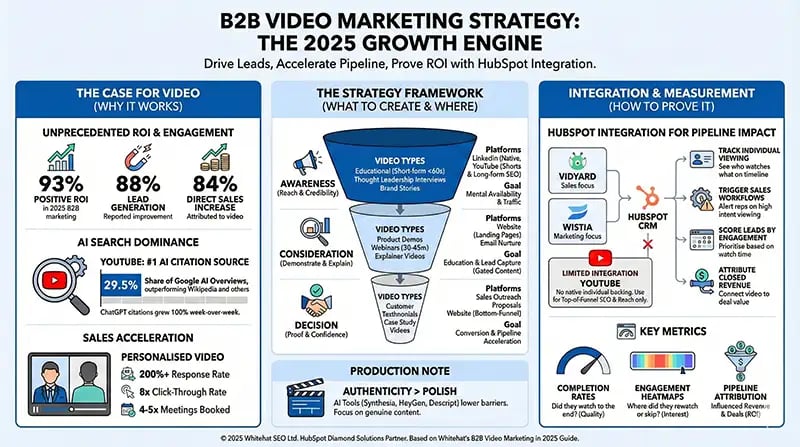
B2B video marketing delivers 93% positive ROI in 2025, with 89% of businesses now using video as a core marketing tool. Video watch time increased 44% last year, whilst YouTube has become the number one cited domain in AI search—receiving nearly 30% of all Google AI Overview citations. This guide covers which video types drive results at each buyer journey stage, how to optimise for AI visibility, and how to integrate video with HubSpot for measurable pipeline impact.
For B2B specifically, the impact on purchasing decisions is substantial. 65% of B2B buyers were influenced by YouTube during a recent purchase decision, whilst 63% indicate that short-form video content influences their buying decisions. Senior executives show particular affinity for video: 59% prefer watching videos over reading text when learning about business topics.
Video marketing ROI has reached unprecedented levels
Video marketers report these measurable outcomes in 2025:
99%
say video increased product understanding
96%
say video increased brand awareness
88%
say video helped generate leads
84%
say video directly increased sales
Perhaps most significantly, landing pages with video convert up to 86% better than those without, and adding video to email can increase click rates by up to 300%. For sales teams specifically, personalised video messages drive 8x improvement in click-through rates and 4x improvement in reply rates.
Different video types power each stage of the buyer's journey
Understanding which videos work at each funnel stage is critical for strategic allocation. Current video distribution skews heavily toward awareness: 48% of B2B videos target the awareness stage, 22% the consideration stage, and only 15% the decision stage—suggesting most companies under-invest in bottom-funnel video content.
Awareness Stage: Build Reach and Credibility
Educational content performs best here. Wistia's research confirms that how-to videos keep viewers watching longest, whilst short-form social videos (under 60 seconds) deliver the highest ROI at 55%. Thought leadership interviews generate 39% ROI, making them valuable for establishing expertise.
Effective video types: Educational videos addressing industry challenges, quick tips and how-to content (under 2 minutes), thought leadership interviews, and brand story videos showcasing company culture.
Consideration Stage: Demonstrate and Explain
As prospects evaluate solutions, they need more depth. Explainer videos help B2B brands distil complex concepts into digestible formats, whilst product demos generate 40% ROI. Webinars remain highly effective, with 47% of companies hosting them at least monthly. Notably, 70% of B2B professionals actively search for webinars with industry tips.
Decision Stage: Provide Proof and Confidence
Customer testimonials and case studies deliver the highest conversion impact at this stage. 79% of people say video testimonials have convinced them to make a purchase, and 53% of B2B marketers rate case studies as most effective for converting leads. Testimonials showed the biggest popularity boost in 2024, with 26% of businesses planning to create them.
The most effective testimonial videos include specific numbers, use a problem-solution-outcome narrative structure, and identify the customer with name, title, and company for credibility.
Personalised video transforms sales performance
One-to-one video prospecting has emerged as a game-changer for sales teams. Vidyard's research shows sales teams using a video-first approach report 200%+ increases in response rates and close rates. BDRs using video for first touches see up to 5x more replies, whilst SDRs using video follow-ups book up to 4x more meetings.
83% of all opportunities were created when video was sent as the first touch in cadence testing—making it one of the highest-impact sales tactics available.
The science behind video's effectiveness in sales is straightforward: people are 13% more likely to remember details from video emails versus text, with 59% remembering details from video emails compared to 46% from text.
Best practices for sales prospecting videos
Keep prospecting videos under 60 seconds. Use a hybrid format combining face and screen share—this combination generates the highest response rates. Structure should include: a personalised opener referencing the prospect's LinkedIn profile or company news, a value statement focused on their challenges (not your product), a specific reason for outreach, and a single clear call-to-action.
Effective personalisation tactics include writing the prospect's name on a whiteboard visible in the thumbnail, hovering over their LinkedIn profile during screen recording, and referencing specific company news or challenges. Sales teams using video in emails see 16% higher open rates and 26% increase in replies—adding "Video" to the subject line increases open rates by 6-7%.
YouTube dominates AI search citations—a major SEO opportunity
The emergence of AI-powered search represents a fundamental shift in video strategy. BrightEdge research reveals that YouTube receives 29.5% of all Google AI Overview citations—making it the number one cited domain, outperforming Mayo Clinic, Wikipedia, and Investopedia. Across all AI platforms, YouTube maintains an average 20% citation share.
YouTube's AI Search Dominance
16.6%
share in Google AI Mode (#1 domain)
9.7%
share in Perplexity (growing 4.8% weekly)
100%
week-over-week growth for ChatGPT citations
No other video platform comes close: Vimeo receives just 0.1% of citations, TikTok 0.1%, and platforms like Dailymotion receive 0%.
How to optimise video for AI visibility
AI systems now watch and listen to videos to extract information, making several technical elements critical. Transcripts are essential—85% of video content lacks proper transcription, creating a massive competitive opportunity. Adding transcripts can drive 40-60% average traffic increases within 6 months. Publish transcripts directly under videos on your website in machine-readable format.
Structure content to answer specific questions using Q&A format. Create long-form, detailed videos (10+ minutes of clear explanation ranks better than brief content). Include data, statistics, and quotable statements—these elements provide 30-40% higher AI visibility.
Implement VideoObject schema markup using JSON-LD format to help AI systems understand video content. Required properties include name, description, thumbnailUrl, and uploadDate. Use Clip markup to specify exact start and end times for video segments, enabling "key moments" that appear in search results. Pages with schema markup show 40% higher click-through rates than those without.
Short-form delivers highest ROI, but long-form converts best
The optimal video length depends entirely on purpose. 73% of marketers report that videos between 30 seconds and 2 minutes are most effective overall. Short-form video delivers the highest ROI at 55%, and 83% of B2B marketers now use short-form videos.
| Video Length | Completion Rate |
|---|---|
| Under 1 minute | 65% |
| 1-2 minutes | 56% |
| 2-10 minutes | 50% |
| Over 20 minutes | 20% |
However, here's the counterintuitive finding: videos 30-60 minutes long are best at converting viewers when lead generation forms appear at the end. A lead capture form at the end of a 60+ minute video achieves 65% conversion rate. This suggests using short-form for reach and awareness, but long-form for conversion-focused gated content.
Platform-specific length recommendations
- LinkedIn Feed: 15-30 seconds (ads), 1-2 minutes (organic)
- YouTube: 15-20 minutes (long-form), 20-40 seconds (Shorts)
- Website landing pages: 60-90 seconds (above fold), 2-3 minutes (demos)
- Sales emails: Under 60 seconds
- Webinars: 30-45 minutes
Vertical video has arrived for B2B. Vertical video uploads increased 51% year-over-year on Wistia. With 57%+ of LinkedIn engagement happening on mobile, vertical (9:16) or square (1:1) formats optimise the viewing experience. YouTube Shorts receives 70 billion daily views and generates 9x more interactions than long-form YouTube content.
Authenticity now outperforms polish in B2B video
A significant mindset shift has occurred. B2B audiences, particularly millennial and Gen Z decision-makers, increasingly favour genuine, relatable content over corporate productions. Nearly 75% of companies now make videos in-house, and 50% of businesses spent under £4,000 on video production last year. Only 14% of marketers now outsource video to external vendors (down from 24% in 2024).
Authenticity works best for:
- Thought leadership content
- Behind-the-scenes footage
- Employee testimonials
- Quick social clips
- Sales outreach videos
- Educational how-to content
High production value matters for:
- Brand awareness campaigns
- Product launch videos
- High-stakes customer testimonials
- Website hero videos
- Trade show content
- Investor presentations
A starter kit costing £200-300 can produce professional results: smartphone (iPhone 12+ or similar), lavalier microphone (£40-80), tripod (£25-40), and ring light (£35-65). Audio quality matters more than video quality—external microphones are non-negotiable.
HubSpot integrations make video measurable and actionable
For HubSpot users, the choice between video platforms significantly impacts capability. Both Vidyard and Wistia offer deep native integrations, whilst YouTube provides only basic connectivity.
Vidyard + HubSpot
Vidyard provides the tightest sales-focused integration. Key features include automatic video view tracking on contact timelines, AI Avatar video generation directly within HubSpot, one-to-one video messaging in Sales Hub emails (Pro/Enterprise), workflow enrollment triggers based on video watched, percentage completed, or form submitted, and lead scoring based on video engagement behaviour.
Pricing: Free (25 videos), Pro ($59/seat/month), Business/Enterprise ($1,500+/month for full automation). Note: Captions and transcription require $300+/month plans.
Wistia + HubSpot
Wistia excels for marketing-led strategies. The integration syncs attendee data, CTA clicks, form submissions, video stats, and webinar engagement to HubSpot contacts. A standout feature is video heatmaps in contact timeline—showing exactly which portions each contact watched. Wistia Channels creates Netflix-style video galleries on your website with built-in email capture and SEO optimisation. AlayaCare increased video views by 900% using Wistia Channels.
Pricing: Free (10 videos), Pro (~$79/month), Advanced ($399/month—required for full HubSpot integration).
YouTube Limitations with HubSpot
YouTube has no native deep integration with HubSpot. You cannot track which specific contacts watched videos or trigger workflows based on video engagement. Basic Zapier connections enable notifications when videos are uploaded, but YouTube cannot provide individual viewer tracking, heatmaps, or CRM attribution.
The recommendation: Use YouTube for SEO and reach (top-of-funnel), but host bottom-funnel content on Vidyard or Wistia for tracking and conversion.
LinkedIn video requires a native-first approach
LinkedIn has emerged as the most important B2B social platform for video. 70% of video marketers now use LinkedIn—the first time it's ranked as the most widely used video marketing platform. Video engagement on the platform increased 44% year-over-year, reaching 3.85% average engagement rate.
Critical LinkedIn video best practices
Native uploads dramatically outperform links. Native videos autoplay in-feed (muted), whilst YouTube links require an extra click—significantly reducing engagement. Video posts receive 5x more engagement than text posts, and users are 20x more likely to share video than any other content type.
Keep videos short. For brand awareness, videos under 30 seconds provide a 200% lift in completion rates. The sweet spot for thought leadership is 1-3 minutes. LinkedIn Live generates 24x more engagement than standard video.
Optimise for mobile viewing. With 57%+ of engagement happening on mobile, vertical (9:16) or square (1:1) formats perform best for organic posts. LinkedIn video ads currently only support horizontal orientation.
Add captions always. Videos autoplay without sound—research suggests 80%+ of social videos are watched muted. Burned-in captions are essential.
Post timing matters. Best times: 10 AM, 11 AM, 12 PM on Tuesday, Wednesday, Thursday. Peak engagement occurs mid-morning to lunch. Avoid weekends, early mornings before 7 AM, and late evenings.
AI tools are revolutionising video production
The production landscape has transformed dramatically. 41% of professionals now use AI for video creation, up from just 18% the previous year. AI usage is accelerating fastest for caption generation (60%+ using or planning to use) and multi-language translation (30%+).
Synthesia
Enterprise leader trusted by 90%+ of Fortune 100. 240+ AI avatars, 120+ languages, SOC 2/GDPR/ISO compliant. Best for: corporate training, onboarding, multilingual content. From $18/month.
HeyGen
Superior lip-sync, 1,100+ avatars, voice cloning, URL-to-video powered by ChatGPT. Best for: marketing videos, personalised sales outreach, social content. From $24/month.
Descript
Text-based video editing with 6+ million users. Edit video by editing transcript, AI voice cloning, automatic Eye Contact. Best for: podcasters, repurposing content. Free to $55/month.
Runway
Creative and advertising work (used in Oscar-winning films). Gen-4 text-to-video with consistent characters. Best for: creative agencies, high-quality advertising. $12-95/month.
Measuring video success requires the right metrics
Views alone tell an incomplete story. 66% of marketers now measure engagement (likes, shares, reposts) as their primary video metric, whilst 62% track views and 49% measure leads/clicks.
Key metrics beyond views
Completion rates reveal content quality. Industry benchmarks: 65% for under 1 minute, 56% for 1-2 minutes, 50% for 2-10 minutes, 20% for over 20 minutes.
Engagement heatmaps (available in Vidyard and Wistia) show exactly which sections viewers watched, rewatched, or skipped. This reveals what resonates and what needs improvement.
Attribution to pipeline connects video viewing to revenue. With HubSpot integration, you can track which videos influenced closed deals, score leads based on video engagement, and trigger workflows when high-intent viewing occurs.
Building video workflows in HubSpot
Sales alert workflow: Trigger when contact watches pricing video >80%. Create task for sales rep, send Slack notification. Outcome: timely follow-up with engaged prospects.
Nurture sequence: Trigger when product demo watched. Wait 2 days → send case study video. Wait 3 days → send comparison guide. If case study watched → enrol in sales sequence.
Lead qualification: Trigger when contact watches 3+ videos. Update lifecycle stage to MQL. Assign to sales rep by territory.
Frequently asked questions
What is the ROI of B2B video marketing in 2025?
93% of B2B marketers report positive ROI from video marketing in 2025. Specific outcomes include 99% saying video increased product understanding, 88% reporting lead generation improvements, and 84% attributing direct sales increases to video content.
How long should B2B marketing videos be?
Optimal B2B video length depends on purpose. For LinkedIn, aim for 15-30 seconds for ads and 1-2 minutes for organic content. YouTube long-form works best at 15-20 minutes, whilst Shorts should be 20-40 seconds. Sales prospecting videos should stay under 60 seconds, and landing page videos work best at 60-90 seconds.
Why is YouTube important for AI search optimisation?
YouTube receives 29.5% of all Google AI Overview citations, making it the number one cited domain—outperforming Wikipedia, Mayo Clinic, and Investopedia. Across all AI platforms, YouTube maintains an average 20% citation share, with ChatGPT citations growing 100% week-over-week.
Should I use Vidyard or Wistia with HubSpot?
Choose Vidyard for sales-led organisations requiring one-to-one video prospecting, AI avatar generation, and tight Sales Hub integration. Choose Wistia for marketing-led strategies needing video heatmaps, Netflix-style video galleries (Channels), and comprehensive marketing analytics. Both offer workflow triggers and lead scoring based on video engagement.
How does personalised video improve sales performance?
Personalised video in sales delivers 200%+ increases in response rates, 8x improvement in click-through rates, and 4x more meetings booked. BDRs using video for first touches see up to 5x more replies, and 83% of opportunities were created when video was the first touch in cadence testing.
Strategic priorities for B2B video in 2025
YouTube has become an SEO imperative. With 29.5% of AI search citations, YouTube is no longer optional—it's essential for visibility in the emerging AI search landscape. Optimise videos with transcripts, schema markup, and question-answering structure to maximise AI citation potential.
Personalised video delivers outsized sales results. The 200%+ improvement in response rates and 4-5x increase in meetings booked represents a significant competitive advantage that most B2B companies haven't yet captured. Vidyard and similar tools make this scalable.
Short-form drives reach; long-form drives conversion. Use under-60-second videos on LinkedIn and YouTube Shorts for awareness and engagement, but create 30-60 minute gated content for lead generation. The 65% conversion rate on end-of-video lead forms in long content is too significant to ignore.
Integration with HubSpot transforms video from content to data. The ability to trigger workflows based on video engagement, score leads based on watching behaviour, and attribute pipeline to specific videos makes video marketing measurable in ways impossible with YouTube alone.
AI tools have made production accessible. With 41% of professionals now using AI for video creation and tools like Synthesia, HeyGen, and Descript maturing rapidly, the barrier to video production has effectively collapsed. Authenticity now outperforms polish for most B2B use cases.
Ready to integrate video into your HubSpot strategy?
As a HubSpot Diamond Partner, we help B2B companies build video workflows that connect viewing behaviour to pipeline. Book a free HubSpot Health Check to see how video can accelerate your results.
Book Your Free Health CheckReferences
- Wyzowl (2025) Video Marketing Statistics
- Wistia (2025) Video Marketing Statistics and Trends
- Vidyard (2025) Business Video Benchmarks Report
- Search Engine Land (2025) YouTube AI Search Citations Data
- BrightEdge (2025) YouTube's Impact on Google AI Overviews
- LinkedIn Marketing Blog: Tips for B2B Video Content
- Vidyard HubSpot Integration
- Wistia HubSpot Integration
- HubSpot (2025) B2B Video Marketing Trends
- Google Developers: Video Structured Data