
Strategic Marketing
Marketing budgets have flatlined at 7.7% of company revenue according to the Gartner 2025 CMO Spend Survey—down from 9.5% just three years prior and well below the pre-pandemic average of 11%. Yet the pressure to demonstrate ROI has intensified: 59% of CMOs report insufficient budget to execute their strategy, while 61% of companies now view marketing as a profit centre rather than a cost centre.
Strategic Marketing Consulting London: Your Guide to Finding the Right Partner in 2026
Strategic marketing consulting in London connects boardroom strategy with measurable execution. Whitehat SEO, a HubSpot Diamond Partner (top 3% globally), combines C-suite-level strategic guidance with platform implementation—bridging the gap where marketing strategies typically fail. With transparent pricing from £2,000/month and full revenue attribution through HubSpot, London businesses get accountable marketing leadership without the £150,000+ cost of a full-time CMO.
Why London businesses need strategic marketing consulting now
This squeeze—do more with less, prove every pound—is driving demand for external strategic expertise. The numbers bear this out: 42% of UK businesses now outsource their marketing, with B2B companies approximately 25% more likely to outsource than B2C. Rising employer National Insurance contributions and minimum wage increases are expected to push B2B outsourcing above 50% in 2025–2026.
For London businesses specifically, the challenge is compounded by market complexity. The capital hosts over 3,000 marketing firms, yet finding a partner who bridges strategy and execution remains difficult. Most agencies are either implementers (they build campaigns but lack strategic perspective) or advisors (they provide frameworks but cannot execute). Whitehat's position as a HubSpot Diamond Partner with deep SEO expertise addresses precisely this gap.
What strategic marketing consulting actually includes
Strategic marketing consulting provides senior-level marketing leadership on a flexible basis. Rather than hiring a £120,000–£180,000 full-time Chief Marketing Officer, businesses access C-suite expertise at a fraction of the cost—typically £2,000–£10,000 per month depending on scope and engagement depth.
Strategic marketing consultants assess your current position (market analysis, competitive landscape, customer research), define clear objectives tied to revenue outcomes, develop positioning and messaging that differentiates your business, build channel strategies that reach your ideal customers, and create measurement frameworks that prove ROI to your leadership team.
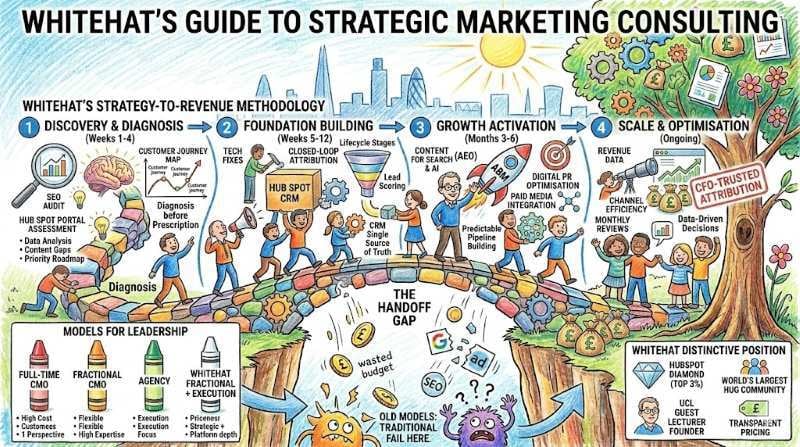
The critical distinction is execution capability. Pure strategy consultancies deliver frameworks and recommendations but leave implementation to others—creating what Whitehat calls "the handoff gap" where strategies die in translation. Whitehat's approach integrates strategic guidance with HubSpot platform execution, Answer Engine Optimisation, and full revenue attribution—ensuring strategy translates directly into pipeline.
Fractional CMO vs full-time CMO vs marketing agency
London businesses evaluating marketing leadership options face three primary models. Each has distinct advantages depending on your stage, budget, and internal capabilities.
| Factor | Full-Time CMO | Fractional CMO / Consultant | Marketing Agency |
|---|---|---|---|
| Annual cost | £120,000–£180,000 + benefits | £24,000–£120,000 | £60,000–£180,000 |
| Strategic capability | High (single perspective) | High (cross-industry view) | Variable |
| Execution capability | Requires team build | Varies by partner | High (core offering) |
| Flexibility | Low (permanent hire) | High (monthly contracts) | Medium (typical 6–12 month) |
| Time to impact | 6–12 months (hire + ramp) | 1–3 months | 3–6 months |
| Best for | £50M+ revenue, complex org | £2M–£50M revenue, growth stage | Specific channel execution |
Whitehat occupies a distinctive position: a strategic consultancy with full execution capability through its HubSpot Diamond Partner status. This means clients receive both the boardroom-level strategic thinking of a fractional CMO and the implementation depth of a specialist agency—without managing multiple vendor relationships or suffering the "strategy-to-execution gap" that undermines most marketing investments.
Whitehat's Strategy-to-Revenue methodology
Whitehat's strategic marketing consulting follows a four-phase methodology designed to connect marketing activity directly to commercial outcomes. This approach addresses the core challenge facing B2B marketers: only 29% of CMOs successfully prove marketing's contribution to business outcomes according to Gartner research.
Phase 1: Discovery and Diagnosis (Weeks 1–4)
Whitehat's discovery phase examines your current organic performance, technical infrastructure, content gaps, and competitive landscape. This includes a comprehensive SEO audit, HubSpot portal assessment, and customer journey mapping. Deliverables include a prioritised roadmap of opportunities ranked by potential revenue impact.
Phase 2: Foundation Building (Weeks 5–12)
Technical fixes blocking performance are addressed alongside existing content optimisation. This phase establishes your HubSpot infrastructure for closed-loop attribution: lifecycle stages, lead scoring, pipeline configuration, and CRM setup that creates a single source of truth. Partner-led HubSpot implementations generate 3× more closed deals and 53% more leads than self-implementations according to HubSpot's analysis of over 25,000 customer accounts.
Phase 3: Growth Activation (Months 3–6)
With foundations solid, Whitehat executes the comprehensive marketing strategy—creating new content optimised for both traditional search and AI answer engines, building authority through digital PR and content partnerships, integrating paid media for high-intent capture, and launching account-based marketing for target accounts.
Phase 4: Scale and Optimisation (Ongoing)
Continuous optimisation based on revenue data, not vanity metrics. Monthly reviews examine pipeline contribution, cost per acquisition, and channel efficiency. Whitehat's HubSpot integration enables full-funnel attribution—showing exactly which marketing activities generate qualified leads and closed revenue. This creates the CFO-trusted reporting that secures continued investment.
What strategic marketing consulting costs in London
Transparent pricing remains rare among London marketing consultancies—only 12% publish concrete price ranges according to industry analysis. This opacity frustrates B2B buyers: 78% find agency pricing "inadequate or confusing" according to Forrester research. Whitehat publishes pricing because transparency builds trust and naturally pre-qualifies clients who are a genuine fit.
Whitehat Strategic Marketing Consulting: Pricing Guide
Monthly Retainers
£2,000–£10,000/month depending on scope, team involvement, and execution requirements
Project-Based Engagements
£5,000–£75,000 for defined-scope projects such as market entry strategy, positioning workshops, or comprehensive audits
HubSpot Onboarding
From £2,500—typically saving £1,200–£6,090 versus mandatory HubSpot direct onboarding fees
Contract Terms
Month-to-month available—no lock-in contracts required. Performance should earn your continued business.
For detailed SEO pricing or comprehensive cost breakdowns, visit our pricing guides. Transparent pricing yields 27% higher conversion rates and 30–40% shorter sales cycles—a benefit that flows to both parties through more efficient discovery conversations.
Results: what to expect from a strategic partner
Strategic marketing consulting delivers measurable business outcomes, not just marketing metrics. Whitehat clients typically experience initial ranking movements within 2–3 months, meaningful traffic improvements by months 4–6, and significant pipeline impact by months 6–12. The compound nature of strategic marketing means results accelerate over time—unlike paid media, where stopping spend immediately stops results.
Industry benchmarks support these timelines: SEO delivers an average 702% ROI for B2B SaaS with a 7-month break-even point. AI search traffic converts at 3–5× higher rates than traditional organic visitors because these prospects arrive pre-qualified through AI recommendations. Partner-assisted HubSpot implementations achieve 87% success rates compared to 45% for DIY implementations—a difference that compounds across every subsequent marketing activity.
Whitehat runs the world's largest HubSpot User Group (London HUG), providing unique insight into what works across hundreds of businesses—not just your own. This community perspective informs strategic recommendations with real-world validation that no single-client experience can provide. Combined with founder Clwyd Probert's position as a guest lecturer at UCL, Whitehat brings academic rigour alongside practical execution capability.
Frequently asked questions
How much does a marketing consultant cost in London?
London strategic marketing consulting typically costs £2,000–£10,000 per month for retainer engagements, or £5,000–£75,000 for defined projects. Fractional CMO arrangements range from £1,500–£5,000 per day. Whitehat's transparent pricing starts at £2,000/month for consulting retainers, with HubSpot onboarding from £2,500—typically saving clients £1,200–£6,090 versus HubSpot direct onboarding fees.
What is the difference between a marketing agency and a marketing consultancy?
Marketing agencies primarily execute campaigns—creating content, managing ads, building websites. Marketing consultancies primarily advise on strategy—market positioning, channel selection, resource allocation. The challenge is that most businesses need both, creating a "handoff gap" where strategies fail in translation. Whitehat bridges this gap as a strategic consultancy with full execution capability through its HubSpot Diamond Partner status.
What is a fractional CMO and when should I consider one?
A fractional CMO provides part-time C-suite marketing leadership, typically working 1–3 days per week across multiple clients. Consider a fractional CMO when your business generates £2M–£50M revenue, needs strategic direction but cannot justify a £150,000+ full-time hire, or requires experienced leadership to manage existing marketing resources more effectively. The fractional model has grown significantly as B2B companies seek senior expertise without permanent headcount commitment.
How do I measure the ROI of marketing consulting?
Effective marketing consulting ROI measurement requires closed-loop attribution connecting marketing activities to revenue outcomes. Key metrics include organic traffic growth, keyword ranking improvements, organic leads generated, lead-to-customer conversion rates, and revenue attributed to marketing-sourced pipeline. Whitehat's HubSpot integration provides this attribution automatically, showing exactly which campaigns generate qualified leads and closed revenue.
Why does HubSpot Diamond Partner status matter?
HubSpot Diamond Partners represent the top 3% of HubSpot's 7,300+ global partners, demonstrating sustained client success and deep platform expertise. Diamond status provides access to advanced implementation support, early access to new features, and direct HubSpot technical resources. More importantly, it indicates an agency that consistently delivers measurable results—the tier requirements demand proven client outcomes, not just sales volume.
How long does strategic marketing consulting take to show results?
Strategic marketing delivers compound returns over time. Expect initial ranking movements within 2–3 months, meaningful traffic improvements by months 4–6, and significant pipeline impact by months 6–12. Technical fixes and HubSpot configuration can show impact within 2–4 weeks. Unlike paid advertising where results stop when spending stops, strategic marketing builds durable assets that continue generating value.
Ready to connect strategy to revenue?
Book a discovery call with Whitehat to discuss your strategic marketing challenges. No obligation, no hard sell—just an honest conversation about whether we're the right fit.
Book a Discovery CallReferences and citations
- Gartner 2025 CMO Spend Survey: Marketing budgets flatlined at 7.7% of company revenue
- Forrester 2025 B2B Marketing and Sales Predictions
- Forrester: B2B buyers expect price transparency across purchase journey
- HubSpot Solutions Partner Program: Partner tiers and benefits
- HubSpot Diamond Partner status: Less than 3% of 7,300+ global partners
- Whitehat SEO: Partner-assisted implementations achieve 87% success vs 45% DIY
About Whitehat SEO
Whitehat SEO is a London-based HubSpot Diamond Partner and full-service inbound marketing agency, founded in 2011. We run the world's largest HubSpot User Group (London HUG) and specialise in connecting strategic marketing to measurable revenue outcomes for B2B companies across the UK. marketing services view our pricing