
How Do Solicitors Generate Leads in 2026?
Solicitor lead generation is the systematic process of attracting prospective clients to your law firm and converting them into paying instructions. In the UK's £52.3 billion legal services market, where over 9,000 firms compete for clients, the firms that win are those with structured, multi-channel lead generation systems—not those relying on word-of-mouth alone.
The data tells a stark story about what separates growing firms from stagnant ones. Research from Clio's UK Legal Trends Report reveals that 67% of prospective clients choose the first law firm that calls them back, yet 48% of UK law firms don't answer their phones and only 33% reply to email enquiries. A five-hour delay in responding to enquiries costs the average firm 46 lost clients annually and approximately £200,000 in foregone revenue.
This guide covers every channel, metric, and system UK solicitors need to build a lead generation engine that delivers consistent, qualified enquiries—from organic search and Google Ads to intake optimisation, SRA compliance, and client retention strategies. For broader context on where lead generation fits within your overall strategy, see our law firm digital marketing guide.
Key Takeaway
67% of prospective clients choose the first firm that calls them back, yet 48% of UK law firms don't answer their phones. Fixing response speed alone—aiming for under one hour—is the single highest-ROI lead generation improvement most firms can make.
What Does Lead Generation Cost for UK Law Firms?
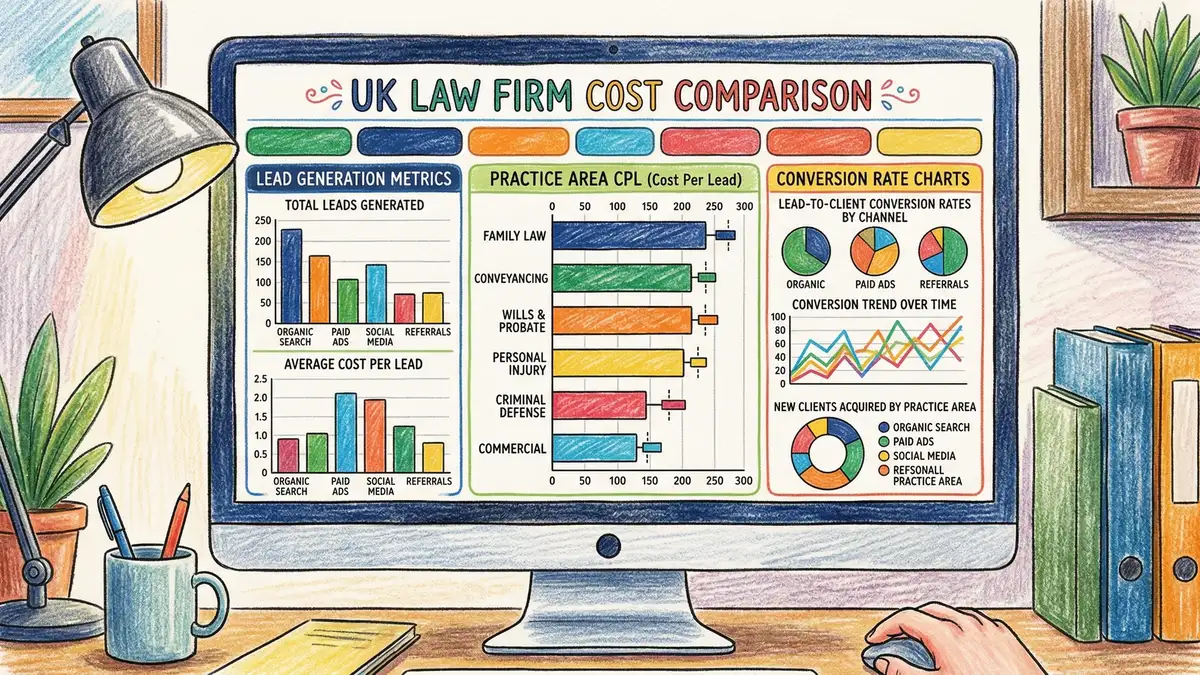
Lead generation costs for UK solicitors vary dramatically by practice area, channel, and geography. Understanding the true cost per lead marketing cost benchmarks for solicitors—and more importantly, the cost per retained client—is essential for budget allocation decisions that actually drive profitable growth.
| Practice Area | PPC Cost Per Lead | Intake Conversion | Matter Value | Demand Pattern |
|---|---|---|---|---|
| Personal Injury | £300–£1,500 | 8–12% | £15,000–£50,000 | Stable with spring/summer peaks |
| Family Law | £150–£450 | 10–15% | £5,000–£20,000 | 33% January surge, summer custody |
| Criminal Defence | £100–£400 | 12–20% | £3,000–£15,000 | Holiday peaks (drink-driving increase) |
| Estate Planning | £75–£200 | 15–25% | £2,000–£8,000 | Steady, slight Q4 increase |
| Conveyancing | £150–£350 | 12–18% | £800–£2,000 | Spring market peaks, Q4 increases |
| Employment Law | £200–£600 | 8–12% | £5,000–£25,000 | Spring and post-holiday periods |
Sources: Whitehat SEO PPC Pricing Guide 2026, Legal Marketing Association benchmarks, Clio Legal Trends Report 2025
The economics differ fundamentally by practice area. A personal injury firm paying £1,200 per lead with 10% conversion acquires clients at £12,000 each—but matter values of £40,000+ make this highly profitable. Estate planning offers the most attractive lead economics: CPCs of £75–£200 combined with conversion rates reaching 25% generate acquisition costs of £300–£800 against matter values of £2,000–£8,000. Geography also matters significantly—Greater London CPCs run 15–30% higher than equivalent keywords in northern England, Scotland, or Wales.
£52.3bn
UK Legal Market
Total revenue in 2024
67%
Choose First Responder
Clients pick whoever calls back first
48%
Don't Answer
UK firms failing to answer phones
£200K
Lost Revenue
Annual cost of 5-hour response delay
Sources: TheCityUK Legal Services Report 2025, Clio UK Legal Trends 2025
Which Lead Generation Channels Work Best for Solicitors?
Organic search is the highest-returning lead generation channel for UK solicitors when executed over an 18–24 month timeframe. Firms ranking on page one for high-intent keywords like "solicitor near me" or "family law solicitor Manchester" attract clients actively seeking legal representation, yielding conversion rates substantially higher than awareness campaigns. Unlike paid advertising that stops generating leads when budget runs out, organic search creates compounding asset value over time.
Google Ads delivers the fastest path to leads but demands sophisticated management. Legal keywords carry the highest average cost-per-click of any industry in the UK, ranging from £6 to £9 per click. Search ads generate approximately 5–6% click-through rates for legal keywords, with about 5% of clicks converting to client contact. Google Local Services Ads (LSAs) operate on a pay-per-lead basis at £25–£150 per lead, and the "Google Screened" badge carries significant trust value. For a detailed breakdown of PPC costs, see our law firm Google Ads guide.
Legal directories remain important despite the rise of organic search. Platforms like ReviewSolicitors, The Law Society's Find a Solicitor, and Legal 500 establish trust signals through verified practitioner profiles and client review systems. Diversifying across two or three directories rather than concentrating budget on a single source captures clients with different search preferences. Referral networks—both client-to-client and professional (accountants, IFAs, estate agents)—still generate the highest-converting leads because they come pre-qualified with built-in trust.
Google Business Profile: The Local Lead Engine
Google Business Profile optimisation determines visibility for local legal searches more than any other single factor. Complete profiles with service descriptions, business hours, photo galleries, and regular posts establish foundational presence. Client reviews directly influence both click-through rates and conversion, with potential clients viewing reviews as primary trust indicators. For a deep dive into local search local SEO for law firms strategy, see our local SEO for law firms guide.

Mobile search is particularly critical—70% of legal leads originate on smartphones, and telephone calls from mobile devices searching "solicitor near me" represent high-intent, time-sensitive opportunities. Prominent click-to-call buttons, mobile-responsive design, and rapid answer protocols for phone enquiries are non-negotiable. Responsive review management—acknowledging positive reviews professionally and addressing negative reviews constructively—demonstrates the kind of client commitment that drives conversion.
How Do You Convert Enquiries Into Retained Clients?
Converting enquiries into instructions requires systematic lead qualification and responsive intake processes. The distinction between high-intent enquiries (clients with immediate legal need) and research-stage contacts shapes appropriate follow-up messaging. Data shows that intake form completions achieve 17.6% conversion rates, significantly outperforming inbound call conversions at 2.6%—demonstrating the importance of optimised online intake alongside phone capabilities.
The BANT Framework for Legal Services
The BANT qualification framework—Budget, Authority, Need, Timeline—adapts effectively to legal services intake. Budget assessment extends beyond raw financial capacity to willingness to invest in representation relative to matter value. Authority evaluation confirms the contact has decision-making power to instruct counsel (in family law, both spouses may need to decide; in commercial matters, procurement departments may need board approval). Need assessment distinguishes genuine legal matters from informational research. Timeline reveals whether prospects face deadline pressure or are exploring options speculatively.
Capture: Minimal-Friction First Contact
Limit intake forms to 4–6 fields: name, phone, email, preferred contact method, and a brief "tell us what happened" box. Every additional field reduces submissions. Cutting form fields by half increases conversion rates by 30–70%.
Qualify: BANT Assessment Within 60 Minutes
Respond to every enquiry within one hour. Use screening questions to assess Budget, Authority, Need, and Timeline during the first conversation. Route qualified leads directly to the appropriate fee earner.
Nurture: Structured Follow-Up for Non-Immediate Prospects
Not every enquiry converts immediately. Build email sequences that provide genuine value—legal guides, FAQ answers, case study summaries—to stay top of mind. Newsletter programmes achieve 30.8–46.4% open rates for law firms, well above the 20–25% industry average.
Retain: Cross-Sell and Lifetime Value Maximisation
Acquiring new clients costs 6–12× more than retaining existing ones. Top-performing firms retain 92% of clients annually versus 85.2% for average firms. Proactive quarterly check-ins, cross-practice referrals, and client satisfaction surveys drive lifetime value that dwarfs acquisition spend.
Want to generate more qualified leads for your law firm? See how Whitehat's SEO services drive consistent organic enquiries for solicitors.
View Our SEO ServicesWhy Is Response Speed the Most Important Lead Generation Metric?
Response speed is the single most impactful variable in law firm lead conversion. When 67% of prospective clients choose the first firm that calls them back, every minute of delay is a competitive disadvantage. Clio's mystery shopper study of UK law firms revealed alarming deficiencies: 48% of firms did not answer phone calls, only 33% replied to email enquiries, and merely 41% provided rate information over the phone. These failures represent extraordinary opportunity for firms willing to build rapid response infrastructure.

The financial impact is concrete. A five-hour delay in responding costs the average firm 46 clients annually and approximately £200,000 in revenue, assuming average matter values of £5,000+. For personal injury, criminal defence, and immigration practices where timing carries legal significance—statutes of limitation, court dates, visa deadlines—rapid response is both a marketing advantage and a professional obligation.
Building rapid response infrastructure requires dedicated intake staff (not general reception), after-hours answering services, AI-powered chatbots for initial contact screening, and automated email acknowledgements setting clear expectations. Email enquiries should receive acknowledgement within one to two hours, with detailed follow-up after qualification assessment. Live chat captures prospects preferring text communication, though chat users expect two to five minute response times—unstaffed chat windows that respond after hours create a worse impression than having no chat option at all.
The £200,000 Mistake
Common mistake: Routing all enquiries through a general reception or shared inbox where they wait hours or days for a response.
The fix: Implement dedicated intake staff with priority ring (all intake phones ring simultaneously), templated email acknowledgements within 60 minutes, and overflow routing to professional answering services during peak periods. Firms responding within one hour capture the vast majority of enquiries competitors miss.
What Are the SRA Rules on Solicitor Marketing and Lead Generation?
The Solicitors Regulation Authority establishes clear boundaries for solicitor marketing under Paragraph 8.9 of the Code of Conduct, which prohibits unsolicited targeted approaches to members of the public. However, SRA guidance clarifies that non-intrusive, non-targeted advertising is fully permissible—including Google Ads campaigns, social social media lead generation for solicitors media advertising, radio, television, billboards, and leaflet drops to all homes within a large geographic area.
The critical distinction is targeting specificity. Running Google Ads targeting the keyword "family lawyer Manchester" is non-targeted advertising because it targets search intent and location, not specific individuals. Identifying people involved in recent road traffic accidents from online sources and sending them letters offering compensation claims is prohibited targeted marketing because it identifies specific individuals based on personal circumstances.
Pricing Transparency and Advertising Standards
Marketing material must meet strict accuracy requirements under Paragraph 8.7. Firms cannot make false or misleading claims about services, experience, success rates, or qualifications. The SRA brings enforcement action against firms making false claims—one notable case resulted in a six-month suspension, two-year practice restrictions, and £15,000 costs where a solicitor posted false information on social media. The Advertising Standards Authority provides additional oversight, and non-compliance can result in advert removal, search engine delisting, and social media platform delistings.
Referral arrangements require explicit client disclosure under SRA Principle 5 and Paragraph 5.1. If a third party receives fees for referring clients, the firm must inform clients of this arrangement. GDPR compliance also shapes lead generation practices—firms cannot retain prospect data indefinitely, must establish lawful basis for processing (typically legitimate interest), and should delete non-converting prospect data within one to two years.

Which Technology Should Solicitors Use for Lead Management?
CRM and practice management adoption among UK solicitors remains inconsistent, representing both challenge and opportunity. Research from Clio indicates that 98% of firms using client intake software report improved marketing decision-making, yet a substantial minority still manage leads through spreadsheets and email folders. This technology gap translates directly to lost visibility on lead sources, conversion bottlenecks, and budget allocation inefficiencies.
| Platform | Type | Best For | Lead Gen Capabilities |
|---|---|---|---|
| Clio | Practice management | Small to mid-sized firms wanting integrated case + intake management | Online intake forms, client portal, referral tracking, source attribution |
| HubSpot | CRM + marketing | Firms prioritising inbound marketing and lead nurturing automation | Email sequences, chatbots, landing pages, lead scoring, analytics dashboards |
| LEAP | Practice management | UK firms wanting all-in-one legal accounting, case management, and compliance | Client intake workflows, document automation, integration with accounting |
| Lawmatics | Legal CRM | Firms focused specifically on intake automation and lead pipeline management | Automated drip campaigns, intake forms, pipeline tracking, appointment scheduling |
Sources: Clio Legal Trends Report 2025, vendor documentation 2026
The competitive advantage of integrated platforms is measurable. Legal AI company Legartis reduced cost per lead by 75% and increased marketing qualified leads by 20× through HubSpot implementation, with MQL to SQL conversion rates improving by 200%. Call tracking integration (platforms like CallRail) attributes phone leads to specific campaigns and keywords, providing visibility into which marketing channels drive actual conversions rather than just clicks. Marketing automation—email sequences triggered by website behaviour, chatbot qualification flows, automated appointment reminders—expands team capacity without proportional resource expansion.
Investment levels are rising to match ambition. Research shows 34% of UK law firms plan to invest over £100,000 in technology during 2026, with 36% specifically allocating budget toward client acquisition and engagement tools. AI is increasingly powering chatbot intake qualification, predictive analytics for prospect scoring, and automated email nurture sequences—with 96% of UK law firms now integrating AI into operations and 62% planning to expand AI use further.
How Can Solicitors Turn Existing Clients Into Their Best Lead Source?
Client retention is the most underestimated lead generation strategy in legal services. Acquiring new clients costs 6–12× more than retaining existing ones, and research from Bain & Company found that increasing client retention by just 5% boosts profits by 25–95%. Top-performing law firms retain 92% of clients annually compared with 85.2% for average firms—that 7% gap compounds dramatically over five years into millions in cumulative revenue difference.
Strategic newsletters constitute an underutilised retention asset. Law firms implementing structured newsletter programmes achieve open rates of 30.8–46.4%, substantially exceeding the 20–25% industry benchmark. The key distinction is providing genuinely valuable content content marketing for solicitors—legal updates, regulatory changes, strategic insights—rather than thinly veiled promotional messaging. Segmentation allows targeted content: personal injury subscribers receive different updates than commercial clients, and existing clients receive different messaging than prospects.
Cross-selling across practice areas transforms one-time clients into lifetime relationships. An estate planning client becomes a probate client, then a business succession client, then potentially an employment law client. Proactive quarterly check-ins, combined with internal coordination between practice groups, identify where multiple legal issues intersect and create opportunities for expanded instructions. This institutional knowledge about client businesses, family situations, and risk profiles enables personalised recommendations that feel helpful rather than promotional.
FAQ: Frequently Asked Questions About Solicitor Lead Generation
How much should a solicitor spend on lead generation?
Most UK law firms allocate 1.5–2.8% of revenue to marketing, though growing firms typically invest 5–7%. As a benchmark, 34% of UK firms plan to spend over £100,000 on technology in 2026, with 36% specifically investing in client acquisition tools. The right budget depends on your practice areas, geography, and growth targets—personal injury firms typically need higher spend due to competitive CPCs, whilst estate planning and conveyancing practices can generate leads more cost-effectively.
What is the best lead generation channel for law firms?
No single channel works best for all firms. Organic search delivers the highest long-term ROI but requires 18–24 months to build momentum. Google Ads provides the fastest leads but at higher cost per acquisition. Referral networks generate the highest-converting leads because they come pre-qualified. The most effective approach combines all three: SEO for compounding organic traffic, PPC for immediate visibility, and referral cultivation for high-trust leads. For comprehensive SEO strategy, see our SEO for solicitors guide.
How quickly should a law firm respond to enquiries?
Within one hour for maximum conversion. Research shows 67% of prospective clients choose the first firm that calls them back, and a five-hour delay costs the average firm 46 clients and £200,000 annually. Yet Clio's mystery shopper study found 48% of UK firms don't answer phones and only 33% reply to emails. Implementing dedicated intake staff, automated acknowledgements, and after-hours answering services addresses these gaps.
Are solicitors allowed to cold call potential clients?
No. SRA Paragraph 8.9 prohibits unsolicited targeted approaches to members of the public. This means you cannot identify specific individuals based on their circumstances and contact them directly. However, non-targeted advertising is fully permissible—Google Ads, social media campaigns, leaflet drops to entire areas, and directory listings are all compliant marketing activities. The critical distinction is whether you're targeting specific individuals based on known circumstances versus advertising to the general public.
What CRM should a law firm use for lead management?
The best CRM depends on your firm's priorities. Clio and LEAP offer integrated practice management with intake features, ideal for firms wanting case management and leads in one system. HubSpot excels at marketing automation, lead scoring, and nurture sequences for firms focused on inbound marketing. Lawmatics specialises in legal-specific intake automation. The key requirement is that your CRM tracks lead source attribution so you know exactly which channels generate retained clients, not just enquiries.
Ready to generate more qualified leads for your law firm?
Whitehat builds SEO-driven lead generation systems for UK solicitors. From organic search visibility to conversion-optimised content, we help firms attract clients who are actively looking for legal services.
Clwyd Probert
Managing Director, Whitehat SEO
Clwyd has led Whitehat since 2011, delivering SEO and content strategy for B2B and professional services clients across the UK. A HubSpot Diamond Partner, he specialises in building sustainable organic visibility through data-driven content and technical SEO. Whitehat has helped over 200 law firms improve their online visibility and client acquisition.