
Why Isn't Your Website Ranking on Google? What a Website Audit Reveals
A comprehensive website audit identifies the technical issues, content gaps and AI visibility problems preventing your site from ranking on Google. Common findings include slow page speeds (the average UK site loads in 1.9 seconds on mobile), missing schema markup, Core Web Vitals failures and poor mobile experience. Whitehat SEO's technical audits help UK B2B companies diagnose exactly why rankings have dropped and create a prioritised roadmap for recovery. SEO audit services
What Does a Website Audit Actually Check?
A website audit systematically examines every factor that affects your Google rankings. This includes technical infrastructure (server response times, mobile rendering, security certificates), on-page elements (content quality, header structure, internal linking) and off-page signals (backlink profile, brand mentions, AI citation presence). In 2026, audits must also evaluate AI search readiness, including how your content appears in ChatGPT, Perplexity and Google AI Overviews.
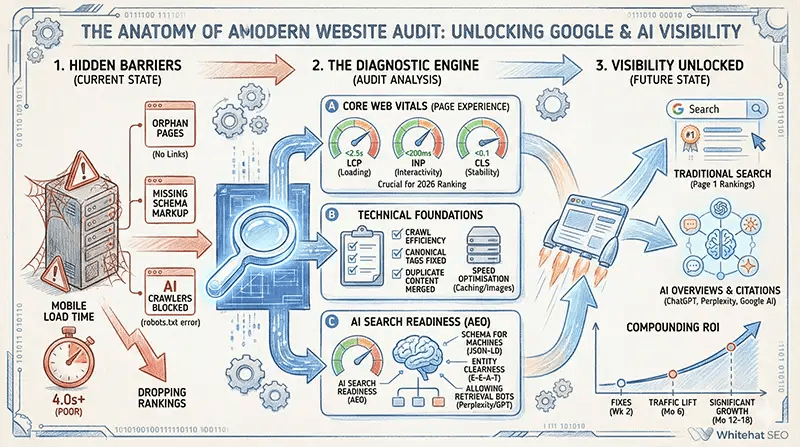
According to a study of over one million domains by Ahrefs, 80.4% of websites have missing image alt attributes, 72.9% have missing meta descriptions and 72.3% have slow-loading pages. These issues accumulate to create significant ranking barriers that only a structured audit can identify and prioritise.
Key Takeaway
A website audit examines 200+ ranking factors across technical SEO, content quality and AI search readiness. With 80.4% of websites missing image alt attributes and 52% failing Core Web Vitals, most UK B2B sites have fixable issues blocking their Google rankings.
Whitehat SEO's comprehensive website audit service examines over 200 ranking factors across technical SEO, content quality and competitive positioning, providing UK B2B companies with a clear diagnosis of ranking problems.
Why Core Web Vitals Matter More Than Ever
Core Web Vitals remain Google's primary page experience signals in 2026. The three metrics are Largest Contentful Paint (LCP) measuring loading speed, Interaction to Next Paint (INP) measuring responsiveness and Cumulative Layout Shift (CLS) measuring visual stability. INP officially replaced First Input Delay as a Core Web Vital in March 2024.
The HTTP Archive Web Almanac 2025 found that only 48% of mobile websites achieve good Core Web Vitals scores, meaning more than half of all sites fail Google's page experience requirements. Desktop performs slightly better at 56%. Research by HostingStep found that pages ranking at position one are 10% more likely to pass Core Web Vitals than URLs at position nine.
The current thresholds remain unchanged: LCP must be under 2.5 seconds, INP under 200 milliseconds and CLS below 0.1. Whitehat SEO's audits measure your actual field data from Chrome User Experience Report (CrUX) rather than lab tests, giving you the real-world performance metrics Google uses for rankings.
| Metric | Good | Poor |
|---|---|---|
| LCP (Loading) | ≤2.5 seconds | >4.0 seconds |
| INP (Interactivity) | ≤200ms | >500ms |
| CLS (Stability) | ≤0.1 | >0.25 |
48%
Mobile CWV Pass Rate
HTTP Archive 2025
8.4%
Conversion Lift
Per 0.1s speed gain
3×
Conversion Rate
1s vs 5s load time
Sources: HTTP Archive Web Almanac 2025, Portent Conversion Research 2024
How Page Speed Affects Your Rankings and Revenue
Page speed directly impacts both search rankings and conversion rates. Google CrUX data shows the average UK website loads in 1.9 seconds on mobile and 1.7 seconds on desktop. The average page speed of a first-page Google result is 1.65 seconds according to Backlinko research.
The revenue impact is substantial. A Google and Deloitte study of 20.5 million user sessions found that a 0.1-second improvement in site speed increases conversions by 8.4% and average order value by 9.2%. Research by Portent across 100 million pageviews showed B2B sites loading in one second convert at three times the rate of sites loading in five seconds.
Bounce rates climb dramatically with slower speeds. Google's SOASTA research established that going from one second to three seconds increases bounce probability by 32%, while one to five seconds increases it by 90%. The BBC's lead technical architect Matthew Clark stated that for every additional second a page takes to load, 10% of users leave.
Whitehat SEO's technical SEO services address performance issues including image optimisation, code minification, server configuration and caching strategies that improve load times.
What Google's 2025 Algorithm Updates Changed
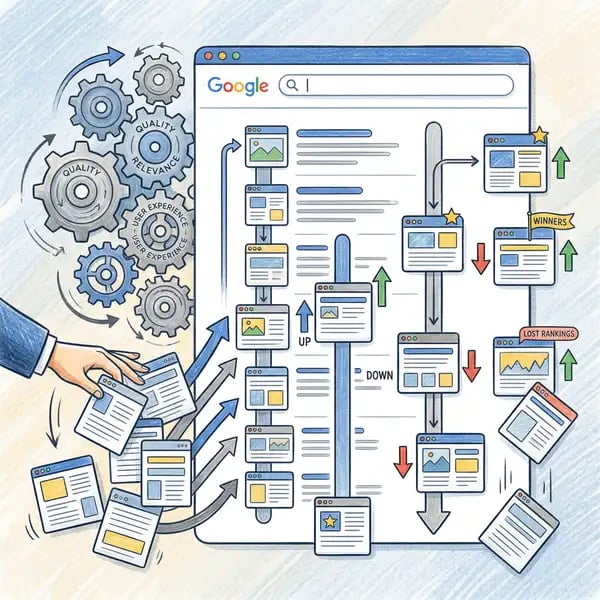
Google launched four confirmed algorithmic updates in 2025: three core updates (March, June and December) plus one spam update in August. The December 2025 core update was the largest and most impactful of the year, completing its rollout on 29 December.
Analysis by Amsive found that Wikipedia lost over 435 visibility points during the December update, making it the biggest loser, while e-commerce and retail brands were the biggest winners. Dataslayer's analysis revealed that sites with LCP above three seconds experienced 23% more traffic loss than faster competitors.
E-E-A-T (Experience, Expertise, Authoritativeness, Trustworthiness) requirements expanded beyond traditional YMYL topics into e-commerce, affiliate sites, SaaS and media verticals. Google's Quality Rater Guidelines were updated twice in 2025, adding formal definitions for AI-generated content evaluation and expanding YMYL definitions to include elections and institutions.
Google's Danny Sullivan confirmed that "Good SEO is good GEO" (Generative Engine Optimisation), meaning traditional SEO best practices remain the foundation for appearing in AI-generated search results.
Common Technical Issues Found in Website Audits
Semrush's study of over 50,000 domains identified the most prevalent technical SEO problems. Orphan pages with no internal links pointing to them affect 69% of websites, effectively hiding content from both Google and users. Duplicate content appears on 50% of sites, diluting ranking signals across multiple URLs.
Other frequent issues include:
- Missing or duplicate title tags affecting crawl efficiency
- Broken internal links disrupting site architecture
- Incorrect canonical tags confusing Google about preferred URLs
- Missing hreflang implementation (67% of sites using hreflang have errors)
- Slow server response times above the 200ms target
Google rewrites meta descriptions 62.78% of the time according to Ahrefs data, but this typically indicates poor meta description quality rather than a reason to ignore them. Well-written descriptions with clear value propositions are more likely to be retained.
Discover exactly what's holding your rankings back with a comprehensive website audit from Whitehat SEO.
View Website Audit ServiceHow AI Search Is Changing What Audits Must Include
The rise of AI search engines fundamentally changes what a comprehensive website audit must examine. ChatGPT has 800 million weekly active users and drives 77.97% of all AI referral traffic. Perplexity processes 780 million queries monthly, a 239% increase from August 2024. Google AI Overviews now appear in approximately 12.5% of UK searches.
The traffic impact is significant. BrightEdge found that while Google search impressions increased 49% year-on-year, click-through rates dropped approximately 30% due to AI Overviews answering queries directly. Ahrefs measured a 34.5% CTR decline at position one when AI Overviews appear.
However, brands cited in AI Overviews earn 35% more organic clicks and 91% more paid clicks according to recent research. Being visible in AI answers appears to boost rather than diminish traffic for cited sources. Whitehat SEO's Answer Engine Optimisation service helps UK B2B companies structure content for AI citation.
A 2026 audit must now include:
- AI crawler access verification in robots.txt
- Content structure assessment for AI extraction
- Brand visibility analysis across ChatGPT, Perplexity and Google AI
- Schema markup implementation for machine comprehension
Managing AI Crawlers: What Your Robots.txt Should Allow
A growing ecosystem of AI crawlers now visits websites alongside traditional search engine bots. The critical distinction is between training crawlers (which scrape content for model training with no traffic return) and search/retrieval crawlers (which can send referral traffic when they cite your content).
Dark Visitors' November 2025 report found that 29% of top websites block AI data scrapers, 23% block AI search crawlers and 18% block AI assistants. However, blocking retrieval crawlers like PerplexityBot prevents your site appearing in those AI search answers.
The recommended approach for B2B companies seeking visibility:
| Crawler | Platform | Recommendation |
|---|---|---|
| GPTBot | OpenAI (training) | Block or Allow |
| ChatGPT-User | ChatGPT search | Allow |
| PerplexityBot | Perplexity AI | Allow |
| Google-Extended | Gemini training | Block or Allow |
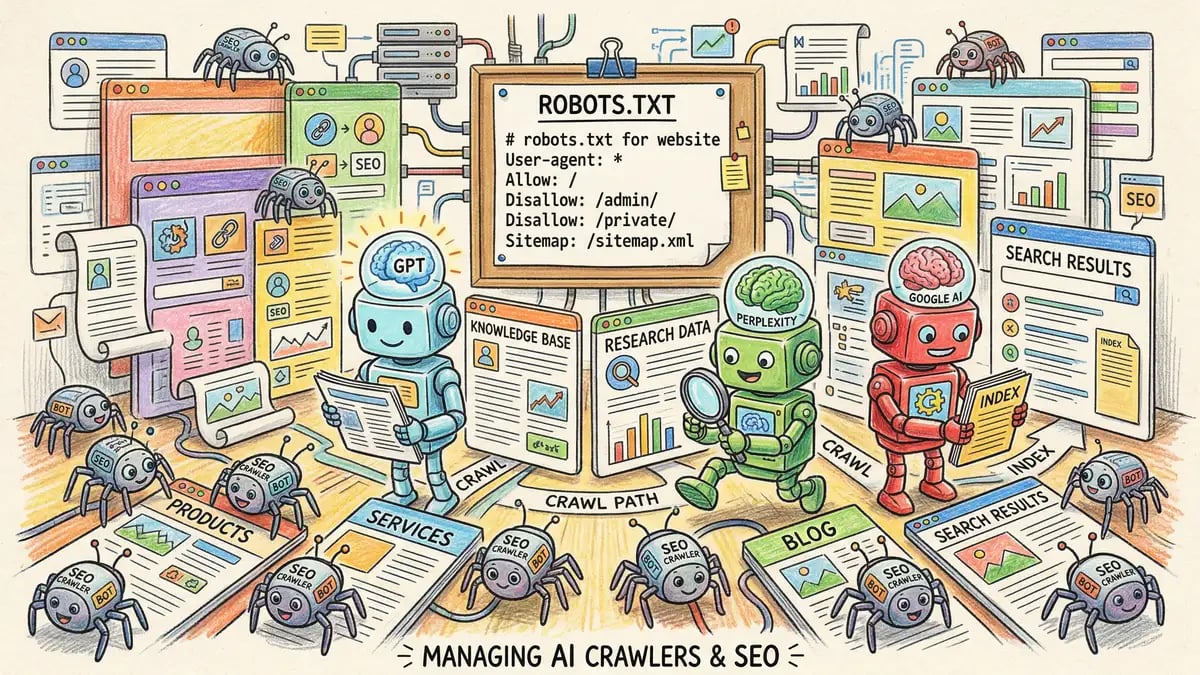
Crucially, Googlebot crawls for both search indexing and AI features (AI Overviews), creating a dilemma for publishers who cannot block AI training without affecting search visibility.
Why Schema Markup Gives You a Ranking Advantage
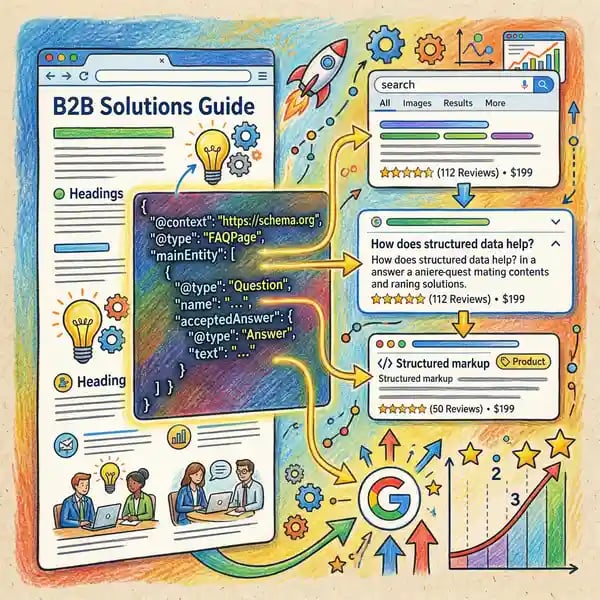
Schema markup helps search engines and AI systems understand your content's meaning, not just its text. W3Techs data from February 2026 shows JSON-LD is used by 52.7% of all websites, making it the dominant structured data format. However, only 21.6% of websites use no structured data whatsoever, meaning many competitors have already implemented schema.
The ranking correlation is clear: 72.6% of pages on the first page of Google use schema markup according to Backlinko research. Users click on rich results 58% of the time compared to 41% for non-rich results. FAQ rich results achieve an average click-through rate of 87% where they appear.
For B2B service businesses, the most important schema types include Organisation (establishing entity identity), LocalBusiness (critical for local visibility), FAQPage (supporting voice search and AI extraction), Service (describing offerings) and Article (essential for content marketing with author attribution).
Microsoft Bing's Fabrice Canel confirmed at SMX Munich that schema markup helps Microsoft's large language models understand content, reinforcing its importance for AI search visibility.
How Much Does a Website Audit Cost in the UK?
Website audit costs in the UK vary significantly based on scope and provider. A basic technical audit from a freelancer typically costs £300 to £1,000. A comprehensive SEO audit covering technical factors, content quality, backlink analysis and competitor benchmarking ranges from £1,000 to £5,000. Enterprise-level audits for large websites with multiple subdomains can exceed £10,000.
Whitehat SEO's website audit pricing reflects the depth of analysis provided, including actionable recommendations prioritised by impact. The investment typically pays for itself quickly when critical issues blocking rankings are identified and resolved.
When evaluating audit providers, consider whether they include AI search visibility assessment, competitor citation analysis and clear implementation roadmaps alongside traditional technical SEO checks.
How Long Before You See Results After Fixing Audit Issues?
Timeline expectations should be realistic. Ranking movement can begin within one to two weeks of implementing technical fixes, though significant traffic improvements typically appear within six months. Recovery from core algorithm updates takes two to six months for most sites and six to twelve months for YMYL content.
Google's updated December 2025 documentation states that you do not necessarily have to wait for a major core update to see the effect of improvements, as they continually update search algorithms including smaller core updates.
An internal study by Incremys of 80 US e-commerce sites documented SEO ROI progression: 0.8x at six months, 2.6x at twelve months, 3.8x at eighteen months and 5.2x beyond 36 months. This demonstrates the compounding nature of SEO improvements over time.
Regular audits can boost organic traffic by as much as 61% and reduce bounce rates by up to 50% according to SEOmator research. Whitehat SEO recommends comprehensive audits at least quarterly, with continuous automated monitoring for technical regressions.
What UK B2B Companies Should Prioritise First
For UK B2B companies, search visibility during the research phase is commercially critical. Research shows that 71% of UK B2B buyers start their journey with a Google search and 57% of the buying journey is completed before contacting any vendor. Crucially, 95% of the time the winning vendor is already on the buyer's Day One shortlist.
The priority sequence for most UK B2B websites should be:
- Core Web Vitals and mobile performance affecting all rankings
- Technical crawlability issues blocking content from indexing
- Content quality and E-E-A-T signals demonstrating expertise
- Internal linking architecture distributing authority
- AI search optimisation for emerging answer engines
B2B SaaS companies see an average SEO ROI of 702% over three years with break-even at seven months according to First Page Sage research. Organic search generates 44.6% of all B2B revenue according to BrightEdge data.
What Expert Opinion Says About SEO in 2026
Google's John Mueller confirmed in November 2025 that "Consistency is the biggest technical SEO factor", emphasising that maintaining technical excellence matters more than chasing individual ranking factors. On Core Web Vitals, he stated they are "a ranking factor, and more than a tie-breaker, but also don't replace relevance".
Google's Gary Illyes addressed AI search directly: "To get your content to appear in AI Overview, simply use normal SEO practices. You don't need GEO, LLMO or anything else." He confirmed Google does not support LLMs.txt and is not planning to implement it.
Industry expert Lily Ray from Amsive advised that "The smartest move right now isn't to choose AEO/GEO over SEO, but to double down on a user-focused approach that serves both." This reinforces that quality content optimised for users naturally performs well across traditional and AI search.
UK SEO consultant Barry Adams stated that "To optimise for AI without SEO is like building a castle on quicksand", emphasising that technical foundations must be solid before pursuing AI visibility.
Next Steps: Getting Your Website Audited
If your website rankings have dropped or you have never had a comprehensive audit, the technical issues accumulating on your site could be costing you significant revenue. The data is clear: half of websites fail Core Web Vitals, 69% have orphan pages invisible to search engines and most lack the AI-optimised structure needed for 2026 search.
Whitehat SEO's website audit service provides UK B2B companies with a complete diagnosis of ranking problems, prioritised recommendations and a clear implementation roadmap. As a HubSpot Diamond Partner, we integrate audit findings with your marketing technology stack for measurable revenue attribution.
Contact Whitehat SEO to discuss your website's performance and identify the specific issues preventing your rankings from improving.
Frequently Asked Questions
How much does a website audit cost in the UK?
A basic technical audit costs £300 to £1,000 from freelancers. Comprehensive SEO audits covering technical, content and competitive analysis range from £1,000 to £5,000. Enterprise audits for large sites with multiple subdomains can exceed £10,000.
How long does a website audit take?
A thorough website audit typically takes one to two weeks depending on site size and complexity. Basic technical audits can be completed in a few days, while comprehensive audits examining content quality, competitor positioning and AI readiness require more time.
What is the difference between a technical audit and a full SEO audit?
A technical audit examines site infrastructure including speed, crawlability, indexing and mobile experience. A full SEO audit adds content quality assessment, keyword analysis, backlink evaluation, competitor benchmarking and now AI search visibility analysis.
How often should I audit my website?
Comprehensive audits should be conducted at least quarterly, with continuous automated monitoring for technical issues between audits. Major site changes, traffic drops or Google algorithm updates warrant immediate auditing.
Why did my rankings drop suddenly?
Sudden ranking drops typically result from Google algorithm updates, technical issues like accidentally noindexed pages, server problems, manual actions, or competitors improving their content. A website audit identifies the specific cause and provides a recovery plan.
Do Core Web Vitals really affect rankings?
Yes, but they are one factor among many. Google's John Mueller confirmed Core Web Vitals are "a ranking factor, and more than a tie-breaker, but also don't replace relevance". Sites with LCP above three seconds lost 23% more traffic during the December 2025 update.
How do I know if my site appears in AI search results?
Search for queries related to your business in ChatGPT, Perplexity and Google AI Mode to see if your brand is cited. Tools like Profound and Averi track AI citation presence. Ensuring AI crawlers can access your content via robots.txt is the essential first step. view our pricing
Is Your Website Losing Rankings You Can't Explain?
Whitehat SEO's technical audits examine 200+ ranking factors across technical infrastructure, content quality and AI visibility — giving UK B2B companies a clear diagnosis and prioritised fix roadmap.
Clwyd Probert
CEO & Founder, Whitehat SEO
Clwyd Probert founded Whitehat SEO in 2011 and has led the agency to HubSpot Diamond Solutions Partner status. He specialises in technical SEO audits, AI search optimisation and revenue attribution for UK B2B companies with £5M–£100M turnover.
References
- Ahrefs. (2024). 124 SEO Statistics for 2024.
- Google Search Central. (2025). Understanding Core Web Vitals and Google search results.
- HTTP Archive. (2026). Web Almanac 2025: Performance.
- Portent. (2024). Site Speed is (Still) Impacting Your Conversion Rate.
- Search Engine Land. (2026). Google algorithm updates 2025 in review.
- Semrush. (2025). 11 Most Common On-Site SEO Mistakes.
- Dark Visitors. (2025). AI & Bot Traffic Trends - November 2025.
- W3Techs. (2026). Usage statistics of structured data formats for websites.
- SE Ranking. (2025). AI Traffic in 2025: Comparing ChatGPT, Perplexity & Other Top Platforms.
- Exposure Ninja. (2026). AI Search Statistics for 2026.