
AEO & GEO Strategy
AI search has crossed the tipping point for UK B2B brands. ChatGPT now reaches 800–900 million weekly active users, processing over 2.5 billion prompts per day. For context, that's more referral traffic than Reddit and LinkedIn combined—and 66% of UK B2B decision-makers now use AI tools to research and evaluate suppliers, according to research from Magenta Associates.
AI Search Optimisation in 2026: The Complete AEO and GEO Guide for UK B2B Brands
With 800+ million weekly ChatGPT users and AI-referred visitors converting at 4.4× the rate of traditional organic traffic, the question is no longer whether to invest in Answer Engine Optimisation—it's how fast you can move.
The landscape has shifted dramatically even in the past three months. Google's Gemini 3 now powers AI Overviews globally, ChatGPT has introduced advertising and shopping features, and a new generation of AI visibility tools has emerged. Meanwhile, the conversion story is where AI search becomes truly compelling: AI-referred visitors convert at 4.4× the rate of traditional organic traffic.
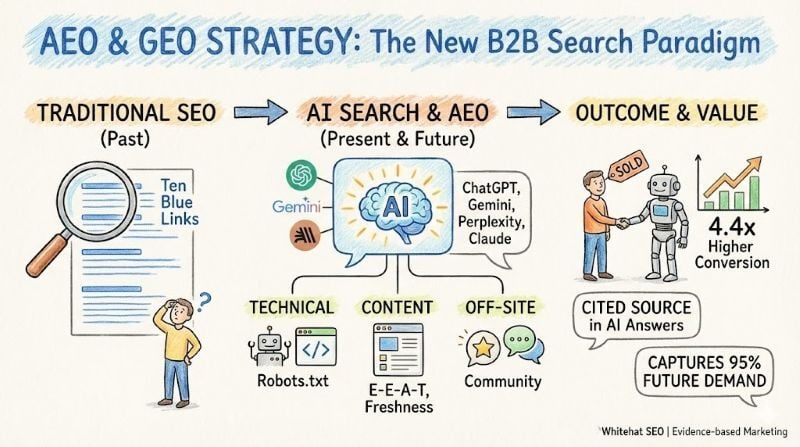
This guide synthesises the latest intelligence from February 2026 onwards—covering statistics, platform changes, technical requirements, strategic shifts, and UK-specific dynamics—to ensure your Answer Engine Optimisation strategy reflects the most current best practices available.
The Numbers That Define AI Search in 2026
ChatGPT's growth trajectory has been extraordinary. Weekly active users doubled from 400 million in February 2025 to 800–900 million by early 2026, with 5.72 billion monthly visits recorded in January 2026—making it the 4th–5th most visited website globally. OpenAI processes over 2.5 billion prompts per day, and 31% of ChatGPT queries now trigger an active web search, rising to 59% for local-intent queries.
ChatGPT commands 80–82% market share of AI chatbot referral traffic, followed distantly by Google Gemini (450 million monthly users), Perplexity (~45 million), and Claude (~20 million).
800M+
Weekly ChatGPT Users
4.4×
Higher Conversion Rate
527%
YoY Traffic Growth
66%
UK B2B Buyers Using AI
Conversion Rates by Platform
The conversion story is where AI search becomes compelling for B2B marketers. Multiple studies converge on the finding that AI-referred visitors convert significantly better than traditional organic traffic:
| Platform | Conversion Rate | vs Google Organic |
|---|---|---|
| ChatGPT | 15.9% | +9× higher |
| Perplexity | 10.5% | +6× higher |
| Claude | 5.0% | +2.8× higher |
| Google Gemini | 3.0% | +1.7× higher |
| Google Organic (baseline) | 1.76% | — |
Source: Seer Interactive, Adobe Analytics, Semrush (2025–2026)
The Zero-Click Challenge
The zero-click challenge is real and growing. Searches triggering AI Overviews show an average zero-click rate of 83%, compared to 60% for traditional queries. Google's AI Mode is even more severe: 93% of sessions end without a click.
However, brands cited within AI Overviews earn 35% more organic clicks and 91% more paid clicks—making citation itself the new visibility currency. This underscores why integrated SEO and AEO strategies are essential.
Platform Updates Reshaping the Battlefield
Each major AI platform has evolved significantly in 2026, with distinct implications for your optimisation strategy.
ChatGPT Search
GPT-5.2 replaced all previous models as the default on 13 February 2026, with legacy models retired entirely. OpenAI introduced advertising for free-tier users and launched a Shopping Research Mode for product comparisons and personalised recommendations.
Critical for AEO: ChatGPT can now be set as the default search engine in Safari, and citation behaviour shows 44.2% of citations come from the first 30% of page content. Front-loading your key messages matters enormously.
Crawler: GPTBot — must be allowed in robots.txt
Google AI Overviews / AI Mode
Gemini 3 became the default model globally on 27 January 2026. AI Overviews now appear in approximately 25% of Google searches (up from 13% in March 2025), with the average overview citing 11.4 source links—nearly double 2024's figure.
Citation volatility: AI Overview content changes 70% of the time for identical queries, with 45.5% of citations replaced each time. Consistent, high-quality content is essential for maintaining visibility.
Crawler: Google-Extended — separate from Googlebot
Perplexity AI
Perplexity launched Perplexity Computer on 25 February 2026—a unified AI system orchestrating tasks across 19 AI models simultaneously. The company reached $200 million ARR and abandoned advertising in favour of subscription-only access.
Most citation-generous: Perplexity provides approximately 21+ citations per answer—nearly 3× ChatGPT's average. Educational content is prioritised.
Crawler: PerplexityBot
Claude (Anthropic)
Opus 4.6 released on 5 February 2026, achieving the highest BrowseComp score (61.6%)—the benchmark for finding hard-to-find information online. A Dynamic Filtering upgrade delivers 11% accuracy gains while consuming 24% fewer tokens.
Distinctive signal: Claude shows the lowest SERP dependency among major platforms (55/100), meaning it trusts its own analysis more than traditional rankings. Quality and depth matter more here than position.
Crawler: Claude-Web
Technical Implementation: Non-Negotiable Requirements
⚠️ Critical Finding
ChatGPT, Claude, and Perplexity crawlers do not execute JavaScript. If your site relies on React, Vue, or Angular SPAs without server-side rendering, your content is effectively invisible to three of the four major AI search platforms. Only Google's Gemini crawler can process JavaScript.
AI Crawler Access (robots.txt)
AI platforms use dedicated crawlers to index content. Your robots.txt must explicitly allow them:
User-agent: GPTBot
Allow: /

User-agent: Google-Extended
Allow: /

User-agent: Claude-Web
Allow: /

User-agent: PerplexityBot
Allow: /
Firewall Configuration
Web application firewalls (Cloudflare, Sucuri, etc.) increasingly block AI bots by default. If using Cloudflare, navigate to Security → Bots and either disable "Block AI Bots" or whitelist specific AI user agents. Check server logs for 403 errors from AI crawler user agents.
Semantic HTML Structure
AI crawlers parse HTML structure to understand content hierarchy. Use semantic tags—<article>, <main>, <section>, <aside>—rather than generic <div> wrappers.
Avoid: Content hidden behind JavaScript execution, infinite scroll without static HTML fallbacks, full-screen popups on page load, and content behind "Read More" buttons or tabs.
For a comprehensive technical assessment, our website audit service includes AI crawler accessibility analysis.
Content Structure and E-E-A-T Signals
E-E-A-T signals have become directly measurable in AI citation data. A study of 11,882 prompts across ChatGPT Search, Google AI Mode, and Perplexity found that E-E-A-T signals delivered a +30.64% improvement in citation rates.
3×
More likely to appear in AI answers with author schema
1.9×
More citations for pages updated within 60 days
76.4%
Of ChatGPT's most-cited pages updated in last 30 days
Off-Site Authority: The 90/10 Reality
This represents a fundamental inversion of traditional SEO logic. Brands are 6.5× more likely to be cited through third-party sources than their own domains. User-generated content now accounts for 21.74% of all AI citations, and Reddit citations in AI Overviews surged 450% in three months.
Your off-site presence strategy should include:
- Review platforms: G2, Capterra, Trustpilot—actively manage and respond to reviews
- Community participation: Reddit, relevant LinkedIn groups, industry forums
- Guest content: Authoritative industry publications and partner sites
- Case studies: Published on client and partner websites with consistent brand messaging
Content Structure Best Practices
ChatGPT preferentially cites content that uses definite language, contains question marks in headers, maintains high entity density, balances facts with opinions, and employs simple writing structures.
Research from Princeton demonstrated that adding statistics to content improves visibility by up to 41%, while adding quotations from authorities improves subjective impression by 28%. For detailed guidance, see our content marketing strategies guide.
The UK Market: A Critical Inflection Point
UK AI adoption sits at 38.9% of citizens, placing the country joint 8th globally. ChatGPT's UK monthly audience reached 16 million by September 2025, with the fastest growth among 35–54 year-olds (+49% over six months) and 44% of AI tool usage occurring during working hours.
UK B2B Adoption Data
The landmark Magenta Associates study of 300 UK senior professionals with B2B purchasing responsibilities revealed compelling adoption patterns:
- 66% use AI tools to research and evaluate suppliers
- 90% trust the recommendations these systems provide
- 45% cite AI as one of their main supplier research methods—ahead of LinkedIn (41%) and industry publications (34%)
- 85% of 25–34 year-olds use AI for supplier research, dropping to just 23% of 55–64 year-olds
Forrester's data shows B2B buyers adopting AI-powered search at 3× the rate of consumers, with 89% using generative AI somewhere in their procurement cycle.
UK Market Opportunity
Only 11% of UK companies claim 75–100% of their content is AI-discovery ready—creating a massive gap between buyer behaviour and brand preparedness. Early movers have a significant first-mover advantage.
UK Regulatory Landscape
The UK has no horizontal AI regulation equivalent to the EU AI Act, but the Data (Use and Access) Act 2025 mandates an economic impact assessment of AI copyright policy by 18 March 2026. If licensing becomes mandatory, AI systems may preferentially surface openly accessible, well-structured content—potentially benefiting brands that have invested early in AEO.
Strategic Recommendations for UK B2B Brands
The GEO services market is valued at $848 million in 2025, projected to reach $33.7 billion by 2034 at a 50.5% CAGR. AI search advertising spend is expected to grow from $1 billion in 2025 to $26 billion by 2029. Here's how to position your brand for success.
1. Audit Your Technical Foundation
Check robots.txt for AI crawler access, verify your WAF isn't blocking AI user agents, and test your site with JavaScript disabled. If critical content doesn't appear in raw HTML, AI crawlers cannot see it. View page source—what you see there is what AI sees.
2. Restructure Content for AI Extraction
Front-load your key messages—44% of ChatGPT citations come from the first 30% of page content. Use question-based headers, maintain clear heading hierarchy, and ensure each section can stand alone. Sections should be 120–180 words with high entity density.
3. Build Off-Site Authority Systematically
With brands 6.5× more likely to be cited through third-party sources, your off-site presence is critical. Actively manage review platforms, participate in relevant communities, contribute to industry publications, and ensure consistent brand messaging across all touchpoints.
4. Implement AI Visibility Tracking
New KPIs for 2026 include Citation Share, Brand Mention Frequency, AI Referral Conversion Rate, and Sentiment Score across AI platforms. Tools like Otterly.AI, Profound, Ahrefs Brand Radar, and Semrush's AI visibility modules can help track performance systematically.
5. Maintain Content Freshness
AI systems automatically append "2026" to 28.1% of sub-queries, systematically biasing retrieval toward recently updated content. Pages updated within 60 days are 1.9× more likely to be cited. Schedule regular content audits and updates—freshness signals matter more than ever.
Frequently Asked Questions
What is Answer Engine Optimisation (AEO)?
Answer Engine Optimisation is the practice of optimising content and brand signals so AI tools like ChatGPT, Google AI Overviews, Perplexity, and Claude can cite and recommend your brand when answering user questions. Unlike traditional SEO targeting page-one rankings, AEO focuses on becoming the source AI systems trust and quote directly in their responses.
Does AEO replace SEO?
No—AEO expands your organic strategy beyond "ten blue links." SEO still captures demand and builds authority, while AEO ensures your expertise is quotable and citable inside AI answers. The tactics overlap significantly, and content optimised for AEO generally performs well in traditional SEO because it's well-structured and provides direct answers.
How long does it take to see results from AEO?
Technical fixes like schema markup and AI crawler access can impact visibility within 2–4 weeks. Content restructuring typically shows measurable citation improvements within 60–90 days. Comprehensive AEO strategies often deliver 25–40% lifts in AI answer share-of-voice within the first 60 days of implementation.
Why do AI-referred visitors convert better?
AI-sourced visitors arrive with clearer intent and pre-qualification from AI interactions. They've already received a recommendation for your brand before clicking through, creating higher engagement and trust. Adobe found AI referrals have a 23% lower bounce rate and generate 41% longer sessions compared to traditional organic traffic.
What if I'm using a JavaScript framework like React or Vue?
ChatGPT, Claude, and Perplexity crawlers cannot execute JavaScript. If your site relies on client-side rendering without server-side rendering (SSR) or static site generation (SSG), your content is invisible to three of the four major AI search platforms. Implement SSR, SSG, or pre-rendering to ensure AI crawlers can access your content.
References & Citations
- TechCrunch (2025). "Sam Altman says ChatGPT has hit 800M weekly active users"
- DemandSage (2026). "ChatGPT Users Statistics February 2026 – Growth & Usage Data"
- Magenta Associates (2025). "Search Forward: How AI is Reshaping the B2B Buyer Journey"
- Procurement Magazine (2025). "Why AI Adoption is Surging Among B2B Buyers"
- FatJoe (2026). "ChatGPT Stats Feb 2026 – Usage, Market Share, and More"
- Superlines (2026). "ChatGPT Statistics 2026"
- SEOProfy (2026). "ChatGPT Users Statistics 2026: Insights and Market Influence"
- SociallyIn (2026). "OpenAI ChatGPT Statistics 2026: The Definitive Data"