
Marketing attribution is the process of identifying which marketing activities drive revenue — and only 52% of CMOs can prove marketing's value to their business, according to Gartner's 2024 Marketing Analytics Survey. With UK marketing budgets flat at 7.7% of revenue and the average B2B customer journey spanning 76 touchpoints over 211 days across 13 stakeholders, CEOs need a practical framework for understanding what marketing spend actually produces. This guide from Whitehat SEO translates attribution from marketing jargon into business language — covering the models that matter, the metrics your board should see, what good attribution costs, and how to build a measurement framework that connects marketing activity to closed revenue.
The Attribution Crisis: Why CEOs Cannot Answer "Is Marketing Working?"
Marketing has a credibility problem — and the data confirms it. Gartner's 2024 Marketing Analytics Survey (n=378 senior marketing leaders) found that only 52% of CMOs successfully proved marketing's value to their organisation. The same survey identified CFOs (40%) and CEOs (39%) as the executives most sceptical of marketing's contribution. When 47% of CMOs report that marketing is viewed as an expense rather than a strategic investment (Gartner 2024 CMO Spend Survey), the attribution gap becomes a boardroom problem — not a marketing department problem.
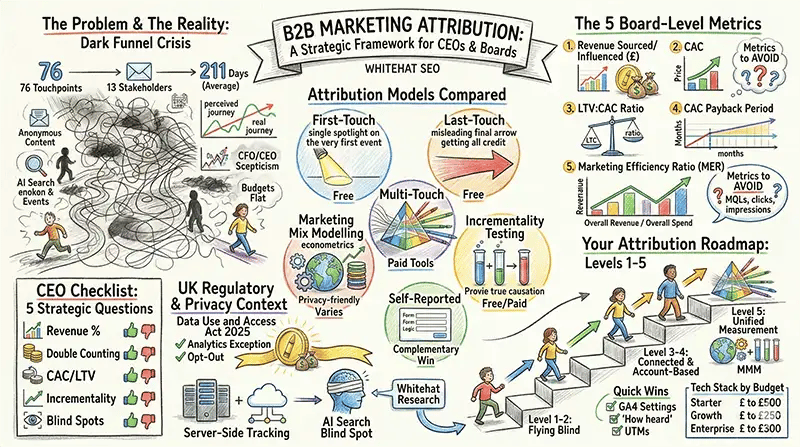
The UK picture is particularly stark. The Marketing Week Language of Effectiveness Survey (n=1,610 brand-side UK marketers, 2022) found that only 28.4% of marketers always measure ROI of their campaigns — yet 48.4% said ROI is the most important metric for their CEO, CFO, and board. CMO tenure has fallen to 4.1 years (Spencer Stuart 2025), versus 7.6 years for CEOs — and 31% of S&P 500 companies have eliminated the CMO role entirely. When marketing cannot prove its value, budgets get cut: UK marketing budgets fell for the first time in four years in Q1 2025 (IPA Bellwether, net balance -4.8%), and global budgets have flatlined at 7.7% of revenue, down from 11% pre-pandemic (Gartner 2025).
52%
of CMOs can prove marketing's value (Gartner 2024)
7.7%
Marketing budget as % of revenue — down from 11% pre-pandemic
4.1 yrs
Average CMO tenure — shortest named C-suite role (Spencer Stuart 2025)
The Dark Funnel: Most of the B2B Journey Is Invisible to Analytics
The attribution crisis is not caused by poor marketing teams — it is caused by the reality of how B2B buying actually works. The MarketOne/6sense 2025 B2B Buyer Experience Study (n=754 UK and Ireland buyers) found that UK/Ireland B2B buyers complete 57% of their journey before any vendor contact, with average deal sizes of £320,000 and 10+ stakeholders involved. Globally, 97% of B2B website traffic is anonymous — fewer than 3% self-identify through a form fill (6sense/Unbounce 2023).
Dreamdata's 2025 B2B Benchmarks Report found the average B2B customer journey now involves 76 touchpoints across 3.7 channels, involving 6.8 stakeholders, over 211 days — up from 62 touchpoints over 192 days in 2023. Forrester found that B2B buying committees now average 13 stakeholders across multiple departments, up from approximately five a decade ago. Yet most CRM systems — including HubSpot and Salesforce — are fundamentally contact-based, not account-based. When 13 people from one company independently research your product, the CRM sees 13 separate journeys rather than one buying committee converging on a decision.
76
Average touchpoints per B2B customer journey (Dreamdata 2025)
211
Average days from first touch to deal close (Dreamdata 2025)
90%
Measurement gap between software attribution and self-reported sources (Refine Labs)
Attribution Models Explained: A Non-Technical Guide for Business Leaders
There are nine attribution models in common use — each with different strengths, costs, and blind spots. You do not need to understand the mathematics behind each model. You do need to understand what each one measures, what it misses, and what it costs — so you can ask your marketing team the right questions.
An important context first: Google Analytics 4 (GA4) removed first-click, linear, time-decay, and position-based models in November 2023, making data-driven attribution the only cross-channel model available in the free platform. Several models now require paid tools like HubSpot Enterprise or Adobe to implement.
1. First-Touch Attribution
All credit goes to the first interaction — the discovery moment. Best for measuring brand awareness and simple, short sales cycles. Free in GA4 and HubSpot (all tiers). However, in B2B with 76+ touchpoints, first-touch attribution misses the vast majority of the buying journey. 53.5% of marketers rate single-touch models as only "somewhat effective" (Ruler Analytics).
Cost: Free | Best for: Brand awareness, short sales cycles
2. Last-Touch Attribution
All credit goes to the final interaction before conversion. Used by 41% of marketers as their primary attribution method (Digiday). In B2B, last-touch systematically inflates paid search ROI and deflates content and brand ROI — because the "last click" is often a branded Google search after months of invisible influence. Refine Labs found a 90% gap between last-touch software attribution and self-reported customer data across 40+ SaaS companies.
Cost: Free | Best for: E-commerce, bottom-of-funnel optimisation
3. Multi-Touch Attribution (Algorithmic / Data-Driven)
AI and machine learning analyse all converting and non-converting paths to assign credit based on each touchpoint's actual statistical contribution — no predetermined rules. GA4 made data-driven attribution the default for all users. Algorithmic approaches held 34.25% of the multi-touch attribution market share in 2025 (Mordor Intelligence). The highest accuracy among digital attribution methods, but still limited to trackable digital interactions and susceptible to platform bias.
Cost: Free (GA4) to £79K+/yr (enterprise) | Best for: Data-rich organisations with significant digital traffic
4. Marketing Mix Modelling (MMM)
An econometric approach using aggregate historical data to estimate each channel's impact on revenue, without individual-level tracking. Experiencing a major resurgence: 67% of marketing leaders plan to increase MMM investment in the next two years (Gartner 2024). Privacy-friendly because it uses no personal data. Free open-source options include Meta's Robyn and Google's Meridian (launched February 2025). Businesses using MMM are 30% more likely to achieve sustained growth (Gartner 2024). Requires 2-3 years of historical data and data science capability.
Cost: Free (open-source) to £400K+/yr (enterprise) | Best for: Large advertisers with £400K+ ad spend
5. Incrementality Testing
Controlled experiments splitting audiences into exposed and unexposed groups to measure the true causal impact of marketing — like a clinical trial for your budget. 52% of US marketers already use incrementality testing (eMarketer/TransUnion, July 2025). The only approach that establishes true causation rather than correlation. Free platform-native tests available through Meta Conversion Lift and Google Ads experiments. Critical finding: retargeting often shows 8x ROAS but only 2x incremental ROAS.
Cost: Free (platform-native) to £8K+/mo (specialist) | Best for: Validating whether campaigns actually cause conversions
6. Self-Reported Attribution
Asking customers "How did you hear about us?" via a free-text field on high-intent conversion forms. Reveals critical blind spots that no software can detect. Refine Labs data across 40+ SaaS companies showed self-reported attribution revealed $14M ARR from LinkedIn, while multi-touch attribution software showed only $977K (93% lower). Essential complement to software-based attribution, particularly for companies investing heavily in content, social media, and answer engine optimisation. Subject to recency bias — buyers remember emotional or recent channels better than utilitarian ones.
Cost: Free | Best for: B2B companies investing in content, social, and brand
What Marketing Attribution Costs: A Practical Comparison
| Tier | Tools | Annual Cost |
|---|---|---|
| Free | GA4 (data-driven), Google Ads experiments, Meta lift tests, self-reported field | £0 |
| Mid-Range | HubSpot Professional (3 seats), Ruler Analytics, call tracking | ~£8,400 |
| Full Attribution | HubSpot Enterprise (5 seats, full revenue attribution suite) | ~£34,200 |
| Enterprise | Adobe Marketo Measure, Northbeam, HockeyStack, open-source MMM | £31K–£400K+ |
The Real Cost of Bad Attribution: What Misattribution Costs UK Businesses
Bad attribution does not just produce inaccurate reports — it causes companies to systematically invest in the wrong channels. Companies without proper attribution models misallocate up to 30% of their marketing budget (Digital Marketing Institute). For a typical B2B company with a £790K annual marketing budget, that represents approximately £237K in recoverable value per year — broken down as roughly £95K in misallocated media, £47K in redundant tools, £32K in lost analyst productivity, and £63K in missed optimisation opportunities (LayerFive 2025).
The headline numbers are sobering. UK advertising spend totalled £42.6 billion in 2024 (AA/WARC Expenditure Report), forecast to reach £45.2 billion in 2025 and £47.8 billion in 2026. Applying conservative international waste estimates (20-26% from Rakuten Marketing and McKinsey studies) yields an estimated £8.5 billion to £11 billion of UK marketing spend that is potentially wasted or poorly attributed annually. By contrast, Forrester found that spending on measurement — which represents only 0.2% of total marketing spending — can deliver 15-20% improvement in budget efficiency. For a UK company spending £1 million on marketing, that represents £150,000 to £200,000 in recoverable value annually.
30%
of budget misallocated without proper attribution (Digital Marketing Institute)
£8.5–11bn
Estimated UK marketing waste from poor attribution annually
15–20%
Budget efficiency improvement from proper measurement (Forrester)
The Branded Search Problem: Paying for Customers You Already Own
One of the most expensive attribution failures in B2B marketing is branded search cannibalisation. Incrementality testing by Haus (2025) found that only 30% of branded search conversions are truly incremental — meaning 70% of those conversions would have happened through organic search without paying for the click. Academic research confirms this: paid search advertising cannibalises approximately 37-38% of a brand's organic search traffic (Simonov and Hill 2019; Golden and Horton 2020, peer-reviewed). One branded Performance Max campaign was found to be paying for an estimated £395,000 in organic revenue the company already owned (Search Engine Land 2025).
The root cause is the 95-5 rule from the LinkedIn B2B Institute and the Ehrenberg-Bass Institute: only 5% of B2B buyers are in-market at any given time. Last-click attribution directs budget toward capturing this in-market 5% and systematically starves the brand-building that influences the other 95% — yet 78% of B2B buyers creating shortlists select products they already knew about before their research began (TrustRadius/LinkedIn B2B Institute). This is why holding your marketing agency accountable requires understanding what attribution can and cannot measure.
The Five Metrics Your Board Should See (and the Ones to Stop Reporting)
Research across Forrester, MarTech, and multiple CFO-focused sources converges on five metrics that belong in board-level marketing reporting. These are the metrics that translate marketing activity into business language. If your marketing reports feature impressions, click-through rates, or engagement rates instead of these five, attribution is either absent or disconnected from business outcomes.
1. Revenue Sourced and Influenced by Marketing (£)
How much revenue did marketing help create? Marketing-sourced pipeline typically represents 5-20% of total pipeline in enterprise B2B, yet marketing influences 60-75% of all deals (Forrester/SiriusDecisions). Mature B2B organisations should see 25-60% of pipeline as marketing-influenced. This single metric forces a connection between marketing activity and closed-won revenue.
2. Customer Acquisition Cost (CAC)
How much does it cost to acquire a new customer? The B2B SaaS average is approximately £555 (Benchmarkit 2025, n=323 B2B tech companies). The median New CAC Ratio is £1.58 of sales and marketing expense per £1 of new annual recurring revenue. This is the language your CFO speaks — connect every PPC campaign and content investment back to acquisition cost.
3. LTV:CAC Ratio
For every £1 spent acquiring a customer, how much lifetime value do they generate? The benchmark is a minimum of 3:1, with the median B2B SaaS ratio at 3.2:1 (Optifai, n=612 companies). Below 2:1 is unsustainable. Above 5:1 suggests the company is likely underinvesting in growth and leaving market share on the table.
4. CAC Payback Period
How many months does it take to recoup the cost of acquiring a customer? The median for private SaaS companies is approximately 23 months (KeyBanc 2024). Sub-12 months is excellent. This metric directly translates to cash flow and is one of the most intuitive for non-marketing board members to evaluate.
5. Marketing Efficiency Ratio (MER)
Total revenue divided by total marketing spend. No attribution complexity, no channel politics, no disputed methodology. Described as "the CFO's favourite metric" (MarTech 2025), MER provides a clean, top-level view of whether marketing spend is generating proportional returns. Track this ratio over time — a declining MER despite stable spend signals a measurement or effectiveness problem.
Metrics to Remove From Board Reports
Click-through rates, cost-per-click, impressions, social media engagement, MQLs (without pipeline connection), and email open rates. These are operational metrics for the marketing team to use in day-to-day optimisation. Presenting them to the board signals that marketing cannot connect its activities to revenue. As MarTech notes: "Executives don't interpret volume as rigour. They interpret it as noise."
Building Your Attribution Framework: A Practical Roadmap
Most companies sit at Level 1 or Level 2 of a five-level attribution maturity model, and that is not necessarily a problem. The goal is not to reach Level 5 immediately — it is to identify where you are today, implement quick wins that cost nothing, and build progressively toward a measurement framework that matches your business complexity. Only approximately 10% of companies reach the most advanced level (Adobe). The key insight: 74% of high-growth companies use multi-touch attribution compared with simpler models at slower-growing peers (Marketing LTB).
Level 1–2: Flying Blind / Getting Started
Basic lead counts by source with no pipeline connection. 43% of companies do not use attribution on most marketing activities (Econsultancy). CRM Lead Source field set to first-touch or last-touch only. GA4 configured but with default reports only.
Level 3–4: Connected / Sophisticated
Built-in attribution models active with multi-touch tracking. HubSpot contact attribution or Salesforce Campaign Influence connected to marketing platforms. Account-based attribution tracking multiple stakeholders with marketing-influenced revenue as the unifying metric.
Level 5: Unified Measurement
Triangulation of multi-touch attribution, marketing mix modelling, and incrementality testing. Predictive budget allocation and scenario planning with continuous optimisation loops. Only approximately 10% of companies reach this level (Adobe).
Quick Wins: What You Can Do This Month for Free
Three actions that cost nothing and can be implemented immediately. First, configure GA4 data-driven attribution (Admin, Data Display, Attribution Settings) and set lookback windows to 90 days for conversions — the maximum available, though still shorter than most B2B sales cycles. Second, add a mandatory "How did you hear about us?" free-text field to your demo and contact forms in HubSpot or any CRM — this single action captures dark funnel influence that no digital tracking can detect. Third, implement consistent UTM tagging on all marketing links using Google's Campaign URL Builder with standardised naming conventions across the entire team. This is the single highest-impact, zero-cost action for improving attribution data quality.
Mid-Term Improvements: 3–6 Months
In months one and two, focus on data hygiene: standardise campaign naming conventions, ensure bidirectional CRM-to-marketing platform sync, and install call tracking for phone-based B2B conversions (Ruler Analytics, a Liverpool-based UK provider, starts from £199 per month). In months two to four, move to multi-touch attribution — U-shaped for awareness focus, W-shaped for full-funnel measurement — and set up closed-loop reporting connecting marketing activity to lead, to opportunity, to closed-won deal. Consider upgrading to HubSpot Professional (approximately £700 per month) for multi-touch attribution reports. In months four to six, build attribution dashboards, establish a sales-marketing alignment cadence with shared metrics, and designate a marketing operations owner.
Attribution Tech Stack by Budget
| Budget Tier | Monthly Cost | Capability |
|---|---|---|
| Starter | £0–60 | Basic data-driven attribution, original source tracking, UTM tagging |
| Growth | £1,100–2,500 | Multi-touch reports, call tracking, closed-loop reporting |
| Enterprise | £5,000–15,000+ | Full attribution suite, account-based, MMM, incrementality testing |
The CEO's Attribution Cheat Sheet: Five Questions to Ask Your Marketing Team
You do not need to become an attribution expert. You need to know which questions to ask and what good answers look like. These five questions — drawn from research across Forrester, Gartner, and practitioner sources — will tell you whether your marketing team has a grip on measurement or is operating in the dark.
Q1: "What percentage of our revenue can marketing prove it influenced — and how do you calculate that?"
This forces a connection between activity and revenue. A good answer specifies marketing-sourced pipeline as a percentage and marketing-influenced revenue as a separate, larger percentage, measured through a named attribution model. Benchmark: 30-60% of pipeline should be marketing-influenced in mature B2B organisations (Forrester/SiriusDecisions).
Q2: "If I added up every channel's claimed conversions, would the total exceed our actual sales?"
Platform-reported conversions routinely exceed actual sales by 40-60% through double-counting (Cometly, Ruler Analytics). If marketing cannot reconcile this discrepancy, attribution is broken. Every ad platform independently claims full credit for the same conversion — Meta claims the impression, Google credits the click, LinkedIn logs the sponsored content.
Q3: "What is our CAC by channel, and how does it compare to customer lifetime value?"
This is the language CFOs speak. A good answer includes customer acquisition cost, LTV:CAC ratio (benchmark: 3:1 minimum), and CAC payback period (benchmark: under 23 months for SaaS) — broken down by channel. If marketing cannot produce these numbers, the attribution infrastructure is insufficient.
Q4: "If we turned off [specific channel] tomorrow, what would happen to pipeline in 90 days?"
This tests incrementality understanding. Many "high-performing" channels are capturing demand that would arrive anyway. Branded search is the clearest example: only 30% is truly incremental (Haus 2025). If your team cannot model the impact of removing a channel, they are reporting correlation rather than causation.
Q5: "What attribution model are we using, and what does it NOT capture?"
Every model has blind spots. CEOs should expect honesty about limitations, not confident-sounding precision from inherently imprecise tools. A good answer names the model, explains what it measures, and openly states what it misses — including offline interactions, word-of-mouth, AI search influence, and the 57% of the UK B2B journey that happens before any vendor contact.
Red Flags That Your Attribution Is Broken
Every channel claims 100% of revenue. If summing platform-reported conversions yields 150-200% of actual sales, multiple platforms are claiming the same conversion.
"Direct" traffic exceeds 25-30% of all sessions. Real direct traffic (typing a URL) rarely accounts for that volume. High "direct" usually means UTM parameters are missing or stripped by privacy tools.
Board reports feature only activity metrics. If impressions, clicks, and engagement rates dominate rather than pipeline, CAC, or revenue influenced — attribution is disconnected from outcomes.
UK Regulatory and Privacy Context: Why Attribution Is Harder in Britain
UK and EU marketers operate with significantly less tracking data than their US counterparts — and this gap is a structural feature of the regulatory landscape, not a temporary inconvenience. When compliant cookie banners offer a genuine "Reject All" option, 50-70% of users reject cookies (Ignite Video meta-analysis, 26 studies, February 2026). The ICO's own analytics dropped 90.8% after implementing its best-practice consent tool (ICO FOI response, reported by VideoWeek). UK/EU marketers typically see only 30-50% of the user journey that US marketers can track.
However, a major development is shifting the landscape. The Data Use and Access Act 2025 (DUAA) introduced a new "statistical purposes" exception effective 5 February 2026, which allows analytics cookies to be used without consent if the sole purpose is collecting aggregate statistics to improve the website or service. Companies must still provide clear information and offer a simple, free opt-out rather than requiring opt-in. PECR fines have been aligned with UK GDPR: maximum £17.5 million or 4% of annual turnover, up from £500,000. This UK-only divergence does not apply to EU audiences, creating a dual compliance burden for companies targeting both markets (Skadden Arps, August 2025).
DUAA 2025: Analytics Exception
Analytics cookies allowed without consent for aggregate statistical purposes (effective 5 February 2026). Must offer simple opt-out. UK-only — does not apply to EU audiences. PECR fines now up to £17.5M or 4% of turnover.
Server-Side Tracking
Adopted by 67% of B2B companies (DigitalApplied 2025-26). Average 41% data quality improvement. Ad-blocker bypass rates approaching 95%. Cookie lifetimes extend from 7 days (Safari ITP) to 90-400 days with first-party server-side cookies.
The AI Search Blind Spot
84-94% of B2B buyers now use AI tools during purchasing (Forrester/Wynter 2025). Zero-click searches grew from 56% to 69% since AI Overviews launched. These interactions are completely invisible to attribution — no pixels, no cookies, no tracking.
The practical implication for CEOs: attribution in the UK will always be more incomplete than in the US, and AI search is making the dark funnel even darker. This does not mean attribution is pointless — it means a triangulated approach (combining digital attribution, marketing mix modelling, and self-reported data) is essential rather than optional. Companies that treat imperfect attribution as "good enough to act on" will consistently outperform those that wait for perfect data that will never arrive. For a deeper analysis of how AI search is reshaping UK B2B visibility, see Whitehat's research on the state of AI search.
Frequently Asked Questions About Marketing Attribution
What is marketing attribution and why does it matter for CEOs?
Marketing attribution is the process of identifying which marketing activities — such as content, advertising, email, events, and SEO — contribute to revenue. It matters for CEOs because only 52% of CMOs can prove marketing's value to their business (Gartner 2024), and marketing budgets have flatlined at 7.7% of revenue, down from 11% pre-pandemic. Without attribution, budget decisions are based on guesswork rather than evidence, and the board has no reliable way to assess marketing's return on investment.
How much does marketing attribution cost to implement?
Marketing attribution can be implemented for free using GA4's built-in data-driven attribution and a self-reported "How did you hear about us?" form field. Mid-range solutions like HubSpot Professional cost approximately £8,400 per year, while full revenue attribution through HubSpot Enterprise costs approximately £34,200 per year. Enterprise-grade marketing mix modelling ranges from free open-source tools (Meta Robyn, Google Meridian) to £400,000+ per year for traditional vendors like Nielsen and Analytic Partners — see Whitehat's transparent pricing page for specific HubSpot implementation costs.
Which attribution model is best for B2B companies?
No single attribution model is sufficient for B2B companies. The emerging best practice is triangulation: combining multi-touch attribution for tactical digital optimisation, marketing mix modelling for strategic budget allocation, and incrementality testing for causal validation. For companies just starting, a U-shaped position-based model is widely recommended as the best first multi-touch model for B2B, supplemented by a self-reported attribution field on conversion forms to capture dark funnel influence. The key insight is that 74% of high-growth companies use multi-touch attribution versus simpler models at slower-growing peers (Marketing LTB).
How does GDPR affect marketing attribution in the UK?
GDPR and PECR regulations mean UK marketers operate with significantly less tracking data than US counterparts. When compliant cookie banners offer a genuine "Reject All" option, 50-70% of users reject cookies, reducing attribution data by 30-40%. However, the Data Use and Access Act 2025 introduced a new exception (effective 5 February 2026) allowing analytics cookies for aggregate statistical purposes without consent, provided companies offer a simple opt-out. Server-side tracking — adopted by 67% of B2B companies — improves data quality by an average of 41% and bypasses ad blockers at rates approaching 95%.
What KPIs should CEOs use to measure marketing effectiveness?
CEOs should focus on five board-level KPIs: revenue sourced and influenced by marketing (benchmark: 25-60% of pipeline marketing-influenced), customer acquisition cost (B2B SaaS average approximately £555), LTV:CAC ratio (benchmark: minimum 3:1, median 3.2:1), CAC payback period (benchmark: under 23 months for SaaS), and Marketing Efficiency Ratio (total revenue divided by total marketing spend). Metrics like impressions, click-through rates, and social media engagement are operational metrics that do not belong in board-level reporting.
Find Out What Your Marketing Spend Is Really Producing
Whitehat SEO helps UK B2B companies build attribution frameworks that connect marketing activity to revenue — starting with a free audit of your current measurement setup, HubSpot configuration, and reporting gaps.
Methodology note: This guide is based on primary research from Gartner (2024-2025, n=378-402), Forrester (2024-2025), the MarketOne/6sense UK Buyer Study (n=754 UK/Ireland B2B buyers), Dreamdata B2B Benchmarks (2025), IPA Bellwether Reports (Q1-Q3 2025), AA/WARC Expenditure Reports, Marketing Week Language of Effectiveness Survey (n=1,610 UK marketers), Spencer Stuart CMO Tenure Study (2025), and Refine Labs Attribution Study (40+ SaaS companies). UK-specific data was prioritised throughout. US benchmarks are clearly labelled. The estimated UK waste figure (£8.5bn-£11bn) is derived by applying international waste percentages to UK total ad spend. All monetary values converted to GBP at 0.79 where applicable. Published March 2026 by Whitehat SEO, a HubSpot Diamond Solutions Partner based in London.
Related Reading From Whitehat SEO
The State of AI Search in UK B2B [2026 Research] — How AI search is making the dark funnel even darker, with 84-94% of B2B buyers using AI tools during their purchasing journey.
HubSpot for UK B2B: The Inbound Marketing Playbook — How HubSpot's attribution models work, including their honest limitations for enterprise reporting.
Why Your Marketing Agency Isn't Working (and How to Fix It) — How to hold your agency accountable with the right performance metrics.
SEO Package Prices UK: What You Should Actually Pay — Transparent pricing benchmarks for connecting SEO investment to attribution.