
B2B Marketing Strategy
This guide provides the technical specifications, benchmarks, and implementation tactics that actually matter for B2B websites—with specific guidance for HubSpot users who want to prove marketing's contribution to revenue.
The HubSpot-Powered Guide to Higher Conversions and Provable ROI
Evidence-based tactics to improve Core Web Vitals, conversion rates, and pipeline attribution—all connected to revenue your CFO will actually trust.
Key Takeaways
- Core Web Vitals are now table stakes: Only 47% of websites meet Google's thresholds—optimised B2B sites gain a measurable competitive advantage.
- Speed directly impacts revenue: Sites loading in 1 second convert 3× higher than those loading in 5 seconds. Every additional second beyond 2 seconds costs approximately 7% in conversions.
- HubSpot integration accelerates pipeline: Companies using HubSpot CRM see a 107% increase in inbound leads and 35% more closed deals within six months.
- Chatbots outperform forms: Lead-generating chatbots convert 3× better than traditional forms whilst answering questions 80% faster.
- Accessibility compliance deadline approaches: The European Accessibility Act takes effect 28 June 2025—non-compliance risks fines reaching hundreds of thousands of euros.
B2B website optimisation is the systematic process of improving technical performance, user experience, and conversion pathways to generate more qualified leads and accelerate pipeline velocity. For Marketing Directors using HubSpot, effective optimisation connects every page view, form submission, and chatbot interaction directly to your CRM—transforming your website from a digital brochure into a revenue-generating engine with attribution your CFO will trust.
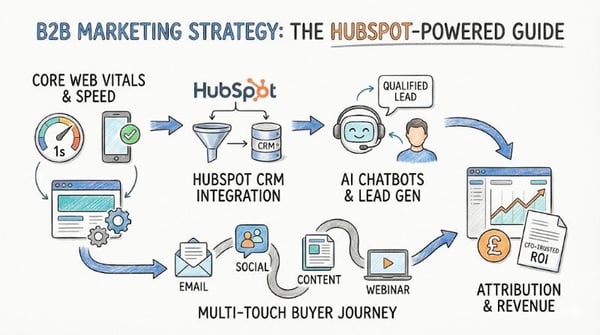
The challenge for B2B companies is that optimisation advice typically focuses on e-commerce metrics: bounce rates, cart abandonment, and checkout flows. But B2B buyers behave differently. According to McKinsey's 2024 B2B Pulse Survey, buyers use an average of 10 different touchpoints throughout their journey, with 42% using more than 11 touchpoints before making a purchase decision. Your website isn't the final destination—it's one stop on a complex, multi-stakeholder journey that may take 6 to 12 months.
Core Web Vitals and Technical Performance Requirements

Google's Core Web Vitals have evolved significantly, with Interaction to Next Paint (INP) replacing First Input Delay (FID) as the official interactivity metric in March 2024. Currently, only 47% of websites meet all Core Web Vitals thresholds—creating a measurable competitive advantage for optimised B2B sites seeking better search visibility.
The current thresholds your website must meet at the 75th percentile are:
| Metric | Good | Needs Improvement | Poor |
|---|---|---|---|
| LCP (Largest Contentful Paint) | ≤2.5s | 2.5s–4s | >4s |
| INP (Interaction to Next Paint) | ≤200ms | 200ms–500ms | >500ms |
| CLS (Cumulative Layout Shift) | ≤0.1 | 0.1–0.25 | >0.25 |
The Business Impact of Speed Optimisation
The commercial implications of Core Web Vitals performance are substantial and well-documented. Whitehat's analysis of client websites confirms the global research findings:
- Vodafone achieved a 31% LCP improvement that drove 8% more sales and 15% cart-to-visit improvement
- Swappie saw 55% LCP and 91% CLS improvements that generated a 42% increase in mobile revenue
- Rakuten 24 experienced 53% higher revenue per visitor and 33% conversion improvement after CWV optimisation
- Research from Portent analysing over 100 million page views found sites loading in 1 second convert 3× higher than those loading in 5 seconds, and 5× higher than 10-second sites
Every additional second beyond 2 seconds costs approximately 7% in conversions.
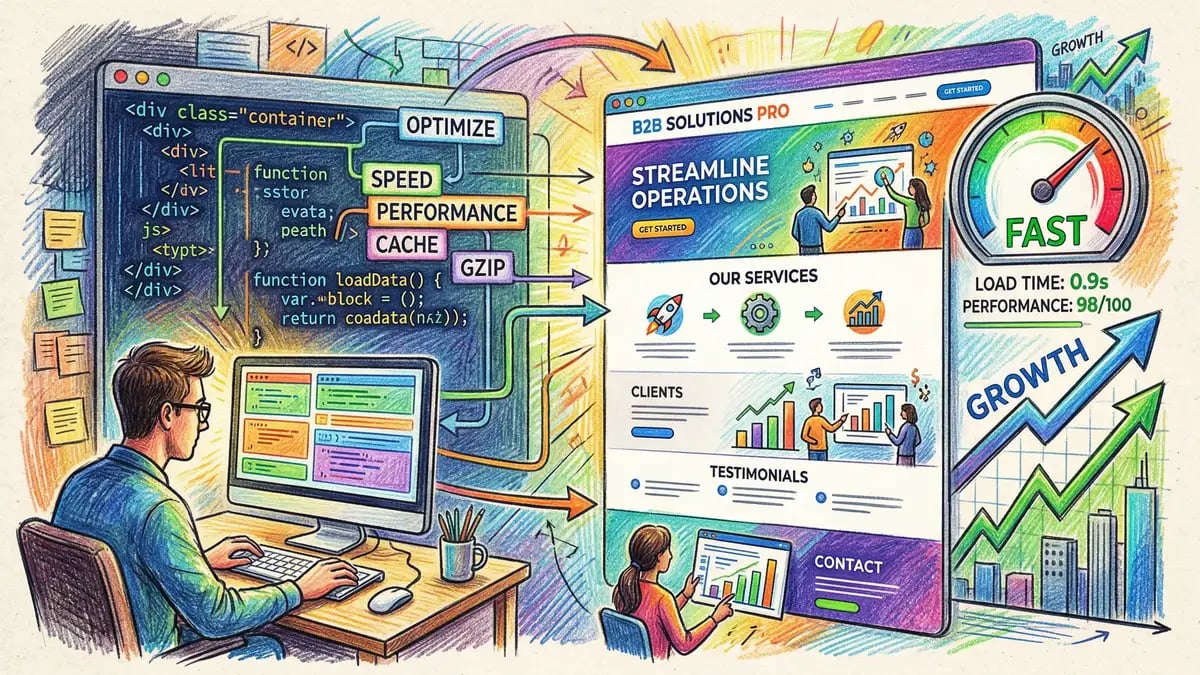
For B2B websites, the ideal page load target is under 2 seconds, with 3 to 5 seconds acceptable for complex pages. Whitehat's website audit service analyses these performance metrics and provides prioritised recommendations for improvement, typically identifying 15 to 25 optimisation opportunities within the first technical review.
Mobile-First Design Remains Non-Negotiable Despite Desktop Prevalence
Whilst most B2B websites still see 60% to 80% desktop traffic, mobile's influence on purchase decisions is decisive and growing. The assumption that B2B buyers only research on desktop no longer holds true.
The evidence is compelling:
- 80% of B2B buyers use mobile devices during working hours for research and buying activities
- Inside leading B2B businesses, mobile drives 40% of revenue on average
- 90% of B2B buyers who experience superior mobile experiences say they're more likely to buy again from that vendor
- 53% of mobile visitors abandon sites taking more than 3 seconds to load
Google's mobile-first indexing, in place since 2019, means your mobile version is the primary version for rankings—regardless of your actual traffic split. If your mobile site loads slowly, displays poorly, or offers reduced functionality compared to desktop, your search rankings will suffer across all devices.
HubSpot CMS Mobile Optimisation
For HubSpot users, the CMS Hub includes responsive design capabilities by default, but proper implementation requires attention to image sizing, font scaling, and touch target dimensions. Whitehat's HubSpot website design service builds mobile-first from the ground up, ensuring performance meets Google's thresholds whilst maintaining visual consistency across all device sizes.
UX and Conversion Rate Benchmarks for B2B
Understanding where your conversion rates sit against industry benchmarks helps identify whether optimisation should focus on traffic acquisition or conversion improvement. Unbounce's Q4 2024 analysis of 41,000 landing pages, 464 million visitors, and 57 million conversions provides the most robust current data.
| Category | Median | Top Performers |
|---|---|---|
| All Landing Pages | 6.6% | 12%+ |
| SaaS Landing Pages | 3.8% | 11.6% |
| B2B Professional Services | 5.2% | 13%+ |
Form Optimisation Has Outsized Impact
Form friction remains one of the largest conversion barriers on B2B websites. The data strongly supports simplification:
- Landing pages with 5 or fewer fields convert 120% better than those with more fields
- Multi-step forms can increase conversions by reducing perceived effort—one VWO case study showed improvement from 0.96% to 8.1%
- 81% of users abandon forms after starting, making field reduction critical
- Personalised CTAs convert 202% better than generic versions
HubSpot's smart content functionality enables progressive profiling—asking different questions based on what you already know about a contact. This allows you to collect comprehensive data over time without creating friction at any single touchpoint. Whitehat's HubSpot onboarding programmes include conversion optimisation configuration as standard, implementing progressive profiling from day one.
CRM Integration Delivers Measurable Pipeline Impact
Website optimisation in isolation is vanity metrics. The real value emerges when website activity connects directly to pipeline and revenue data in your CRM. This is where HubSpot's integrated platform creates genuine competitive advantage.
The numbers tell the story:
- HubSpot customers see a 107% increase in inbound leads and 35% more deals closed within the first six months
- Marketing teams using CRMs are 128% more likely to declare their marketing strategy effective
- CRM integrations deliver £8.71 for every £1 spent—an 871% ROI
- Partner-led HubSpot implementations generate 3× more closed deals and 53% more leads than self-implementations
Attribution That Your CFO Will Trust
One of the most significant limitations of Google Analytics 4 for B2B companies is its 90-day attribution lookback window. For businesses with 6 to 12 month sales cycles, this means GA4 breaks attribution for the majority of customer journeys—the first touches that started a relationship simply disappear from reports.
HubSpot's full multi-touch attribution (available in Enterprise tier) provides no lookback limitation, tracking the complete customer relationship through the CRM. Every touchpoint—from first website visit to closed deal—remains connected and reportable.
Whitehat's position: "Only 52% of CMOs can prove their contribution to revenue," according to Gartner. The problem isn't your marketing—it's that your website operates in isolation from your CRM, creating a gap between "someone visited" and "someone became a customer." Proper CRM integration closes that gap.
Whitehat specialises in connecting SEO performance directly to pipeline attribution—we don't just report on traffic and rankings, we show you which content and keywords generate actual revenue. This approach has helped our clients demonstrate clear marketing ROI to their leadership teams.
AI Chatbots Outperform Forms for B2B Lead Generation

The adoption of conversational AI for lead capture has accelerated dramatically. 60% of B2B companies now use chatbots—significantly higher than the 42% adoption rate in B2C. The performance advantages are substantial.
3×
higher conversion rate vs forms
80%
faster responses vs live agents
£0.50
per interaction (vs £6 human)
21×
more likely to qualify leads (5-min response)
Speed-to-Lead Is Critical
The research is unambiguous: companies responding within 5 minutes are 21× more likely to qualify leads. Yet average B2B lead response time without automation is 42 hours. With 50% of buyer conversations happening outside business hours, 24/7 availability through AI chatbots isn't a nice-to-have—it's essential for competitive lead capture.
Case study results demonstrate the commercial impact:
- ThoughtSpot achieved 10× more sales conversations, 70% more MQLs, and 64% more meetings
- Gamma generated nearly £1 million in closed revenue with a 33% website conversion increase
HubSpot's native chatbot functionality integrates directly with the CRM, whilst custom AI chatbots can extend capabilities further. Whitehat's AI consultancy service helps B2B companies design and implement conversational AI that qualifies leads, books meetings, and answers common questions—all whilst feeding data directly into HubSpot for complete attribution.
Accessibility Compliance Deadline Approaches
The European Accessibility Act (EAA) deadline is 28 June 2025. UK businesses selling to EU customers must comply with WCAG 2.1 Level AA minimum (WCAG 2.2 recommended). Fines can reach hundreds of thousands of euros per member state.
WCAG 2.2, published October 2023 and updated December 2024, added nine new success criteria including:
- Focus appearance requirements
- Target size minimums (24×24 CSS pixels)
- Accessible authentication
- Redundant entry prevention
WebAIM's 2025 analysis of one million home pages found 94.8% had detected WCAG 2 failures—improving from 95.9% in 2024 but still indicating massive compliance gaps across the web.
One in five UK residents lives with a disability, making accessibility both a legal requirement and a market expansion opportunity. Inaccessible websites exclude 20% of potential customers by design.
Beyond compliance, accessible websites typically see improved SEO performance (semantic HTML benefits both screen readers and search engines) and better conversion rates (clearer navigation helps all users). Whitehat's website audits include WCAG compliance checks and provide prioritised remediation recommendations.
B2B Buyer Behaviour Demands Multi-Touchpoint Strategy
B2B website optimisation cannot be approached like e-commerce. The buyer behaviour data reveals a fundamentally different purchase journey:
- 90% of B2B buyers research 2 to 7 websites before making a purchase
- B2B buyers engage with 3 to 7 pieces of content before talking to a sales rep, with 11% consuming over 7 pieces
- According to McKinsey, buyers use an average of 10 different touchpoints, with 42% using more than 11
- Forrester's 2024 research reveals that 86% of B2B purchases stall during the buying process
- An average of 13 people are now involved in B2B buying decisions, with 89% of purchases involving two or more departments
The Implication for Website Strategy
Your website must serve multiple personas at different stages of their buyer journey—often within the same organisation. The Marketing Director researching solutions has different needs than the IT Director evaluating security, or the CFO reviewing ROI projections.
Effective B2B website optimisation includes:
- Content for multiple funnel stages: Not just bottom-funnel "speak to sales" pages, but educational content for early-stage research
- Persona-specific pathways: Technical content for IT decision-makers, ROI content for finance stakeholders, strategic content for executive sponsors
- Low-friction conversion options: ROI calculators, assessment tools, email courses—not just demo requests
- AI-ready content: With 95% of buyers anticipating using generative AI to support purchasing decisions in the next 12 months, your content must be structured for AI citation and recommendation
Whitehat's Answer Engine Optimisation (AEO) service ensures your content is structured to appear in AI-generated responses from ChatGPT, Perplexity, and Google's AI Overviews—capturing the growing segment of B2B research happening through conversational AI rather than traditional search.
Implementation Roadmap: Priority Order
Website optimisation is most effective when approached systematically. Based on Whitehat's experience with B2B HubSpot implementations, we recommend the following priority order:
Technical Foundation (Weeks 1–2)
Fix Core Web Vitals issues, ensure mobile responsiveness, implement proper schema markup, configure analytics and CRM tracking. This establishes the measurement foundation for everything that follows.
Conversion Pathway Optimisation (Weeks 3–4)
Simplify forms, implement progressive profiling, add chatbot for 24/7 capture, create low-friction mid-funnel offers (calculators, assessments, guides).
Content Gap Analysis (Weeks 5–6)
Identify missing content for each buyer persona and funnel stage. Prioritise based on search volume, buyer intent, and competitive gap. Create content briefs for production.
Attribution Configuration (Week 7)
Configure HubSpot's multi-touch attribution reports, establish UTM conventions, connect marketing activity to pipeline and revenue metrics. Build the reporting dashboard your CFO needs.
Ongoing Optimisation (Month 3+)
Establish regular conversion rate testing, content performance review, and iterative improvement cycles. Monitor for accessibility compliance and Core Web Vitals changes.
Ready to Build a Peak-Performing Website?
As a HubSpot Platinum Partner since 2016, we build conversion-ready websites backed by data-driven SEO and performance optimisation.
Get Your Free Website AuditFrequently Asked Questions
How long does B2B website optimisation take to show results?
Most B2B companies see measurable improvements within 3 to 4 months for conversion rate optimisation and Core Web Vitals fixes. SEO-driven traffic growth typically becomes significant by month 6. Full attribution clarity—connecting marketing activity to closed revenue—requires 6 to 12 months of data depending on your sales cycle length. Whitehat's approach focuses on quick wins in the first 30 days whilst building toward longer-term compounding gains.
What's a realistic budget for B2B website optimisation?
For HubSpot-powered B2B websites, comprehensive optimisation typically ranges from £5,000 to £25,000 for initial implementation depending on site complexity and scope. Ongoing optimisation retainers range from £2,000 to £10,000 monthly. The key is ensuring ROI tracking from day one—Whitehat's clients typically see 3× to 5× return on optimisation investment within the first year, measured through pipeline and revenue attribution.
Should I fix Core Web Vitals or focus on conversion rate first?
Start with Core Web Vitals. Poor technical performance affects both search rankings and conversion rates simultaneously—a slow site loses visitors before they ever reach your conversion points. Additionally, Core Web Vitals fixes provide the cleanest A/B testing environment for subsequent conversion optimisation work. Whitehat's audits assess both and provide prioritised recommendations based on your specific performance gaps.
Can HubSpot handle enterprise-level website optimisation?
Yes. HubSpot CMS Hub Enterprise includes the technical capabilities required for complex B2B websites: multi-language support, dynamic content personalisation, advanced A/B testing, and enterprise-grade security. The key advantage is native CRM integration—every website interaction connects directly to contact records without additional integration complexity. Whitehat holds Diamond Partner status with extensive certifications across HubSpot's platform, enabling us to implement sophisticated optimisation strategies within the HubSpot ecosystem.
How do I prove website optimisation ROI to my CFO?
The answer is attribution-connected measurement. Configure HubSpot's multi-touch attribution reports to show which website pages and content pieces influenced deals at each stage. Track the full journey from first touch to closed revenue. Report on pipeline generated, not just traffic and leads. Whitehat's approach explicitly focuses on CFO-trusted metrics—we build reporting dashboards that show marketing's contribution to revenue in terms finance leaders understand and believe.
Ready to Grow Your Organic Pipeline?
Get a free audit and 90-day action plan from our team.
Get Your Free AuditWhitehat SEO
HubSpot Diamond Partner • London
Whitehat is a London-based HubSpot Diamond Partner specialising in B2B marketing, SEO, and website optimisation. We run the world's largest HubSpot User Group and have helped over 200 companies transform their digital marketing from random acts to predictable pipeline. Learn more about us → view our pricing
Clwyd Probert
Founder, Whitehat SEO
Clwyd Probert is the founder of Whitehat, a London-based SEO and inbound marketing agency and HubSpot Platinum Partner since 2016. He runs the largest London HubSpot User Group and advises B2B companies on connecting marketing to revenue.