
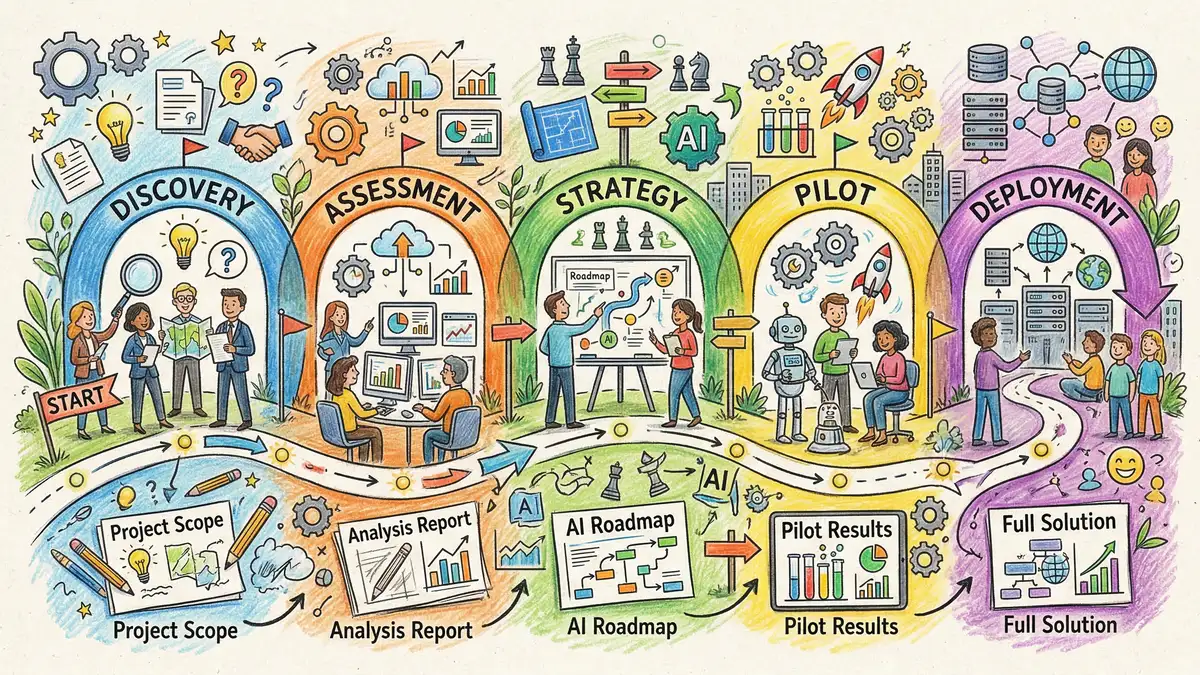
Organisations embarking on AI transformation often face a critical question: how do we ensure this investment delivers measurable value? A structured consulting process—with clearly defined phases, transparent decision gates, and built-in knowledge transfer—dramatically increases the probability of success. This guide walks you through the five-phase methodology that leading AI consulting firms use to guide clients from initial discovery through post-implementation optimisation.
Key Takeaway
Leading AI consulting firms follow a structured four to five-phase engagement model, with discovery spanning 1–3 weeks, strategy development 2–4 weeks, and pilot validation 4–8 weeks. Organisations that prioritise governance and internal capability building achieve 2.5 times higher ROI than those treating AI as a one-off project.
Phase 1: Discovery and Diagnostic Assessment
The discovery phase sets the foundation for the entire engagement. Leading consultancies invest 1–3 weeks understanding your current state, business drivers, technical environment, and organisational readiness. This is not a sales conversation—it's a diagnostic exercise designed to surface the real constraints and opportunities specific to your business.
During this phase, consultants assess data readiness across five critical dimensions: context (do you understand your data sources?), clarity (is the data semantically correct?), coverage (do you have sufficient volume?), credibility (is the data reliable?), and capacity (can you process it at scale?). According to McKinsey's 2023 AI State of the Nation report, 88 per cent of AI proof-of-concept initiatives fail to reach widescale deployment due to poor data readiness, making this assessment essential for long-term success.
A robust discovery process also maps stakeholder ecosystems, identifies decision-makers at each level, and uncovers hidden technical debt or legacy system constraints that could derail implementation later. Expect your consulting partner to conduct stakeholder interviews, audit your data infrastructure, review existing technology stacks, and benchmark your maturity against industry peers.
Phase 2: Strategy and Business Case Development
Once discovery is complete, strategy development (typically 2–4 weeks) transforms raw findings into a comprehensive AI roadmap. This phase produces three critical deliverables: a prioritised list of AI use cases ranked by business impact and feasibility, a detailed financial model showing expected returns and payback period, and a change management strategy that addresses the human and organisational dimensions of AI adoption.
The business case development is where consultants explicitly model hidden costs—typically 40–60% of total project spend. As noted in Gartner's AI Infrastructure and Operations analysis, these include data preparation (20–30% of total), system integration (15–25%), change management (15–20%), and ongoing governance infrastructure (8–12%). UK businesses that acknowledge and budget for these costs from the outset report significantly faster ROI realisation.
Strategy should also define success metrics before implementation begins. Leading consultancies work with you to establish KPIs across three dimensions: business metrics (cost reduction, revenue lift, efficiency gains), technical metrics (model accuracy, inference latency, uptime), and adoption metrics (user engagement, knowledge transfer, capability maturity). Without clear metrics defined upfront, it becomes impossible to distinguish genuine business value from technical success.
Phase 3: Pilot Validation and Proof-of-Concept
The pilot phase (typically 4–8 weeks) is where strategy meets reality. Rather than building production systems immediately, leading consultancies conduct a structured proof-of-concept on a high-priority use case, using real data and production-grade infrastructure. This de-risks the full implementation by testing technical assumptions, validating business model assumptions, and identifying integration challenges before they become expensive problems.
A well-designed pilot is scoped tightly—one defined business problem, 4–12 weeks duration, measurable success criteria, and clear decision gates. The goal is not perfection; it's learning. According to Accenture's AI insights, leading consultancies use pilots to generate three critical insights: Can we build the model? Can we integrate it into your business processes? Will your team adopt it? Each 'yes' reduces risk for full-scale implementation.
Pilots also serve as change management catalysts. By involving frontline teams early—data analysts, business users, operations managers—consultants build internal champions who become advocates for the broader transformation. This early involvement dramatically improves adoption rates during subsequent rollout phases.
Phase 4: Full-Scale Implementation and Integration
Implementation typically spans 2–6 months for moderate complexity projects, though enterprise transformations can extend 12+ months. This phase covers data pipeline construction, model training and refinement, integration with business systems, infrastructure deployment, comprehensive testing, and user training.
Technical Integration Risks
Data quality issues, system latency, API compatibility, and real-time performance constraints often emerge during integration. Leading consultancies build contingency buffers (typically 20–30% schedule buffer) into implementation timelines.
Organisational Adoption Risks
Change resistance, insufficient training, and unclear ownership models cause more AI implementation failures than technical issues. Parallel deployment (running legacy and AI systems simultaneously initially) reduces adoption friction.
Implementation success depends heavily on governance and decision rights. Leading consultancies establish clear escalation paths, define who owns the model (business or technology), and create feedback loops for continuous refinement. Without clear governance, implementation projects drift, budget overruns accumulate, and decision-making stalls.

Phase 5: Post-Launch Optimisation and Knowledge Transfer
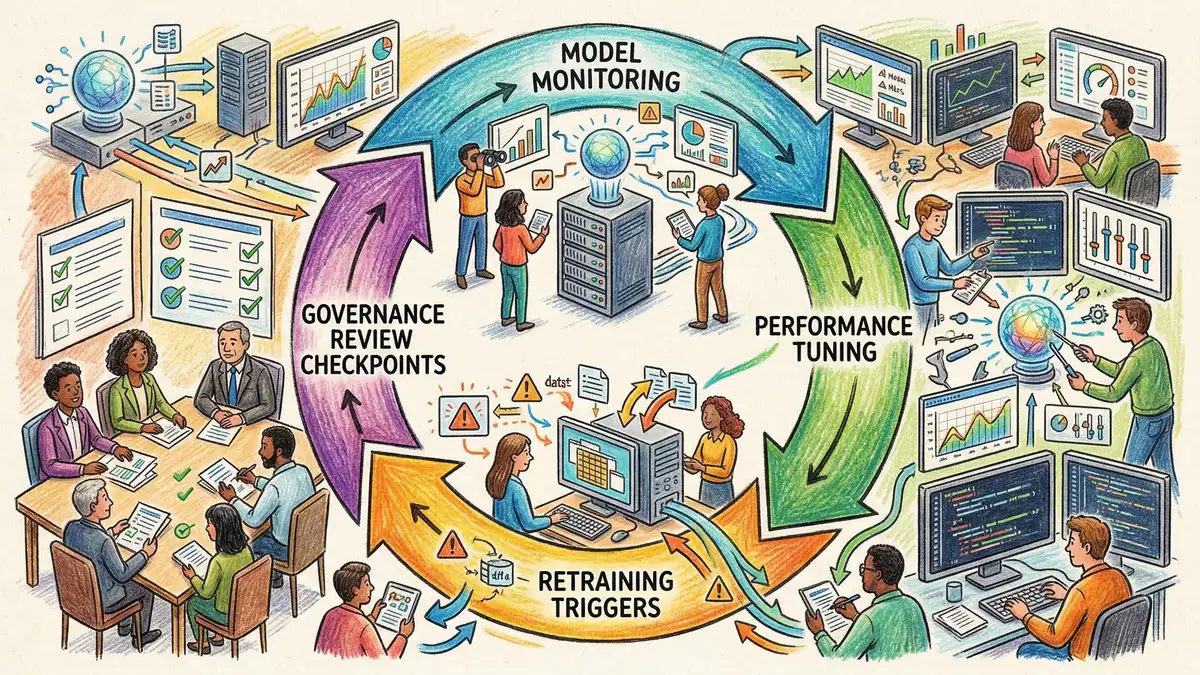
The engagement doesn't end at go-live. Leading consultancies allocate 4–12 weeks post-launch to monitor model performance, optimise for real-world conditions, and systematically transfer knowledge to internal teams. During this phase, consultants move from hands-on execution toward coaching and mentoring, gradually reducing external dependency.
Post-launch activities include performance monitoring (is the model delivering expected accuracy and business results in production?), continuous improvement (retraining with new data, handling edge cases), and building internal capability. The most successful transformations transition to a model where your internal team runs the AI system independently, with the consultant available only for complex problem-solving or roadmap expansion.
Timeline Expectations: From Discovery to ROI
| Phase | Typical Duration | Key Deliverables |
|---|---|---|
| Discovery | 1–3 weeks | Data audit, stakeholder interviews, readiness assessment, problem prioritisation |
| Strategy | 2–4 weeks | AI roadmap, business case, financial model, change management plan, success metrics |
| Pilot | 4–8 weeks | Proof-of-concept model, integrated solution, pilot results, scaling plan |
| Implementation | 2–6 months | Production system, integrated workflows, trained teams, operational handover |
| Optimisation | 4–12 weeks | Performance tuning, internal capability, handover docs, support transition |
| ROI Realisation | 12–24 months | Full financial return, competitive advantage, strategic insights |
Sources: McKinsey AI Consulting Framework 2025, Deloitte State of AI Report 2025
Critical Success Factors: Why 61% of AI Engagements Fail
McKinsey's research indicates that 61 per cent of AI engagements fail to deliver sustained value. The primary culprits are never technical—they're organisational. Here are the critical factors that distinguish successful transformations from those that stall:
Executive Sponsorship and Governance
AI transformation requires active C-suite support and clear governance structures. Projects with executive sponsors and defined governance models are 3x more likely to achieve sustained ROI.
Data Readiness and Infrastructure Investment
Don't underestimate data preparation. Consulting partners must assess and remediate data quality issues before model training. Budget 20–30% of project costs for data work.
Clear Ownership and Decision Rights
Per Forrester's guidance on responsible AI governance, ambiguous ownership of AI systems causes delays and poor adoption. Establish clear responsibility: who owns the data? Who manages the model? Who handles failures? Define this in writing.
Realistic Scoping and Contingency
Build 20–30% contingency into timeline and budget. Hidden costs commonly add 40–60% to estimates. A consulting partner who doesn't acknowledge this is either inexperienced or misleading you.
Knowledge Transfer and Internal Capability
The goal is to build internal expertise, not perpetual external dependency. A consulting partner who transitions from execution to coaching, and eventually to advisory-only mode, is setting you up for long-term success.
Vendor Selection and Fit
Big 4 consultancies command £4,000–£8,500 per day; specialist boutiques £2,500–£5,500. Higher cost doesn't guarantee better outcomes. Evaluate consultants on industry experience, methodological rigor, and commitment to knowledge transfer.
Typical AI Engagement Cost Model
£8K–£25K
Strategy Assessment
4–8 weeks, scoping
£35K–£120K
Pilot/POC
8–16 weeks, proof of concept
£150K–£2M+
Full Implementation
4–12+ months, production
Sources: Deloitte AI Consulting Pricing Analysis 2025, McKinsey Consulting Benchmarks
Choosing an AI Consulting Partner: Questions to Ask
When evaluating consulting partners, move beyond credentials and focus on methodological rigor, industry depth, and transparency about risk. The consulting partner you choose will significantly influence your transformation outcomes. Ask these critical questions during partner evaluation:
1. Do you conduct structured discovery before scoping? A consultant should invest time understanding your business, data, and organisational readiness before proposing timelines and budgets. If a consultant provides estimates without discovery, walk away.
2. How do you handle hidden costs? Experienced consultants budget 40–60% for data preparation, integration, and change management upfront. A partner who claims they can build AI on a fixed budget without acknowledging these costs is either inexperienced or misleading you.
3. What's your approach to knowledge transfer? The goal is to build internal expertise, not perpetual external dependency. Ask how consultants transition from execution to coaching, and how they document systems so your team can maintain them independently.
4. Can you show me case studies in my industry? Industry-specific experience matters enormously. A consultant with deep healthcare expertise can anticipate regulatory challenges that a generalist would discover painfully mid-project.
Common Mistakes When Selecting Consultants
Choosing on cost alone: A £1,500/day consultant may save short-term budget but often lacks specialist AI expertise, underestimate risks, and leave you stranded post-implementation.
Overestimating vendor expertise: Just because a firm lists 'AI' doesn't mean they've succeeded at it. Ask for case studies, client references, and specific methodologies.
Frequently Asked Questions
How long does a typical AI consulting engagement take from start to measurable ROI?
Most organisations see measurable ROI between 12–24 months from project start. Small, focused implementations can achieve ROI in 6–9 months; complex enterprise transformations often require 24–36 months. The timeline depends heavily on data readiness, team availability, and post-launch optimisation investment.
What percentage of AI consulting projects succeed?
Research shows 39 per cent of AI engagements achieve sustained value; 61 per cent fall short of expectations. Success is highly correlated with executive sponsorship, clear governance, realistic scoping, and investment in knowledge transfer. Projects with all five elements have over 80 per cent success rates.
What are hidden costs in AI implementation?
Hidden costs typically add 40–60% to initial budgets. The biggest culprits are data preparation (20–30%), system integration (15–25%), change management (15–20%), and governance infrastructure (8–12%). Leading consultancies budget for these upfront rather than treating them as surprises.
How do I evaluate if my data is ready for AI?
A structured assessment examines five dimensions: context (documented data sources), clarity (semantic correctness and naming standards), coverage (sufficient volume and time periods), credibility (documented lineage and quality metrics), and capacity (can you process at scale?). Expect this assessment to take 1–2 weeks and cost £5K–£10K.
Should we do a pilot before full implementation?
Absolutely. Pilots (4–8 weeks) de-risk implementation by testing technical assumptions, validating business models, and identifying integration challenges early. Pilots cost £35K–£120K but save organisations from £500K+ mistakes on scaling untested solutions.
What's the difference between Big 4 and boutique AI consultancies?
Big 4 firms (Deloitte, EY, KPMG, PwC) command £4,000–£8,500 per day and offer broad services, integration across audit/tax, and enterprise-scale teams. Specialist boutiques (£2,500–£5,500/day) offer deeper AI expertise, faster decision-making, and often stronger methodological rigor. For focused transformations, boutiques often deliver better ROI; for complex multi-service engagements, Big 4 may be appropriate.
Build Your AI Transformation Roadmap
Ready to explore AI opportunities for your organisation? Our five-phase methodology has guided UK businesses through successful transformations.
Explore AI ConsultingNext Steps: Start Your AI Journey Today
The AI consulting process is more art than science—successful transformations depend on rigorous methodology, realistic scoping, and unwavering focus on business outcomes. Whether you're evaluating your first AI use case or scaling across multiple business units, the five-phase framework outlined here provides a proven roadmap for avoiding the 61 per cent failure rate and joining the 39 per cent of organisations that achieve sustained competitive advantage from AI investment.
The best time to start is now. Begin with discovery, establish clear success metrics, build executive sponsorship, and commit to realistic timelines and budgets. Your future competitive advantage depends on the decisions you make today.
Ready to transform your business with AI?
Get expert guidance on your AI strategy, from discovery through successful implementation. Whitehat's AI consulting team helps UK organisations build sustainable competitive advantage through structured transformation.
About the Author
Michael Chen
AI Strategy Director, Whitehat
Michael leads AI transformation engagements for enterprise clients across financial services, healthcare, and retail sectors. With 12+ years of consulting experience at McKinsey and Deloitte, he specialises in translating AI strategy into measurable business outcomes through structured delivery methodologies and risk mitigation.
Sources: McKinsey AI Consulting Framework 2025, Deloitte State of AI Report 2025, Gartner AI Consulting Market Analysis