
SEARCH ENGINE OPTIMISATION
The most significant shift in SEO since 2014 is Google's move from penalising bad content to actively rewarding genuinely helpful content. Two interconnected systems now govern content quality across all search results.
How Content Quality, Author Authority, and AI Have Transformed Search
SEO in 2025 requires demonstrated expertise, first-hand experience, and content structured for AI extraction—not keyword density or link schemes. Google's algorithms now evaluate entire websites holistically using E-E-A-T principles and the Helpful Content System, whilst AI search engines like ChatGPT (800+ million weekly users) and Google AI Overviews are fragmenting discovery. Whitehat SEO's analysis of current ranking factors shows that success now depends on building author authority, creating genuinely helpful content, and optimising for both traditional search and AI citation.
E-E-A-T and the Helpful Content System now define quality
E-E-A-T (Experience, Expertise, Authoritativeness, Trustworthiness) became Google's expanded quality framework in December 2022, adding "Experience" to the original E-A-T guidelines. Crucially, E-E-A-T is not a direct ranking factor—Google's Danny Sullivan has explicitly stated: "E-E-A-T is not a score, is not a ranking factor, it is not an algorithm." Instead, it's a conceptual framework used by 16,000 Quality Raters to evaluate search results, with their feedback training Google's algorithms to recognise quality patterns.
The Helpful Content System, launched in August 2022 and integrated into Google's core algorithm in March 2024, represents an even more significant change. Unlike Panda's page-level approach, this system evaluates entire websites—meaning a high volume of low-quality content can drag down rankings for otherwise excellent pages. Google's March 2024 core update achieved a 45% reduction in unhelpful content in search results.
Whitehat SEO insight: Recovery from Helpful Content penalties takes months of demonstrated improvement, not quick fixes. When we audit client websites, we assess site-wide content quality before optimising individual pages—a fundamental shift from the page-by-page approach that worked in 2014.
Author authority has evolved beyond Google+ Authorship
Google discontinued its Authorship programme in August 2014 due to low adoption and implementation errors. What replaced it is far more sophisticated: entity recognition through Google's Knowledge Graph, which now contains over 1.6 trillion facts about 54 billion entities—up dramatically from 500 billion facts about 5 billion entities in 2020.
The March 2024 "Killer Whale" Knowledge Graph update showed Google's commitment to author identification: Person entities increased by 17%, with E-E-A-T-friendly subtitles (researchers, writers, academics, journalists) growing by 38%. Google isn't just tracking authors—it's building comprehensive profiles of their expertise domains.
Google's Gary Illyes confirmed at Pubcon in March 2023 that whilst "Google is still not using authors as a ranking factor," the company was "actively pursuing ways to better identify authors, mostly for use as entities in its knowledge graph." The practical implication: author bylines don't directly boost rankings, but they correlate with characteristics Google's systems reward.
Building author authority in 2025
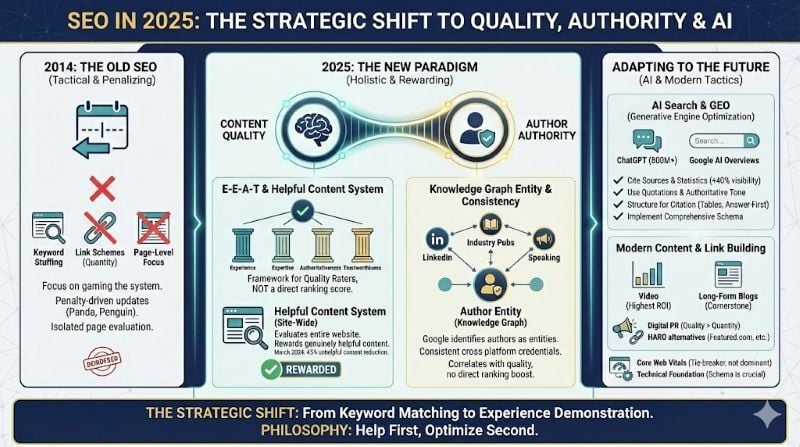
Whitehat SEO's approach to author authority building includes:
- Comprehensive author pages with verifiable credentials and expertise areas
- Consistent name usage across all platforms (LinkedIn, industry publications, speaking engagements)
- Guest publications on authoritative sites within your industry vertical
- Proper schema markup (Article + Person types) connecting content to author entities
- For YMYL topics: displaying specific credentials (MD, CPA, JD) and review processes
Social signals still don't impact rankings—but they matter differently
Google's position on social signals has remained consistent since 2015: they are not a direct ranking factor. John Mueller stated unequivocally: "It is not the case that [social shares] would give you any kind of ranking boost." Gary Illyes was even more direct at SMX 2017: "SEs will rank you better [because of social]—that's BS."
However, social's indirect value has grown significantly. Viral content attracts natural backlinks. Brand visibility increases branded search volume (a positive signal). And importantly, content that ranks well tends to get shared more—the correlation exists because good content performs well across channels, not because shares cause rankings.
The more nuanced development is Google's treatment of brand mentions. Gary Illyes acknowledged at Brighton SEO 2017 that beyond links, Google considers "mentions on social networks and people talking about your branding." Google's 2012 Panda patent introduced "implied links"—unlinked mentions that reference a target resource. Whilst John Mueller clarified these aren't "the same thing as a link" for PageRank purposes, brand entity recognition clearly factors into how Google understands and evaluates sites.
Key takeaway: At Whitehat SEO, we advise clients to use social for brand building and audience engagement—not as a ranking tactic. The indirect benefits (links, brand searches, entity recognition) flow naturally from genuinely valuable content shared with the right audiences.
Content marketing delivers measurable ROI—but AI is reshaping formats
Content marketing adoption remains strong: 97% of B2B marketers include content marketing in their strategies, with 73% of B2B and 70% of B2C marketers using it as a core approach. The ROI case is compelling—content marketing costs 62% less than traditional marketing whilst generating 3x more leads. SEO specifically delivers 748% ROI for B2B companies.
Blogging continues to drive results
Despite the rise of video and social, blogging remains a cornerstone of effective content strategy. Companies that blog receive 55% more website traffic and generate 67% more leads than non-bloggers. Those publishing 16+ posts monthly see 3.5x more traffic and 4.5x more leads than those publishing 0-4 posts. The average blog post has grown to 1,400 words—77% longer than a decade ago—reflecting the shift toward comprehensive, authoritative content.
Video emerges as the highest-ROI format
91% of businesses now use video marketing, with 93% reporting positive ROI—the highest percentage ever recorded. Short-form video is the #1 format used by marketers, with 21% citing it as delivering the highest ROI.
AI adoption in content creation
AI usage in content creation jumped from 64.7% in 2023 to 83.2% in 2024, with B2C industries showing the biggest growth (38% to 87%). However, only 61% of organisations have guidelines for AI use—creating compliance risks. Whitehat SEO recommends establishing clear AI content policies that maintain quality standards whilst leveraging efficiency gains.
Modern link building has shifted toward digital PR
The link building landscape has transformed since 2014. Google removed its statement that links determine page relevancy in 2024, and Gary Illyes stated links are "not in the top 3 ranking factors." Quality and relevance matter far more than quantity.
Digital PR has emerged as the most endorsed strategy. John Mueller stated in 2021: "I love some of the things I see from digital PR... It's just as critical as tech SEO, probably more so in many cases." Industry surveys confirm this: 89.6% of professionals believe digital PR is the most effective backlink tactic. The average Domain Rating of digital PR coverage is 61 (Ahrefs), with 20.62% of backlinks achieving DR 70-79.
HARO alternatives for 2025
HARO (Help A Reporter Out) was shut down in December 2024, then acquired by Featured.com in April 2025. Current alternatives include:
- Source of Sources — Created by HARO's original founder, free to use
- Featured.com — Fastest turnaround at 18 days average
- Qwoted — Real-time journalist connections
- JournoFinder — AI-powered semantic search for relevant opportunities
Guest posting remains viable when done selectively. Google's documentation states it doesn't discourage guest articles "when they inform users, educate another site's audience or bring awareness to your cause or company." Whitehat SEO's approach focuses on 5-10 high-quality placements annually on relevant DA 50+ sites, avoiding sites that sell posts or accept over-optimised anchors.
AI search engines are fragmenting discovery—and require new optimisation
The emergence of AI-powered search represents the most disruptive change since the mobile revolution. ChatGPT now has 800+ million weekly active users (up from 400 million in February 2025). Perplexity processes 780 million monthly search queries—a 239% increase from August 2024. Google AI Overviews appear in 30% of US desktop searches as of September 2025, with 475% year-over-year growth on mobile.
The traffic impact is significant. A Seer Interactive study found organic CTR dropped 61% for queries with AI Overviews (from 1.76% to 0.61%). Zero-click searches have increased from 56% to 69% between May 2024 and May 2025. Some publishers report devastating losses—Daily Mail's desktop CTR dropped from 25.23% to 2.79% when AI Overviews appeared (an 89% decline).
Generative Engine Optimisation (GEO): The new discipline
The landmark Princeton/Georgia Tech study tested 9 optimisation tactics across 10,000 queries and found GEO can boost AI visibility by up to 40%. The most effective strategies ranked by impact:
- Citing sources — 115.1% visibility increase for 5th-ranked sites
- Including statistics — 40% higher citation rates than qualitative statements
- Adding quotations from relevant, authoritative sources
- Using authoritative tone — especially for business, science, health queries
- Technical terminology that signals domain knowledge
Content structure for AI citation
Whitehat SEO's analysis of AI citation patterns reveals several critical structural factors:
| Factor | Impact |
|---|---|
| Answer-first formatting (40-60 words) | Drives citations across all platforms |
| Page load under 0.4 seconds | 40% more likely to be cited |
| Content updated within 30 days | 3.2x more frequently cited |
| Tables in content | 2.5x increase in citation rates |
| FAQPage schema markup | 3.2x more likely in AI Overviews |
Currently, only 12.4% of websites implement structured data—creating a significant competitive advantage for those who do. Whitehat SEO implements comprehensive schema markup across all client websites as part of our technical SEO foundation.
Core Web Vitals remain a factor—but not dominant
Google's page experience signals consolidated around three Core Web Vitals metrics. INP (Interaction to Next Paint) replaced FID in March 2024, measuring responsiveness across all interactions rather than just the first input.
| Metric | What It Measures | "Good" Threshold |
|---|---|---|
| LCP | Loading speed | ≤2.5 seconds |
| INP | Responsiveness | ≤200 milliseconds |
| CLS | Visual stability | ≤0.1 |
John Mueller has been clear about their relative importance: "Relevance is still by far much more important... just because your website is faster doesn't necessarily mean you will jump to position number one." Only 33% of sites meet Core Web Vitals thresholds according to Ahrefs, yet the ranking impact functions primarily as a tiebreaker between similarly-ranked pages rather than a dominant factor.
Google's algorithm evolution shows a clear trajectory
Since 2014, Google has released a series of landmark updates that collectively redefined content quality:
RankBrain (October 2015) introduced machine learning to query understanding, eventually becoming involved in every search query and reaching 80% accuracy at interpreting never-before-seen queries—compared to 70% for human engineers.
Penguin 4.0 (September 2016) integrated link evaluation into the core algorithm, enabling real-time assessment rather than periodic refreshes.
BERT (October 2019) brought natural language understanding to search, initially affecting 10% of queries and eventually expanding to 70+ languages. It enabled Google to understand context and nuance—like recognising that "brazil traveler to usa need a visa" asks about travelling to the USA specifically.
The March 2024 Core Update marked the most significant recent shift, integrating the Helpful Content System into core ranking and introducing three new spam policies: Scaled Content Abuse (targeting mass-produced content regardless of creation method), Expired Domain Abuse, and Site Reputation Abuse (targeting "parasite SEO"). This 45-day rollout—the longest core update ever—resulted in 800+ websites being completely deindexed.
The trajectory is unmistakable: from keyword matching to intent understanding to experience demonstration. Google's 2014 approach penalised specific tactics through periodic algorithm refreshes. The 2025 approach uses continuous AI-powered evaluation across multiple systems that assess site-wide quality, user satisfaction, and demonstrated expertise.
What this means for your SEO strategy in 2025
The foundational advice from 2014—create quality content, build authority, engage audiences—remains valid. But the implementation has changed entirely. Here's what Whitehat SEO recommends for businesses adapting their strategy:
- Prioritise depth over breadth — Comprehensive, genuinely helpful content outperforms thin content farms
- Build author entities — Consistent cross-platform presence, credentials, and expertise demonstration
- Structure content for AI extraction — Answer-first formatting, tables, FAQ sections, and clean HTML
- Implement proper schema markup — Article, Person, FAQ, and Organisation schemas as standard
- Maintain site-wide quality — Audit and improve or remove low-quality content across your entire domain
- Accept the new metrics reality — Traffic may decline whilst the value of remaining traffic increases
The bottom line: The sites that thrive in 2025 will be those that genuinely help users—which was always Google's stated goal, now backed by AI systems sophisticated enough to evaluate it. At Whitehat SEO, we've built our entire methodology around this principle: help first, optimise second.
Frequently Asked Questions
Is E-E-A-T a ranking factor in Google's algorithm?
E-E-A-T is not a direct ranking factor or algorithm score. It's a conceptual framework used by Google's 16,000 Quality Raters to evaluate search results. Their feedback trains Google's algorithms to recognise quality patterns, so demonstrating Experience, Expertise, Authoritativeness, and Trustworthiness helps your content match what Google's systems reward—even though there's no "E-E-A-T score" being calculated.
How do I optimise content for AI search engines like ChatGPT?
Generative Engine Optimisation (GEO) requires answer-first formatting with direct answers in the first 40-60 words, citing credible sources, including statistics, and using structured content like tables and FAQ sections. Pages loading under 0.4 seconds get cited 40% more often, and content updated within 30 days gets cited 3.2x more frequently. Whitehat SEO implements these GEO principles alongside traditional SEO for comprehensive visibility.
Are backlinks still important for SEO in 2025?
Links remain relevant but are no longer in the top 3 ranking factors according to Google's Gary Illyes. Quality and relevance matter far more than quantity. Digital PR has emerged as the most effective link-building approach, with 89.6% of professionals endorsing it. Focus on earning high-quality links from relevant, authoritative sites rather than pursuing volume through outdated tactics.
How has Google's Helpful Content System changed SEO?
The Helpful Content System evaluates entire websites rather than individual pages, meaning low-quality content anywhere on your domain can drag down rankings for otherwise excellent pages. Google's March 2024 update achieved a 45% reduction in unhelpful content in search results. Recovery from penalties takes months of demonstrated improvement across your entire site, not quick fixes to individual pages.
What ROI can I expect from content marketing in 2025?
Content marketing costs 62% less than traditional marketing whilst generating 3x more leads. SEO specifically delivers 748% ROI for B2B companies. Companies that blog receive 55% more website traffic and generate 67% more leads than non-bloggers. Video marketing shows the highest satisfaction, with 93% of businesses reporting positive ROI—the highest percentage ever recorded.
References & Citations
- Google Search Central. (2024). Google Search Quality Rater Guidelines. developers.google.com/search/docs/fundamentals/creating-helpful-content
- Aggarwal, P., Murahari, V., et al. (2023). GEO: Generative Engine Optimization. Princeton University & Georgia Tech. arxiv.org/abs/2311.09735
- HubSpot. (2024). State of Marketing Report 2024. hubspot.com/state-of-marketing
- Ahrefs. (2024). Search Traffic Study. ahrefs.com/blog/search-traffic-study
- Google Search Central Blog. (2024). March 2024 Core Update. developers.google.com/search/blog/2024/03/core-update-spam-policies
- Content Marketing Institute. (2024). B2B Content Marketing Research. contentmarketinginstitute.com/research
- Semrush. (2024). State of Content Marketing Report. semrush.com/state-of-content-marketing
- web.dev. (2024). Core Web Vitals. web.dev/articles/vitals
About the Author
Clwyd Probert is the Founder and CEO of Whitehat SEO, a HubSpot Diamond Partner based in London. He leads the world's largest HubSpot User Group and is a guest lecturer at UCL on digital marketing strategy. With over 14 years of experience in SEO and inbound marketing, Clwyd helps B2B companies build predictable, sustainable growth through ethical, evidence-based marketing.
Connect: LinkedIn | whitehat-seo.co.uk
Ready to modernise your SEO strategy?
Book a free SEO audit with Whitehat SEO and discover how E-E-A-T, Helpful Content, and AI optimisation can transform your organic visibility.
Get Your Free SEO Audit