
Remote sales leadership • HubSpot • Revenue Operations • UK
How to Run a Remote Sales Team in 2026
Remote sales works in 2026 when you stop managing people by presence and start managing outcomes with a visible, automated system. Build a single source of truth in your CRM, automate handoffs and follow-ups, and use AI to remove admin. Then coach on pipeline reality, not vibes.
“Remote sales” used to mean “how do we do the same thing, but on Zoom?” That’s ancient history. In 2026, buyers are self-serving for most of the journey: Gartner found 61% of B2B buyers prefer a rep-free buying experience (survey published June 25, 2025).[1] That means your remote team wins by being fast, relevant, and operationally boring.
The goal isn’t to recreate the office. It’s to replace the office’s visibility, energy, and coaching loop with a system: clear process, clean data, automated follow-up, and a rhythm that doesn’t melt everyone’s calendar.
Remote sales management is a visibility problem, not a motivation problem
Most leaders reach for surveillance when performance dips. That’s the wrong diagnosis. Remote sales usually breaks because managers can’t see what’s real: which deals are stuck, which leads went cold, and whether activity is progressing towards revenue. In a physical office, you pick up signals by osmosis. Remotely, you only get signals through data.
The fix is to create “passive visibility” through your CRM: every email, call, meeting, note, stage change, and next step captured without reps having to remember. Once visibility is automated, you can coach behaviour and messaging instead of playing detective.
Practical rule: if an activity can’t be seen on a dashboard, it isn’t real. Build a tight set of ‘truth’ views (lead response time, meetings set, stage conversion, next-step coverage) and review them weekly—then coach the behaviour behind the number, not the person.
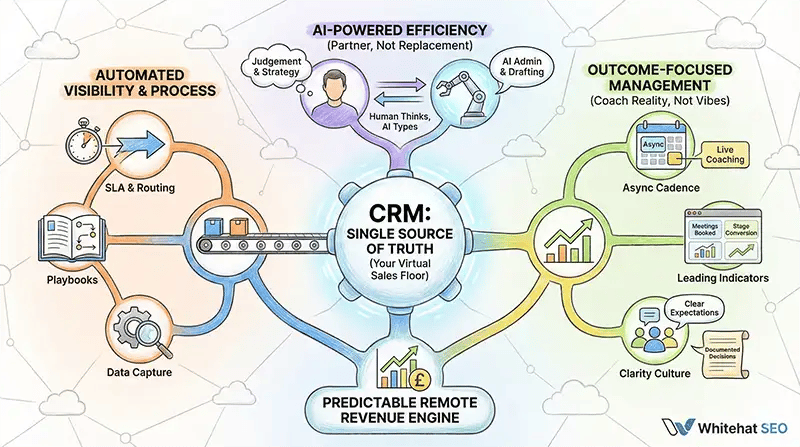
A single source of truth in your CRM is the virtual sales floor.
In 2026, your CRM isn’t a database; it’s your shared reality. If your team uses spreadsheets, personal inboxes, or “I’ll update it later” notes, you don’t have a remote sales system—you have a set of individual freelancers. Start with a simple rule: if it’s not in the CRM, it didn’t happen.
Build the fundamentals first: connected email (Outlook/Gmail), meeting links, call logging, and mandatory deal fields. Then layer dashboards for pipeline health and activity. When marketing and sales work from the same contact record, your team can act on intent signals (page views, form fills) without guesswork.
Hybrid work is now the default, but leaders still argue about it
You’re managing in a permanent hybrid reality. The UK’s Office for National Statistics tracks working arrangements through the Opinions and Lifestyle Survey, with ongoing updates through late 2025.[2] In practice, that means your hiring pool expects flexibility, and your systems must work whether a rep is in London, Leeds, or their kitchen.
The commercial risk isn’t “remote vs office.” It’s inconsistency: managers running one cadence for in-office days and another for home days, which fractures accountability. Standardise the system and the rhythm so location becomes irrelevant.
Treat flexibility as a go-to-market advantage. Your best reps will choose employers that let them protect deep work time for prospecting and follow-up. If you do require office days, make them purposeful (roleplay, deal clinics, onboarding) rather than performative (sitting on Teams calls in a different building).
UK flexible working rules have teeth, so treat policy like a revenue constraint
In the UK, “flexibility” isn’t just culture—it’s governance. Acas notes the Employment Rights Bill became law (Royal Assent on 18 December 2025), with changes phased in over 2025–2027.[3] The government’s overview of the Employment Rights Act 2025 includes strengthening the day-one right to request flexible working and requiring employers to give a rationale when refusing requests.[4]
The practical sales leader takeaway: you can’t “policy” your way out of remote. If you want performance, you need systems that deliver performance wherever people work—because your ability to mandate office presence is increasingly constrained.
Operationally, build a simple ‘request-to-decision’ workflow: intake form, decision deadline, documented rationale, and a manager checklist. That reduces HR friction and gives sales leaders consistency across regions. The goal isn’t to say yes to everything—it’s to avoid ad-hoc decisions that create retention risk mid-quarter.
The work-from-home tax relief change affects retention, not your P&L
Many remote reps quietly used the UK’s flat-rate homeworking expense relief as a small offset for extra bills. GOV.UK confirmed the removal of tax relief on non-reimbursed homeworking expenses, impacting an estimated 300,000 individuals.[5] Even if the numbers aren’t huge, the psychology is.
Your move is simple: convert “invisible frustration” into a visible benefit. Reallocate some office overhead into a home office allowance or equipment policy (with clear guardrails). It’s cheaper than replacing a good rep and faster than rebuilding pipeline coverage.
A pragmatic fix is to reimburse specific costs (equipment, broadband contribution, ergonomic chair) through a clear policy—employees feel supported, and you control spend. For sales teams, this also reduces performance drag from bad setups (poor audio, back pain, flaky Wi‑Fi) that quietly kills call quality and activity.
Cyber risk increases when your sales team is distributed, so lock down access
Remote selling widens your attack surface: laptops on home Wi‑Fi, deals discussed in coffee shops, and CRM access from phones. The UK government’s Cyber Security Breaches Survey 2025 is the best baseline for SME cyber resilience, and it’s worth treating as required reading for anyone shipping customer data around.[6]
Practical controls: enforce single sign-on and MFA, require managed devices for CRM access where possible, lock down exports, and standardise the tools (no “random WhatsApp voice notes” as your deal strategy). Security isn’t a separate project; it’s part of remote sales enablement.
Minimum bar: multi-factor authentication (MFA) everywhere, role-based permissions in your CRM, enforced password policies, and device controls (managed laptops or at least mobile device management). Add a monthly ‘phishing + data handling’ micro-training and make security part of onboarding—not an annual tick-box.
The inbound traffic era is fading, so your remote team must convert harder
Your marketing engine is competing with AI summaries and zero-click results. SparkToro’s 2024 Zero-Click Search Study reported that a majority of searches end without a click, with only a minority going to the open web.[7] Bain’s research frames the same shift: generative summaries and “clickless” experiences are changing how people discover brands.[8]
Translation for sales leaders: fewer inbound leads, but higher intent when they arrive. Remote teams can’t survive on volume. They need tight response-time SLAs, sharp follow-up sequences, and a process for turning “I read your guide” into a booked meeting inside 24 hours.
If you want the marketing-side playbook for visibility in AI answers, this is the companion piece: SEO & AEO Strategy.
Translation: fewer form fills, more ‘already-informed’ prospects. Your remote team needs crisp, fast response, clear next steps, and a frictionless path from enquiry to meeting. Build self-serve assets (pricing explainer, implementation timeline, proof library) so reps can send one link that answers objections instead of writing essays.
AI doesn’t replace remote reps, it removes the admin that kills momentum
Remote sales fails when reps spend their best energy doing busywork alone. The data is getting clearer that “AI partnership” is a performance differentiator: Gartner reported that sellers who effectively partner with AI are 3.7x more likely to meet quota (press release published September 16, 2024).[9]
The winning pattern is consistent: AI drafts, summarises, routes and prompts—humans decide, personalise and close. If your AI strategy is “we bought a tool,” but you didn’t redesign the workflow, you’ll get novelty, not leverage.
Use AI for the boring bits: call summaries, next-step suggestions, email drafts, and pre-call briefs. Then hold humans accountable for judgement: qualification, deal strategy, stakeholder mapping, and commercial negotiation. If AI is doing ‘thinking’, you’ve implemented it wrong; it should be doing ‘typing’.
HubSpot Breeze and agents help remote teams act faster with less context switching
HubSpot’s “Breeze” positioning is essentially a promise: AI inside your CRM, not bolted on as another tab. HubSpot’s Breeze product pages outline AI capabilities across marketing, sales, and service.[10] For sales teams, the big wins are prospect research, email drafts, conversation summaries, and next-best-action prompts.
A practical example is the Breeze Prospecting Agent, which HubSpot positions as automating lead research and personalised outreach so reps focus on closing.[11] In a remote context, that matters because “getting started” is half the battle. Reduce friction and you’ll get more consistent activity.
Start with a pilot: one segment, one rep, one measurable outcome (e.g., meetings booked per week). Create a simple governance doc: approved prompts, tone rules, and what data the agent can and cannot use. Done well, agents become a consistent ‘BDR co-pilot’ that reduces variance between reps working in different locations.
Sales Workspace creates a command centre that remote reps can actually live in
One underrated remote problem is “tab fatigue”: bouncing between inbox, calendar, LinkedIn, CRM, and spreadsheets. HubSpot’s updated Sales Workspace is designed to bring tasks, actions, queues, and sales activity into one place, so reps can execute without losing focus.[12]
For managers, the win is a shared operating picture. You can see whether a rep’s day is loaded with follow-ups or empty air, without interrogations. That enables coaching: “Your top three deals all stalled at legal—let’s fix the enablement,” not “Did you do your calls?”
The point isn’t a prettier interface—it’s behaviour change. If the workspace surfaces guided actions (follow-ups, replies, stale deals) in one queue, reps spend less time deciding what to do next and more time doing it. Managers get a clean coaching signal: what’s being ignored, what’s moving, and where deals are stalling.
A smarketing SLA prevents lead leakage when nobody is in the same room
In professional services and B2B SaaS, the remote handoff is where revenue quietly dies. An SLA (Service Level Agreement) defines what counts as a Marketing Qualified Lead, where it routes, and the maximum time to first response. Without it, your “best” lead might sit in someone’s inbox while they’re on another call.
Build the SLA inside the CRM, not in a slide deck. Use workflow automation to assign, notify, and escalate. If a lead isn’t moved to “Working” within two hours, reroute. If it isn’t contacted within 24 hours, alert the manager. Remote teams don’t need more meetings; they need fewer grey areas.
Make it measurable: response time targets by lead type, required first-touch steps, and an escalation path when SLA breaches occur. Then put it on a dashboard both teams see. Remote environments amplify ambiguity—so write the rules down, automate enforcement, and review performance weekly like any other revenue metric.
Playbooks standardise discovery and compliance when coaching is asynchronous
The office advantage is easy access to “how we do things here.” Remote reps don’t have that, so they improvise. That’s dangerous in regulated sectors and expensive in any sector. CRM-native playbooks solve it by putting the talk track, qualification steps, and required fields directly into the call flow.
The goal isn’t robotic scripts. It’s consistent data and consistent customer experience: every rep asks the core questions, logs the answer, and progresses the deal using the same logic. Then managers can coach the exceptions, not rebuild the basics every week.
Design playbooks around your sales methodology (MEDDICC, BANT, Sandler, your choice) and tie them to required fields. If a deal is in ‘Proposal’, the value hypothesis and decision criteria should already be captured. This is how you scale quality without ‘listening to every call’—the CRM record becomes the coaching artefact.
Asynchronous cadences beat daily video standups for most remote sales teams
A remote team can drown in meetings while still being “busy.” Fix it by moving status to async and keeping live time for coaching. Daily standups work better as short written updates (Slack/Teams): yesterday, today, blockers. Managers can triage quickly, and reps keep momentum.
For pipeline, use a two-layer rhythm: an async dashboard review mid-week (manager comments on deals, reps respond), and a live weekly deal clinic focused on the handful of stuck opportunities. Your calendar should reflect where the money is stuck—not where the noise is loud.
Keep synchronous time for high-value work: deal strategy, objection handling, and peer roleplay. Everything else should be written or recorded. A good cadence is: daily async standup, twice-weekly pipeline review, weekly skills coaching, and monthly retros. The constraint is attention—don’t burn it on status theatre.
Measure leading indicators that predict pipeline, not activity for activity’s sake
Remote leadership fails when measurement becomes punishment. Calls and emails are diagnostic, not targets. Instead, track leading indicators that correlate with revenue: first-response time, new meetings booked, qualified opportunities created, sequence enrolments, stage conversion rates, and deal velocity.
When you anchor on these metrics, coaching becomes clean. Example: “Your response time slipped above 4 hours and conversion dropped—let’s fix routing and templates,” not “do more calls.” This also keeps marketing honest: if lead-to-meeting conversion is low, the problem might be lead quality, not sales effort.
A strong leading set usually includes: speed-to-lead, meetings set, meetings held, stage conversion, and ‘next step scheduled’ rate. If you track activity, use it diagnostically (are emails logged? are calls connected?) rather than as a performance stick. Remote reps will game activity; they can’t game conversion.
Forecasting improves when you reduce human optimism and improve data hygiene
Remote reps can unintentionally distort forecasts: deals look “fine” until they aren’t, because updates lag reality. The fix isn’t bigger spreadsheets. It’s cleaner stage definitions, mandatory next steps, and deal properties that reflect actual progress (legal sent, security review, budget confirmed).
Once the data is consistent, forecasting tools and AI prompts become useful—because they’re built on signals, not stories. If your CRM is full of stale deals, AI will just produce confident nonsense. Garbage in, but with better grammar.
Most forecast pain is self-inflicted: inconsistent stages, stale close dates, and missing next steps. Fix those three and your forecast improves immediately. Then layer assistive AI to spot risk patterns (no stakeholder engagement, long time-in-stage, low activity after proposal). Forecasting becomes a system, not a vibe.
Remote culture is built through clarity, not forced fun
Here’s the uncomfortable truth: virtual socials don’t fix poor systems. They can help belonging, sure, but clarity is the real culture builder in remote sales. People feel safe when they know what “good” looks like and how success is measured.
The FlexJobs 2025 State of the Workforce report highlights the intensity of return-to-office pushback, with 76% of workers saying they’d look for a new job if forced back.[13] Translation: flexibility is now part of your talent strategy. Build a culture that respects focus time, documents decisions, and coaches generously.
Codify how you communicate: response-time expectations, where decisions live, how handovers work, and how feedback is given. Remote teams with strong writing habits move faster. Add rituals that support performance (win/loss notes, weekly learning shares) and you’ll get connection as a by-product—without awkward ‘mandatory fun’ sessions.
A 30-60-90 rollout makes remote performance improvements predictable
Big “CRM transformations” fail because they try to do everything at once. A remote sales improvement plan works best in 30-day chunks. Days 1–30: data hygiene, integrations, and dashboards. Days 31–60: automation (routing, SLAs, sequences) and playbooks. Days 61–90: optimisation (conversion rates by stage, enablement gaps, forecasting accuracy).
Each phase needs one metric that proves progress. Example: “response time under 2 hours” by day 30; “MQL-to-meeting conversion up 20%” by day 60; “deal velocity improved” by day 90. If you can’t measure it, you can’t coach it.
Treat the rollout like a mini change programme. Communicate ‘why’ (visibility + conversion), train in short modules, and measure adoption weekly (log-ins, activities auto-logged, playbooks completed). Expect a dip while habits change—then bake the new way of working into onboarding so the system doesn’t regress when you hire.
A real-world reference point: process-first HubSpot sales implementations
When organisations modernise remote sales, the winning implementations map the CRM to the sales methodology, not the other way around. Whitehat has documented Sales Hub deployments where pipelines and governance were built to match the team’s process, with training designed to drive adoption (not just “here’s the software”).[14]
This is the difference between a CRM that stores data and a CRM that runs the business. If your team’s methodology isn’t reflected in stages, required fields, and playbooks, your remote team will drift. And drift is just churn, but slower.
The common pattern in successful rollouts is boring but powerful: map the sales process, configure the CRM to enforce it, train reps on the workflow (not the buttons), and review the data weekly. When this is done well, remote managers stop asking ‘what’s happening?’ and start asking ‘how do we improve conversion at stage 3?’
When you need help, optimise for adoption and speed, not customisation theatre
If you’re choosing between “DIY setup” and “partner implementation,” don’t overthink it. The cost of a messy build is paid in lost deals, bad data, and manager time. Whitehat’s Sales Hub onboarding services are designed around repeatable, fixed-scope implementations with training and post-launch support.[15]
A good implementation is opinionated: it enforces your process, removes optionality, and gets reps productive quickly. The “perfect” CRM is the one your team actually uses every day.
A good partner will challenge your process, standardise your portal, and get you live quickly—then iterate. Look for fixed-scope onboarding, clear responsibilities, and training that makes reps productive fast. The biggest ROI in remote sales isn’t a fancy integration; it’s consistent usage, clean data, and a cadence that turns insight into action.
Want a remote sales system that runs itself?
If you want visibility without micromanagement, faster follow-up, and cleaner pipeline data, we can set this up for you. Whitehat is a HubSpot Solutions Partner, and our Sales Hub onboarding turns HubSpot into a real virtual sales floor: workspaces, playbooks, automations, reporting, and governance—plus a 30-day adoption sprint so the team actually uses it.
- 90-minute remote sales audit: pipeline hygiene, SLAs, reporting, and security gaps.
- Implementation sprint: integrations, activity logging, guided actions, and playbooks.
- Adoption plan: training, manager coaching cadence, and success metrics for week 2, 4, and 8.
If you’d rather stop guessing and start managing by data, book a call and we’ll map the fastest route to a predictable remote revenue engine, with owners, deadlines, and reporting your CFO will actually trust.
Frequently asked questions about running a remote sales team
How do you monitor remote sales reps without micromanaging?
Automate visibility in your CRM: logged activity, clear stages, and dashboards for response time, meetings booked, and stage conversion. Then coach on bottlenecks and messaging. If the system shows reality, you don’t need surveillance or constant check-ins.
What’s the best CRM setup for a remote sales team?
The best setup is the one that enforces your process: connected email and meetings, mandatory deal properties, standard stages, and automated lead routing. Tools matter, but adoption matters more—keep the workflow simple and remove “optional” fields that make data unreliable.
How fast should remote sales respond to inbound leads?
Aim for under 2 hours for high-intent leads and under 24 hours for everything else. Define it as an SLA and automate it in the CRM: assign, notify, and reroute if a lead isn’t marked “Working.” Speed protects conversion, especially when traffic is down and intent is high.
How do you keep remote reps prospecting consistently?
Reduce “getting started” friction. Give reps a daily queue, templated sequences, and AI-assisted research/drafts so prospecting is a repeatable routine, not a willpower test. Then track leading indicators like new meetings booked and qualified opportunities created.
What’s the biggest mistake companies make with remote sales tools?
Buying software without redesigning the workflow. If reps still have to manually log everything, data will be incomplete and forecasting will be fantasy. Implement integrations, enforce minimal required fields, and build dashboards that make good behaviour the easiest behaviour.
Does remote sales culture matter if the process is solid?
Yes—but culture is driven by clarity and coaching, not forced “fun.” Document decisions, protect focus time, celebrate wins publicly, and run deal clinics that help reps progress opportunities. A strong system removes anxiety; good leadership builds belonging. HubSpot CRM view our pricing
References
- Gartner. “Gartner Sales Survey Finds 61% of B2B Buyers Prefer a Rep-Free Buying Experience.” Gartner Newsroom, 25 June 2025. https://www.gartner.com/en/newsroom/press-releases/2025-06-25-gartner-sales-survey-finds-61-percent-of-b2b-buyers-prefer-a-rep-free-buying-experience
- Office for National Statistics (ONS). “Public opinions and social trends, Great Britain: working arrangements” (dataset). Release updated 18 December 2025. https://www.ons.gov.uk/peoplepopulationandcommunity/wellbeing/datasets/publicopinionsandsocialtrendsgreatbritainworkingarrangements
- Acas. “Employment Rights Bill.” Accessed January 2026. https://www.acas.org.uk/employment-rights-bill
- UK Government. “Employment Rights Act 2025 overview” (PDF). Accessed January 2026. https://assets.publishing.service.gov.uk/media/69440cd78f4636fa2c547e8a/employment-rights-act-2025-overview.pdf
- UK Government (HMRC). “Removal of tax relief on non-reimbursed homeworking expenses.” Published December 2025. https://www.gov.uk/government/publications/income-tax-removal-of-the-tax-relief-for-additional-homeworking-expenses/removal-of-tax-relief-on-non-reimbursed-homeworking-expenses
- UK Government (DSIT/Home Office). “Cyber security breaches survey 2025.” Updated 19 June 2025. https://www.gov.uk/government/statistics/cyber-security-breaches-survey-2025/cyber-security-breaches-survey-2025
- Fishkin, Rand. “2024 Zero-Click Search Study…” SparkToro, 1 July 2024. https://sparktoro.com/blog/2024-zero-click-search-study-for-every-1000-us-google-searches-only-374-clicks-go-to-the-open-web-in-the-eu-its-360/
- Bain & Company. “Goodbye Clicks, Hello AI: Zero-Click Search Redefines Marketing.” Published 2025 (accessed January 2026). https://www.bain.com/insights/goodbye-clicks-hello-ai-zero-click-search-redefines-marketing/
- Gartner. “Gartner Sales Survey Reveals Sellers Who Partner With AI Are 3.7 Times More Likely to Meet Quota.” Gartner Newsroom, 16 September 2024. https://www.gartner.com/en/newsroom/press-releases/2024-09-16-gartner-sales-survey-reveals-sellers-who-partner-with-ai-re-three-point-seven-times-more-likely-to-meet-quota
- HubSpot. “Meet Breeze — HubSpot’s AI tools…” Accessed January 2026. https://www.hubspot.com/products/artificial-intelligence
- HubSpot. “Breeze prospecting agent.” Accessed January 2026. https://www.hubspot.com/products/sales/ai-prospecting-agent
- HubSpot Knowledge Base. “Manage sales activities in the updated sales workspace.” Last updated 2 December 2025. https://knowledge.hubspot.com/sales-workspace/manage-sales-activities-in-the-updated-sales-workspace
- FlexJobs. “Return to Office Pushback Intensifies: 76% of Workers Would Quit If Forced Back.” Updated 24 September 2025. https://www.flexjobs.com/blog/post/state-of-the-workforce
- Whitehat. “Sandler Training UK HubSpot Sales Hub Onboarding and Implementation Case Study.” Published 2024. https://whitehat-seo.co.uk/blog/hubspot-sales-implementation-case-study
- Whitehat. “HubSpot Sales Onboarding Services.” Accessed January 2026. https://whitehat-seo.co.uk/hubspot-onboarding-sales