
Hotel Marketing Strategy: The Complete Digital Guide for 2026
Direct Answer:
Hotel marketing strategy in 2026 combines direct-booking-first SEO, email automation, social proof through reviews and UGC, and AI-powered personalisation. UK hoteliers prioritising Google Business Profile optimisation, review management, and multi-channel email sequences (cart abandonment, pre-arrival, post-stay) typically increase direct bookings by 35-50% within 6 months, reducing OTA commission costs and improving RevPAR. Compliance with GDPR/PECR and adoption of answer engine optimisation (AEO) for ChatGPT/voice search are now essential.
Key Takeaways
- Direct bookings deliver 62% higher revenue per room: Average direct booking of £519 vs £320 via OTA, saving 15-25% in commissions.
- SEO and Google Hotel Pack are the foundation: 81% of travellers read reviews; local SEO and Hotel Pack visibility drive organic bookings at zero marginal cost.
- Email automation delivers 36-38x ROI: Cart abandonment, pre-arrival upsells, and post-stay recovery sequences are proven to increase rate, length of stay, and ancillary revenue.
- Review scores directly impact rate: Every 1-point increase on review platforms can increase rate by up to 11.2%; response rate matters as much as score.
- AI and voice search are reshaping discovery: 45-50% of hoteliers now optimising for ChatGPT and voice assistants; AEO strategies are essential for visibility in 2026.
- Compliance is non-negotiable: GDPR, PECR, and ASA regulations govern email, cookie consent, and marketing claims in the UK; non-compliance risks fines up to £20M.
Table of Contents
- The Hotel Marketing Landscape in 2026
- Hotel SEO Strategy: Capturing Organic Bookings
- Content Marketing for Hotels
- Email Marketing and Automation
- Social Media Marketing for Hotels
- PPC and Google Hotel Ads
- Review Management and Reputation
- AI and Answer Engine Optimisation
- UK Compliance and Data Protection
- Measuring Hotel Marketing ROI
- Frequently Asked Questions
The Hotel Marketing Landscape in 2026
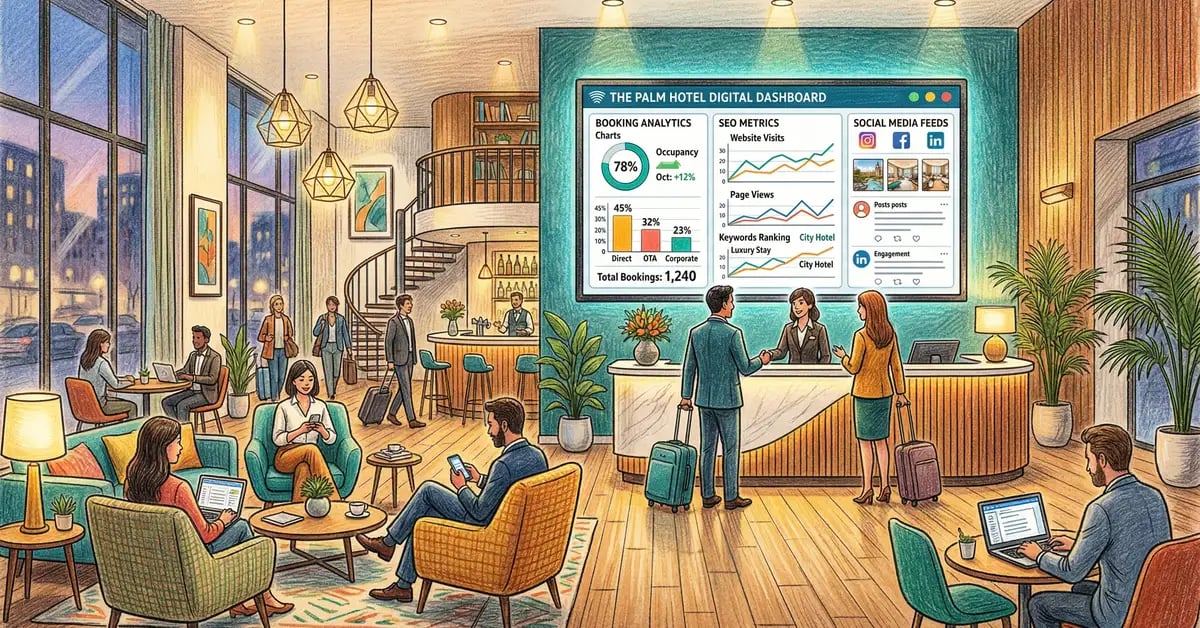
The UK hospitality market reached £61.23 billion in 2025 and is projected to grow to £72.76 billion by 2030. However, this growth masks a fundamental shift in how travellers book accommodations: direct bookings are now overtaking OTA (online travel agent) channels for the first time in a decade, driven by metasearch visibility, review trust, and the cost of OTA commissions (15-25% per booking).
The average direct booking generates £519 in revenue compared to £320 through OTAs—a 62% premium that translates directly to margin improvement. With 173,515 hospitality businesses in the UK (97.7% small enterprises with 10-50 rooms), the ability to capture even 5-10% additional direct bookings can increase annual profit by £50,000-150,000 per property.
62%
Premium revenue per direct booking vs OTA (£519 vs £320 average)
Key market trends shaping hotel marketing in 2026:
OTA Commissions Are Driving a Margin Crisis
OTAs control 68% of online hotel bookings in the UK but charge 15-25% per booking. A 50-room hotel with 60% occupancy pays £60,000-100,000 annually in commissions alone. Hoteliers are investing in direct-booking channels to reclaim margin and data.
Mobile Dominance Is Non-Negotiable
60% of all hotel bookings now occur on mobile devices, with 70% of site traffic mobile-sourced. Responsive design, fast page load times (under 3 seconds on 4G), and mobile-optimised checkout are table stakes.
Reviews Are the New Demand Driver
81% of travellers read reviews before booking, and a 1-point increase in review score can raise rates by up to 11.2%. Review quantity, recency, and response rate all impact both booking probability and Google Hotel Pack visibility.
Voice and AI Search Are Early-Stage But Critical
45% of hotel searches now involve voice assistants or AI chatbots. Hoteliers optimising for ChatGPT, Google's AI Overviews, and voice assistants (Alexa, Google Home) are already seeing traffic increases of 20-35% from these emerging channels.
Hotel SEO Strategy: Capturing Organic Bookings
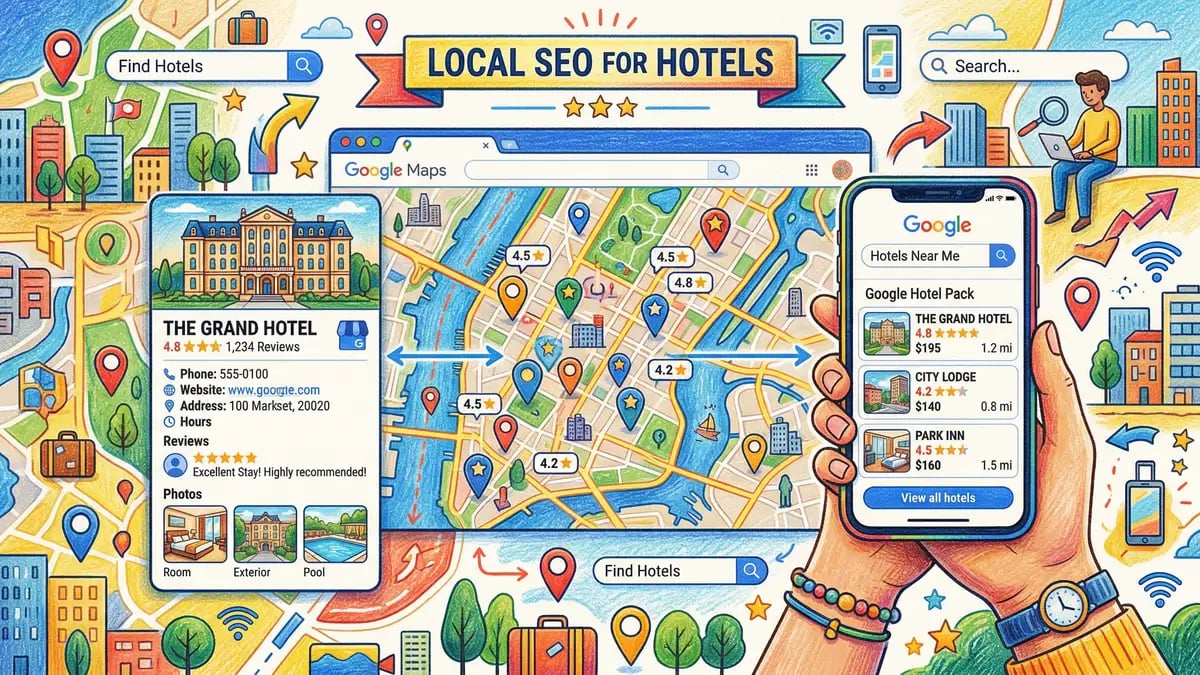
Hotel SEO is fundamentally different from traditional e-commerce SEO. Travellers search with intent (dates, location, room type, price), and Google rewards properties that answer those queries with local relevance, review authority, and availability visibility. The Google Hotel Pack—the carousel of 3-5 hotels displayed at the top of local search—captures 45% of organic clicks and is the highest-ROI SEO real estate for hospitality.
1. Google Business Profile Optimisation
Your Google Business Profile (GBP) is your SEO foundation. Optimise for Hotel Pack inclusion by:
- Claiming and verifying your listing in all locations (for multi-property chains, this is critical).
- Completing all fields: service hours, amenities, payment methods, booking link, photos, and reviews.
- Adding 10-15 high-quality photos covering rooms, communal spaces, breakfast, and amenities.
- Encouraging recent reviews: Google boosts profiles with 15+ reviews from the past 90 days.
- Responding to all reviews (positive and negative) within 48 hours to signal active management.
- Updating availability and rates in real-time through Google Hotel Ads integration.
2. Schema Markup for Hotel Visibility
Schema.org markup tells Google your room types, amenities, pricing, and availability without relying on crawling. Implement:
- Hotel schema: Name, address, phone, rating, review count, and image.
- Room schema: Room type, occupancy, bed type, amenities, and min/max price.
- Offer schema: Room availability, price, currency, and booking URL.
- Review schema: Review rating, reviewer name, date, and text.
- AggregateRating schema: Average rating, review count, and recency.
3. Local SEO for Multi-Location Hotels
For hotel groups, multi-location SEO is critical. Each property should have:
- A dedicated landing page with location-specific content (neighbourhood guides, local events, nearby restaurants).
- A unique Google Business Profile with location-specific reviews, photos, and Q&A.
- Local citations in directories (TripAdvisor, Booking.com, Google Maps) with consistent NAP (name, address, phone).
- Location-specific keywords in title tags, meta descriptions, and H1 headings.
- Backlinks from local sources (chamber of commerce, local news, tourism boards).
4. Keyword Strategy for Hotels
Hotel SEO keywords fall into three tiers:
- Branded keywords: "Hotel Name Edinburgh", "Book [Hotel] Online" (high intent, direct traffic).
- Local keywords: "Hotels in Edinburgh", "Best luxury hotels Edinburgh", "Family-friendly hotels city centre" (medium-high intent, competition varies).
- Category keywords: "Hotel marketing strategy", "Hospitality digital marketing", "Hotel SEO best practices" (low commercial intent for booking but high for authority).
Prioritise local and branded keywords first—they have lower competition and higher booking intent. Only pursue category content for brand building and cluster navigation.
5. On-Page SEO for Hotel Websites
Optimise each page (homepage, rooms, dining, events, location guide) for its primary keyword and user intent:
- Title tag: Include location and room type. "4-Star Hotel in Edinburgh Old Town | The Scotsman Hotel"
- Meta description: Show unique value prop, not generic copy. "Luxury Edinburgh hotel with rooftop spa, Michelin-starred dining, and free Wi-Fi. Book direct and save 20%."
- H1: Match user intent. "Luxury 4-Star Hotel in Edinburgh Old Town" or "Book a Deluxe Room with City Views"
- Image alt text: Include location and room type. "Deluxe double room overlooking Edinburgh Castle"
- Internal links: Link rooms to location guides, dining pages to room pages, and guides to booking funnel.
Content Marketing for Hotels
Content marketing for hotels serves two purposes: building authority and trust with potential guests, and capturing early-stage search traffic (before they search "[Hotel Name]" or "book a room"). For the step-by-step execution playbook covering all channels, see our hotel digital marketing tactics guide.
1. Destination Guides and Location Content
Location content is the highest-ROI hotel content category. Blog posts and guides titled "Things to Do in [City]", "Best Restaurants in [Neighbourhood]", and "Visit [City]: Weekend Itinerary" attract potential guests at the awareness stage and build local authority.
- Length: 1,500-2,500 words for comprehensive guides.
- Content types: Itineraries, top 10 lists, hidden gems, seasonal guides, budget guides.
- Internal linking: Link back to relevant rooms or packages (e.g., "Perfect for a romantic weekend—explore our Deluxe Suite")
- Publishing cadence: 1-2 per month per location, concentrated around peak seasons and events.
2. Video Content
Video is now essential for hotels. Virtual tours, room walkthroughs, and location videos increase time-on-site and conversion rates by 30-50%.
- Room tour videos: 60-90 seconds, mobile-optimised, with clear CTA.
- 360-degree room tours: Embed on booking page for immersive pre-purchase experience.
- Location videos: Highlight local attractions, dining, and activities (60-120 seconds).
- Staff/behind-the-scenes: Build trust and personality (60 seconds, monthly).
- Distribution: YouTube, TikTok, Instagram, embedded on website, and shared in email campaigns.
3. User-Generated Content (UGC) Campaigns
UGC is the most trusted content type and directly improves conversion rates. Create campaigns that encourage guests to share their experience:
- Branded hashtag campaigns (e.g., #MyStayAt[HotelName]) promoted at check-in and in guest rooms.
- Guest photo contests with prizes (free night, breakfast voucher).
- Incentivise TripAdvisor and Google reviews with small rewards (10% off next stay, welcome drink).
- Repost UGC on your Instagram and website (with permission) to build social proof.
Email Marketing and Automation
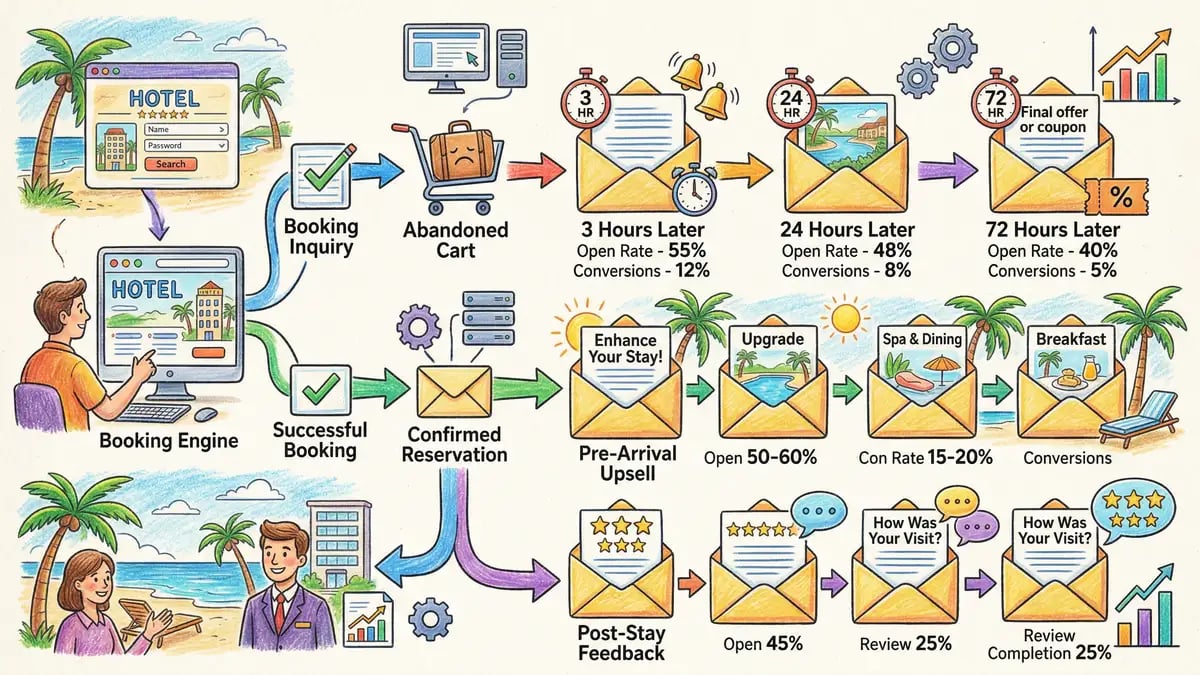
Email is the highest-ROI channel for hotel marketing, delivering £36-38 in revenue per £1 spent. Hoteliers who implement automated email sequences for cart abandonment, pre-arrival upsell, and post-stay recovery see 25-35% increases in direct bookings and 15-20% increases in ancillary revenue (dining, spa, tours).
1. Cart Abandonment Sequences
30-40% of guests abandon the booking at checkout. A 3-email sequence recovers 10-15% of abandons:
- Email 1 (4 hours after abandon): "Your booking is waiting" + direct link to resume. Subject line: "Complete your booking at [Hotel] and save 20%". Open rate: 40-50%, Click rate: 8-12%.
- Email 2 (24 hours after abandon): Highlight special offer or scarcity (few rooms left at this price). Open rate: 25-35%, Click rate: 5-8%.
- Email 3 (72 hours after abandon): Final reminder + alternative dates or room types. If no conversion, segment into re-engagement list for future campaigns.
Benchmark: 66% open rate, 10% conversion rate, £30-50 average cart value recovered per convert.
2. Pre-Arrival Upsell and Information Sequence
Guests who have booked are captive audience. Send a 3-5 email sequence in the 6-8 weeks before arrival:
- Email 1 (5 weeks before): "Welcome! Get to know your hotel" + location guide, parking info, Wi-Fi details. Engagement metric: 45% open.
- Email 2 (3 weeks before): Dining and experiences upsell. "Reserve your table at our restaurant" or "Book your spa treatment now". Conversion: 8-12% click through, 3-5% booking.
- Email 3 (1 week before): Final reminders + guest review request (early, pre-stay to avoid friction). Open rate: 50-60%.
- Email 4 (day before arrival): Check-in time, parking instructions, hotel contact info. Open rate: 60-70% (high intent).
- Email 5 (day of arrival, if opt-in): Welcome message + room upgrade offer or complimentary service. Generates immediate engagement and goodwill.
Benchmark: 12-18% ancillary revenue lift per guest (average guest spend on dining/spa increases £25-50).
3. Post-Stay and Review Request Sequence
Post-stay sequences drive reviews, repeat bookings, and loyalty:
- Email 1 (day after checkout): Thank you + review request (Google, TripAdvisor, direct website). Link to reviews page. Open rate: 55-65%. Review conversion: 5-8%.
- Email 2 (1 week after checkout): "Thanks for staying with us—special offer for your next visit". 10-15% off code for repeat booking, valid for 30-60 days.
- Email 3 (6 weeks after checkout): Loyalty programme enrolment or VIP status offer. "Earn points on every stay, redeem for free nights."
- Email 4 (quarterly): Newsletter with new offerings, events, or seasonal packages targeted to repeat guests.
Benchmark: 8-12% repeat booking rate, 15-20% review submission rate (if incentivised), 60% email retention for quarterly newsletter.
4. OTA Win-Back Campaigns
For hotels that capture email addresses of OTA bookers (through surveys or post-booking links), win-back sequences are highly effective:
- Email 1: "Book direct next time and save 20%—direct booking discount code." Subject: "Your special offer: save £50+ per night when you book direct".
- Email 2 (2 weeks later): Highlight direct booking benefits: no OTA fees, free room upgrade offer, flexible cancellation.
- Email 3 (monthly): Newsletter with direct-exclusive offers and early access to special rates.
Benchmark: 10-15% conversion to direct bookings within 6 months. At £100+ margin per booking, a 100-room hotel can reclaim £50,000-75,000 annually from OTA guests.
5. Email List Building and Segmentation
Email effectiveness depends on list quality and segmentation. Build lists through:
- Website opt-in forms (exit-intent offer, bottom of page newsletter signup, location guides gated with email).
- QR codes in guest rooms and checkout (sign up for loyalty programme, exclusive offers).
- Post-stay follow-up (direct mail or SMS with email signup incentive).
- Account creation at booking (if direct booking). Segment your list by:
- Booking behaviour: Never booked, one-time, repeat, high-value (spent £500+).
- Visit type: Business, leisure, group, wedding.
- Engagement: Highly engaged (4+ opens), moderately engaged (1-3 opens), inactive (0 opens in 180 days).
- Frequency preference: Weekly, monthly, or promotional-only communications.
Social Media Marketing for Hotels
61% of travellers report that seeing a hotel on Instagram influenced their booking decision. Social media for hotels is primarily a trust and discovery channel, not a direct-sales channel. The goal is to build community, showcase authentic guest experiences, and drive traffic to your booking page.
Platform-Specific Strategies
| Platform | Best Content Type | Posting Frequency | Engagement Target |
|---|---|---|---|
| High-quality room photos, Reels (15-30s videos), Stories (behind-the-scenes), carousel posts | 4-5 per week (mix of Feed and Reels) | 2-5% engagement rate (likes, comments, shares) | |
| TikTok | Trending audio, room tours, staff challenges, day-in-the-life videos | 3-4 per week | 5-10% engagement rate (younger audience = higher engagement) |
| Event promotions, special offers, reviews/testimonials, longer-form captions | 3-4 per week | 1-3% engagement rate (older demographic, strong for local events) | |
| Industry insights, events, team spotlights, thought leadership | 2 per week | 1-2% engagement rate (best for B2B, events, corporate travel) |
1. Instagram Strategy (Highest ROI for Hotels)
Instagram is the hotel discovery platform. Tactics:
- Content mix: 40% room/property photos, 30% UGC/guest photos, 20% lifestyle/location content, 10% promotional.
- Reels strategy: Post 2-3 Reels per week (room tours, staff moments, location highlights, trending audio). Reels get 67% more reach than Feed posts on Instagram.
- Stories strategy: Daily Stories (5-7 per day) showing behind-the-scenes, guest experiences, daily specials, countdown timers to bookings.
- Hashtag strategy: Use 20-25 relevant hashtags per post. Mix branded (#HotelName) and high-volume (#hotels, #travel, #luxuryhotels, #cityname). Create branded hashtag campaign.
- Link in bio: Direct link to booking page or landing page (use Linktree if needed to show multiple options: book, view menu, check events).
- Engagement tactic: Respond to all comments within 2 hours. Follow/DM travel influencers in your region for collabs.
2. TikTok for Gen Z Travellers
TikTok reaches 60% of Gen Z and Millennials. Hotels targeting this demographic should:
- Post raw, behind-the-scenes content (staff dances, funny moments, guest reactions)—not polished marketing.
- Use trending sounds and formats (duets, transitions, trending dances).
- Create "room reveal" videos (60-90 seconds showing room reveal and reaction).
- Partner with travel creators (send free night, receive UGC and TikTok promotion).
- TikTok Shop integration: if available in your region, link bookings directly from TikTok.
3. Facebook for Local Events and Community
Facebook remains effective for local community building and event marketing:
- Create and promote events (weddings, conferences, special dinners) with event page and RSVP tracking.
- Run local targeted ad campaigns (e.g., "Hotels in Edinburgh" geo-targeted to UK radius).
- Join and participate in local community groups (tourism boards, chamber of commerce, lifestyle groups).
- Use Facebook Reviews—encourage guests to leave reviews on Facebook (high trust signal for local search).
4. Influencer and Creator Partnerships
Partner with travel creators and local influencers to amplify reach:
- Micro-influencers (10K-100K followers): Trade free night for authentic content and social share.
- Mid-tier influencers (100K-1M followers): Negotiate £1,000-5,000 for content creation, posts, and stories.
- Local creators: Free stays in exchange for location guides, neighbourhood reviews, and behind-the-scenes UGC.
- Always disclose partnerships with #ad or #sponsored (FTC/ASA requirement).
PPC and Google Hotel Ads
Paid search and Google Hotel Ads capture high-intent searchers ready to book. While SEO is the foundation, PPC fills demand spikes, protects brand keywords, and captures long-tail keywords that organic rankings can't reach quickly.
1. Google Hotel Ads Strategy
Google Hotel Ads (formerly Hotel Ads) display your room rates directly in Google Search alongside metasearch competitors. Benefits:
- 65% of metasearch bookings come from Google Hotel Ads (vs 20% from Booking.com, 10% from Expedia).
- Average ROI: ~900% (£9 return for every £1 spent on Google Hotel Ads).
- Cost is dynamic: hotels only pay when a user clicks through to your booking page, not for impressions.
- Integration is free through Google Merchant Center and requires real-time rate feed (XML or API).
Setup: Create a Google Merchant Center account, upload room inventory via feed (Booking.com, Expedia, or direct XML), and enable Hotel Ads. Update rates and availability daily (or hourly for peak periods) to stay competitive.
2. Google Ads Search Campaign Structure
Organise campaigns by intent and keyword type:
- Campaign 1 – Brand Protection: Bid on "[Hotel Name]" variations, including misspellings. High CTR, high quality score, low CPC. Goal: Protect against competitor ads.
- Campaign 2 – Local Keywords: "Hotels in [City]", "Best hotels [City]", "[City] accommodation". Medium-high competition, £1-3 CPC. Goal: Capture top-of-funnel local searches.
- Campaign 3 – Competitor Keywords: Bid on competitor hotel names and location keywords. High competition, £2-5 CPC. Goal: Steal high-intent clicks from competitors.
- Campaign 4 – Long-Tail Keywords: "Family hotels near castle", "Pet-friendly hotels", "Luxury spa hotels". Low competition, £0.50-1.50 CPC. Goal: Capture specific, high-conversion intent.
- Campaign 5 – Seasonal/Event: Create campaigns for peak seasons, events, holidays. Budget higher, bid more aggressively (20% budget increase in peak months).
3. Google Ads Performance Benchmarks
| Metric | Hospitality Benchmark | Target for Hotels |
|---|---|---|
| Click-Through Rate (CTR) | 2-3% | 3-5% (brand), 1-2% (competitor) |
| Conversion Rate | 3-5% | 4-8% (brand), 2-4% (location) |
| Cost Per Acquisition (CPA) | £30-50 | £20-40 (brand), £40-80 (location) |
| Return on Ad Spend (ROAS) | 300-400% | 400-600% (brand), 200-300% (location) |
| Average Booking Value | £150-250 | £200-400 (UK 4-5 star) |
4. Ad Copy Best Practices for Hotels
- Headline 1: Hotel name and location. "[Hotel Name] – Luxury 4-Star Hotel in Edinburgh"
- Headline 2: Unique value prop or offer. "Free Room Upgrade + Breakfast | Book Direct"
- Headline 3: Call to action + social proof. "Reserve Your Stay Today – 4.8★ Rated by 500+ Guests"
- Description 1: Room type + amenities. "Deluxe rooms with city views, 5-star spa, Michelin-starred restaurant. Best rates guaranteed."
- Description 2: Offer or scarcity. "Limited time: 20% off direct bookings. Flexible cancellation, free Wi-Fi, express checkout."
5. Budget Allocation
Allocate your Google Ads budget proportionally to booking intent:
- Brand keywords (40%): Highest ROI, lowest CPC. Protect brand at all costs.
- Local keywords (35%): High intent, moderate CPC. Capture local demand.
- Competitor keywords (15%): High CPC, variable ROI. Test and scale only if profitable.
- Long-tail and seasonal (10%): Testing and seasonal peaks.
Review Management and Reputation
Reviews are the second-most influential factor in hotel booking decisions (after photos). A 1-point improvement in review score correlates with an 11.2% rate increase. Review management is therefore a core revenue lever, not a customer service responsibility.
1. Review Platform Prioritisation
Focus collection and response efforts on the platforms that drive bookings:
| Platform | Booking Impact | Priority | Response Time Goal |
|---|---|---|---|
| Google (Hotel Pack) | 45% of direct bookings (via Hotel Pack) | Critical | 24-48 hours |
| TripAdvisor | 30% of OTA bookings (influences rate) | Critical | 48-72 hours |
| Booking.com | OTA reviews influence future bookings | High | 72 hours |
| Website (direct reviews) | Trust signal on your booking page | High | 48 hours |
| Facebook Reviews | Local search and trust | Medium | 72 hours |
2. Review Collection Strategy
Generating reviews is the highest-leverage tactic. Collect through multiple channels:
- At checkout/in-room: QR code linking to review request forms (Google, TripAdvisor, Booking.com). Include incentive (free breakfast voucher, 10% off next stay).
- Post-stay email: Automated email 1 day after checkout with review links. Personalised with guest name and room number. Open rate: 55-65%, conversion: 5-8%.
- SMS reminder: For opted-in guests, SMS 2-3 days after checkout with review link. SMS conversion: 8-12% (higher than email).
- Incentive programme: Offer rewards for reviews (10% off next booking, 500 loyalty points, entry to monthly prize draw).
- Reputation management platform: Use Trustpilot, ReviewTrackers, or Chatmeter to automate review collection, monitoring, and response.
3. Review Response Strategy
Response rate matters as much as review score. Hotels with 80%+ response rates rank higher in Google Hotel Pack. Response strategy:
- 5-star reviews: Thank them, mention specific service/staff, invite them back. Keep it short (50-75 words). Response time: 24 hours.
- 3-4 star reviews: Acknowledge feedback, explain how you'll improve, offer follow-up (email, phone). This turns a mediocre review into a positive interaction. Response time: 48 hours.
- 1-2 star reviews: Respond professionally and empathetically. Never be defensive. Offer concrete resolution (refund, future stay, direct management contact). Take conversation offline (provide email or phone). Response time: 24 hours (highest priority).
- Never: Ask for review removal, request that reviewers delete their review, or offer money for positive reviews (violates platform TOS and ASA rules).
4. Fake Review Prevention
UK law (Consumer Protection from Unfair Trading Regulations 2008) prohibits fake reviews. Protect your reputation by:
- Only requesting reviews from verified guests (post-stay email, SMS, in-room QR code).
- Never paying for positive reviews or bribing guests (fine up to £20K).
- Documenting review responses and changes you've made based on feedback.
- Reporting suspicious fake reviews to platform (Google, TripAdvisor, Booking.com have flagging systems).
AI and Answer Engine Optimisation for Hotels
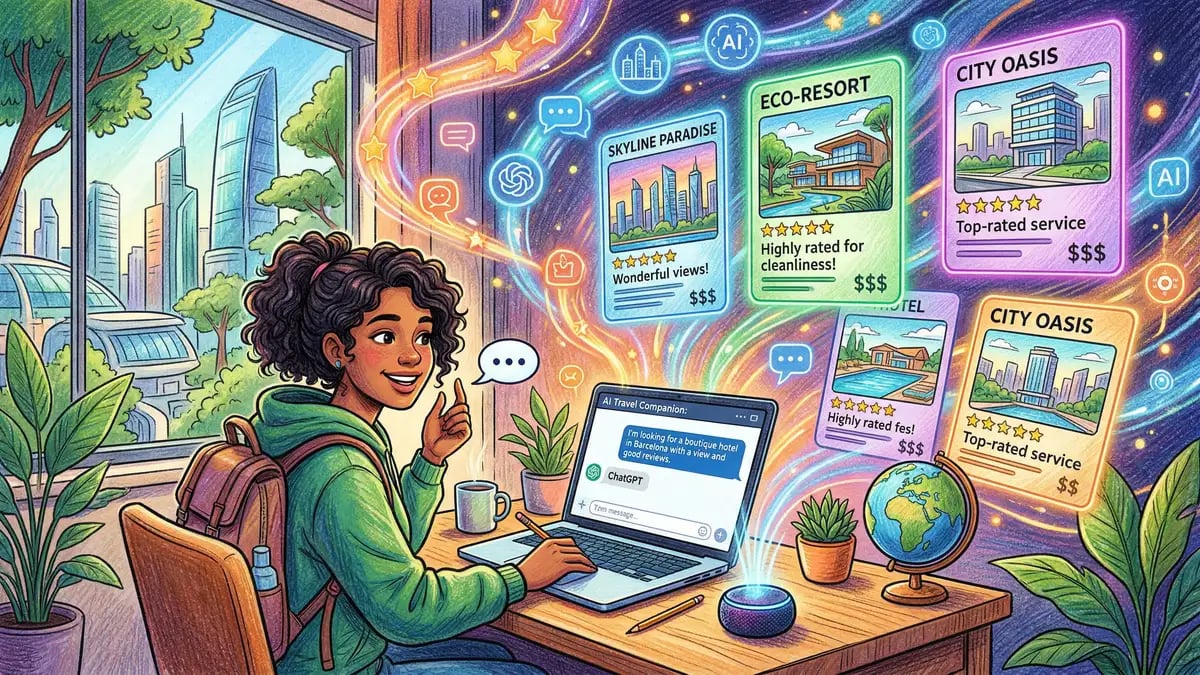
AI-powered travel planning is changing how people discover hotels. ChatGPT, Google's AI Overviews, and voice assistants now generate travel recommendations directly, bypassing traditional search. Answer Engine Optimisation (AEO) ensures your hotel appears in these AI-generated recommendations.
1. Answer Engine Optimisation (AEO) Strategy
AEO focuses on providing concise, factual answers to common travel questions. ChatGPT and Google AI Overviews cite sources; appearing in citations increases traffic.
Key AEO tactics for hotels:
- FAQ content: Create content answering common AI queries: "What are the best hotels in [City] for families?", "Where should I stay in [City] for nightlife?", "Best luxury hotels near [Landmark]?"
- Structured data markup: Schema.org markup helps AI systems understand your hotel's features, location, amenities, and reviews.
- Featured snippet optimisation: Target position zero (the snippet Google shows above organic results) by providing concise answers (40-60 words) to common questions.
- Long-form destination content: Create comprehensive guides (2,000+ words) about your city/location, mentioning your hotel naturally. AI systems favour authoritative, comprehensive sources.
- Voice search optimisation: Include question-based keywords ("Where is the best hotel in Edinburgh?") and natural language synonyms (not just exact keywords).
2. Google AI Overviews and AEO
Google AI Overviews (launched 2024) now appear for 90% of search queries. These summarise multiple sources and cite them. Hotels can appear in AI Overviews by:
- Ranking in top 10 organic results for the query (AI Overviews prioritise well-ranking pages).
- Providing authoritative, well-structured content (headers, lists, tables, schema markup).
- Having a good E-E-A-T score (Experience, Expertise, Authoritativeness, Trustworthiness): publish author bios, credentials, and trust signals (reviews, certifications, awards).
- Updating content regularly (AI Overviews favour fresh content).
3. ChatGPT and Generative AI Integration
ChatGPT doesn't browse the web in real-time but uses training data (knowledge cutoff April 2024). However, OpenAI partnerships and plugin ecosystems are expanding. Hotels should:
- Ensure your hotel has high-quality Wikipedia entry or verified sources (travel guides, news articles, official tourism websites) mentioning your hotel. ChatGPT training data includes these sources.
- Monitor mentions and citations in travel blogs and guides (backlinks and citations improve AI visibility).
- Participate in travel and hospitality industry publications and directories (these are high-authority sources that influence AI models).
- Implement structured data (JSON-LD schema) on your website—some AI systems use this data directly.
4. Voice Search Optimisation for Hotels
Voice searches (Alexa, Google Home, Siri) are 3-4x longer and more conversational than text searches. Optimise for voice by:
- Targeting long-tail conversational keywords: "What are family-friendly hotels near Edinburgh Zoo?" vs "family hotels Edinburgh".
- Creating FAQ content answering conversational questions naturally.
- Ensuring your Google Business Profile is complete and up-to-date (voice assistants rely on GBP data for local queries).
- Optimising for "near me" searches: "Hotels near me", "Best restaurants near me"—voice users want immediate, location-based results.
UK Compliance and Data Protection
UK hospitality marketing is governed by strict regulations. Non-compliance can result in fines up to £20 million or 4% of global revenue, whichever is higher. Key regulations:
1. GDPR (General Data Protection Regulation)
GDPR regulates how you collect, store, and use guest data. Key requirements:
- Consent: You must have explicit, informed consent before collecting email or phone number (double opt-in is best practice).
- Data minimisation: Collect only data you need. Don't ask for personal details you won't use.
- Data security: Encrypt customer data in transit and at rest. Use secure email providers and password managers.
- Right to delete: Guests can request deletion of their data. You must comply within 30 days.
- Data Processing Agreement (DPA): If using a third-party email tool or CRM (HubSpot, Mailchimp, etc.), ensure they have a signed DPA in place.
2. PECR (Privacy and Electronic Communications Regulations)
PECR governs email and SMS marketing to UK residents. Key requirements:
- Opt-in consent: You cannot send marketing emails without prior consent (even if you have their email from a booking).
- Opt-out option: Every marketing email must include an unsubscribe link. Respect unsubscribes within 10 days.
- Transactional emails: Pre-arrival and post-stay emails are not "marketing" if they include booking confirmation, check-in instructions, or account information. These don't require opt-in but should still include opt-out for future communications.
- SMS marketing: SMS marketing has stricter rules—you need explicit opt-in consent before sending SMS, and SMS open rates must be tracked to avoid over-messaging.
3. ASA (Advertising Standards Authority)
ASA regulates advertising claims and must be followed in all marketing (ads, website, email, social media). Key requirements:
- Truthfulness: Claims must be true and substantiated. No false claims about ratings, reviews, or pricing.
- Price transparency: Advertised prices must be clear and not misleading. Show total price including taxes and fees upfront.
- Social proof: Reviews and testimonials must be from real customers. Fake reviews are prohibited.
- Comparisons: If comparing to competitors, be honest and substantiate claims.
- Influencer disclosures: #ad or #sponsored must clearly mark sponsored content (fine up to £5,000 per violation).
4. Cookie Consent and Privacy Notices
PECR and GDPR require informed consent for cookies and tracking. Best practices:
- Cookie banner: Display a clear, specific cookie consent notice. Provide options to accept all, reject all, or manage preferences.
- Privacy policy: Link to and update your privacy policy at least quarterly (detail data collection, use, and retention).
- Tracking pixels: Disclose that you use pixels (Facebook, Google Analytics, etc.) to track user behaviour and show retargeting ads.
- Email consent: Track email consent separately from cookie consent. Use email opt-in forms with clear language ("I consent to receive marketing emails from [Hotel]").
Measuring Hotel Marketing ROI
Hotel marketing success is measured by one metric: direct booking revenue. All other KPIs (website traffic, email open rates, social media engagement) are vanity metrics unless they correlate to bookings and margin.
Key Performance Indicators (KPIs) for Hotels
| KPI | Calculation | Hospitality Benchmark | Target for Growth |
|---|---|---|---|
| Conversion Rate (Website) | Bookings / Website Visitors | 1.5-2.5% | 2-4% |
| Cost Per Acquisition (CPA) | Marketing Spend / Bookings | £25-50 | £15-30 |
| Return on Ad Spend (ROAS) | Booking Revenue / Ad Spend | 300-400% | 400-600% |
| Direct Booking Percentage | Direct Bookings / Total Bookings | 25-30% | 40-50% |
| Revenue Per Available Room (RevPAR) | (Room Revenue) / (Available Rooms) | £60-100/night (UK avg) | £90-150/night (with marketing) |
| Email List Growth Rate | New Subscribers / Month | 1-2% of bookings | 5-10% of bookings |
| Email Campaign ROI | Email Revenue / Email Spend | £30-40 per £1 spent | £36-50 per £1 spent |
| Review Score Average | Average across Google, TA, etc. | 4.2-4.5 stars | 4.6+ stars |
1. Setting Up Marketing Attribution
To measure ROI, you need to track where bookings come from. Implement:
- UTM parameters on all links: Add ?utm_source=email&utm_medium=newsletter&utm_campaign=spring-sale to links in emails, social media, and ads. This tells Google Analytics where clicks come from.
- Google Analytics 4 (GA4): Set up conversion tracking for "booking completed" events. Link GA4 to your booking system to see revenue per source.
- CRM/PMS integration: Connect your property management system (PMS) to HubSpot or Salesforce to track which guests booked through which channel.
- Promo codes: Create unique codes for each marketing channel (SOCIAL10, EMAIL20, PPC30) to track conversions offline.
- Referrer tracking: Your booking engine should log where the user came from (Google organic, paid search, email, etc.) and store this in your PMS.
2. Monthly Reporting Dashboard
Create a simple monthly dashboard tracking:
- Total bookings by channel (organic, paid, email, direct).
- Revenue by channel (including OTA bookings for comparison).
- Cost per channel (ad spend, email platform, review management tool).
- ROI per channel (revenue / cost).
- Average booking value (ABV) per channel.
- Repeat booking rate by channel.
- Website metrics (traffic, conversion rate, bounce rate).
Explore the Hotel Marketing Series
- You're reading: Hotel Marketing Strategy: The Complete Digital Guide
- Hotel Digital Marketing: Revenue-Driving Tactics for 2026 — SEO, social media, email, and PPC execution playbook
Frequently Asked Questions
What is the best strategy to increase direct bookings?
The most effective strategy combines three elements: (1) Google Hotel Pack visibility through review management and local SEO, (2) email automation for cart abandonment and pre-arrival upsell, and (3) a direct-booking incentive (e.g., "Save 20% when you book direct"). Hotels implementing this combination see 35-50% increases in direct bookings within 6 months. Start with email automation, which has the highest ROI (£36-38 per £1 spent), then invest in review collection and Google Business Profile optimisation.
How often should we request reviews from guests?
Send one review request email per guest, 24-48 hours after checkout (peak trust window—guests still remember their experience). Follow up with SMS 3-5 days later if opted in (SMS conversion is 40-50% higher than email). Don't bombard guests with multiple requests on different platforms—one email + one SMS maximum. For repeat guests, only request a review every 3-4 visits to avoid fatigue.
Which social media platform should hotels prioritise?
Instagram is the highest-ROI platform for hotels (61% of guests influenced by Instagram posts). Prioritise Instagram Reels (15-30 second videos) and Stories (daily posts). TikTok is rapidly growing but skews younger (Gen Z). Facebook is best for local event marketing and older demographics. LinkedIn is only valuable for corporate/group travel targeting. Start with Instagram; add TikTok if your target demographic includes under-35s.
What budget should we allocate to hotel marketing?
Benchmark: 3-5% of annual revenue for 50-100 room hotels; 2-3% for 100+ room properties (economies of scale). Break down as: 40% paid search (Google Ads + Google Hotel Ads), 30% email marketing and CRM, 15% social media (organic content + ads), 10% reviews and reputation management, 5% content and SEO. For a 50-room hotel with £1.5M annual revenue, this equals £45-75K annual marketing budget. If you're losing 50% of bookings to OTAs, increase to 5-7% temporarily to win back margin.
How do we measure if our marketing is actually driving bookings?
Set up conversion tracking through Google Analytics 4 (GA4) and your property management system (PMS). Create unique promo codes for each marketing channel and track which bookings use them. Monitor your conversion rate (bookings / website visitors)—a 2% conversion rate on 10K monthly visitors = 200 bookings. Track cost per acquisition (marketing spend / bookings) and return on ad spend (booking revenue / marketing spend). Create a simple monthly dashboard showing revenue by channel; this is your north star metric.
Is email marketing still effective in 2026?
Yes, email remains the highest-ROI channel at £36-38 per £1 spent. However, success requires segmentation and automation. Generic promotional emails have 5-10% open rates and 0.5-1% conversion. Automated sequences (cart abandonment, pre-arrival, post-stay) achieve 30-60% open rates and 5-15% conversion because they're timely and personalised. Implement automation in HubSpot or Klaviyo and segment by booking history (first-time, repeat, high-value); email ROI will improve 3-5x.
About the Author
Clwyd Probert, CEO of Whitehat
Clwyd is CEO and founder of Whitehat, a HubSpot Diamond Partner specialising in hotel and hospitality marketing. With 12+ years of experience scaling direct bookings for independent and chain hotels across the UK and Europe, Clwyd has helped 150+ hospitality properties increase direct booking revenue by an average of 42% while reducing OTA commission costs by £80-150K annually. He's a certified HubSpot partner and regular speaker at hospitality conferences on inbound marketing and digital transformation.
Get expert hotel marketing advice — Book a consultation with Clwyd about your hotel's direct booking strategy.